Tasting is not a gift. It's a protocol: the same four moves every time, in the same order. I've watched hundreds of people discover in one evening that they were tasters all along; they'd simply never been shown where to point their attention. This chapter is the long version of what I teach at my tastings in Stockholm: the four steps in full, then how to train your nose between bottles, and finally how to run a blind tasting of your own. Pour yourself something before you read on. Homework goes better with props.
Step one: look
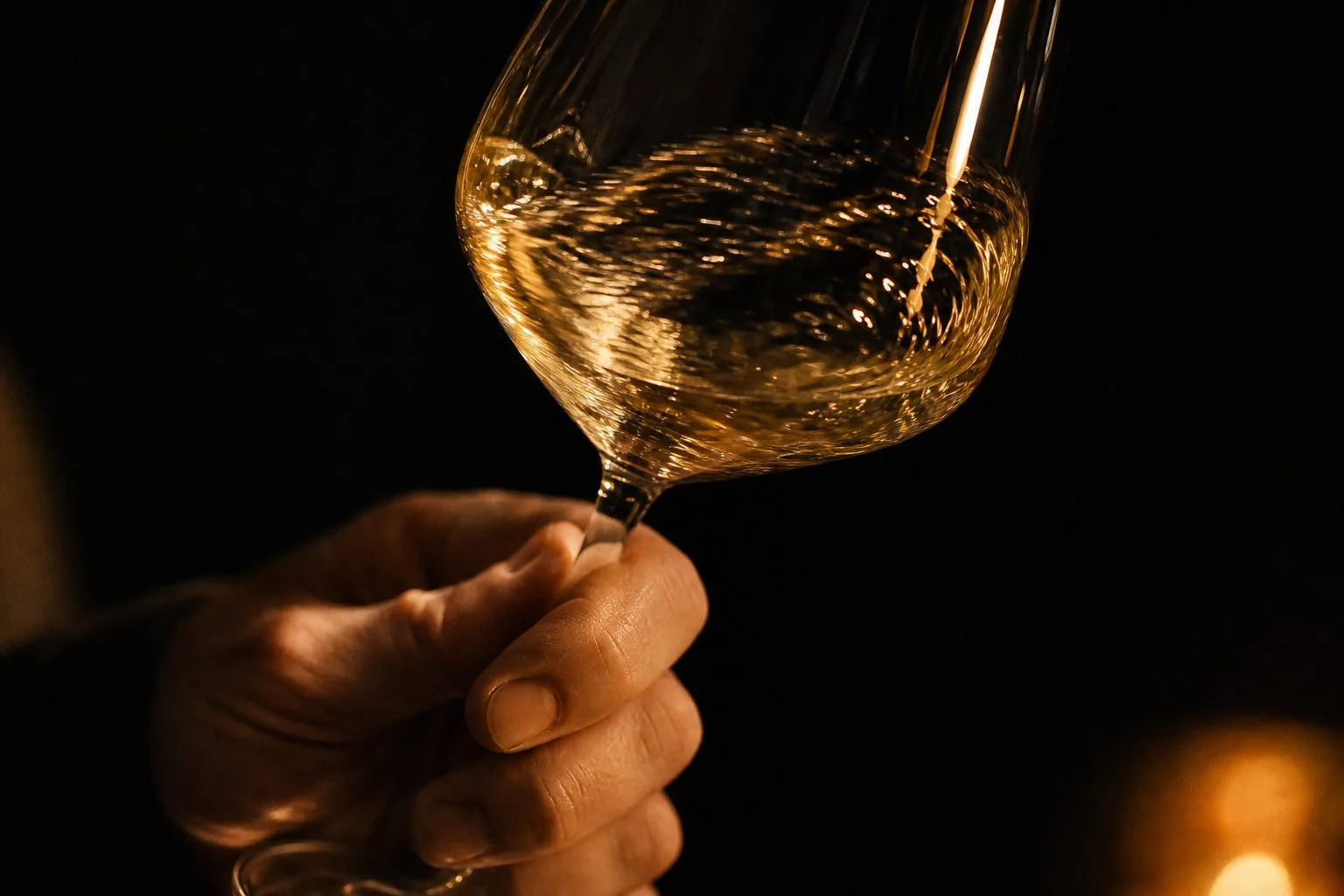
the rim is where the age showsPour about 75 ml, a third of a glass, no more. You need room to swirl. Tilt the glass to 45 degrees against something white: a napkin, a menu, your shirt if you're brave. (If you ever pay for a tasting and the venue has laid black tablecloths, ask for a white napkin. I have made scenes over this.) Now read the colour, because colour is a confession, and it makes two separate statements. Intensity, meaning how much pigment, speaks mostly about the grape and the climate it grew in. Hue, meaning which colour exactly, speaks mostly about age and winemaking. The tilted glass gives you both at once: the deep core shows concentration, and the thin rim at the edge is where age appears first, like grey at the temples.
The white ladder
White wines are born nearly colourless and darken all their lives. Climb the ladder left to right:
- Platinum, almost water-white: an infant raised in a steel tank, nearly always from somewhere cool. Muscadet, Pinot Grigio, most young Riesling. Expect crunch, citrus and a cold shiver of acidity.
- Green glints at the rim: a flash of high acid and cool-climate pedigree. Sauvignon Blanc and Grüner Veltliner keep this green flicker their whole (short) lives.
- Straw: the default resting state of dry white wine. On its own it tells you little; wait for the nose.
- Gold: something happened. Oak barrels, very ripe warm-climate fruit, sweetness, or a few years in bottle. An oaked Californian Chardonnay and a Sauternes both wear gold; your nose will tell them apart in two seconds.
- Brass and amber: real maturity, or a style built on oxygen (sherry, skin-contact "orange" wine, old white Rioja). In a cheap young white, though, it means a corpse. Smell before you sip.
The red ladder
Reds run the opposite way. They're born saturated and spend their lives giving colour back, because the pigment slowly binds with tannin and falls to the bottom of the bottle as sediment. Same drill, left to right:
- Purple-magenta: months from the harvest. Beaujolais Nouveau and young Malbec glow almost neon at the rim. A chemistry party trick lives here: red-wine pigments behave like litmus paper, so a blue-violet tinge points to lower acidity and a bright red glint to higher. You can estimate acid with your eyes closed. Sorry, open.
- Ruby: the classic youthful red, from Rioja to Margaux. Nothing to report yet; the wine hasn't started talking about its age.
- Garnet: the first grey hairs, orange creeping into the rim. One famous trap, though: Nebbiolo and Sangiovese are garnet from birth. Half of blind tasting is memorising the exceptions.
- Brick and tawny: proper age, or oxygen invited in on purpose. Tawny port and old-school Rioja Gran Reserva are walked to this colour deliberately, over years in barrel.
And intensity: pale reds are not weak reds. Pinot Noir, Gamay and Grenache are born with thin skins and less pigment. That's genetics, not timidity. If you can't see your fingers through the glass at all, you're likely holding Malbec, Syrah or Petite Sirah. Depth of colour predicts tannin and body rather well. It predicts quality not at all.
Put the ladders together and the glass starts making predictions before your nose gets anywhere near it:
| You see | The likely story | Your bet before sniffing |
|---|---|---|
| Near-colourless white, green glint | Young, unoaked, cool climate, steel tank | High acid, citrus and green apple; serve it cold |
| Deep gold white | Oak, warm-climate ripeness, sweetness or bottle age | Fuller body; vanilla or honey on the nose |
| Brass or amber white | Real maturity, an oxidative or skin-contact style, or a dead young bottle | Let the nose rule: nuts and dried apricot, or vinegar and regret |
| Vivid purple-magenta red | Months old, bottled young for freshness | Primary fruit, gentle tannin, happily chillable |
| Pale, see-through red | A thin-skinned grape: Pinot Noir, Gamay, Grenache | Perfume and acidity, not power |
| Ruby core, brick rim | Bottle age, or a grape born garnet, like Nebbiolo | Tertiary territory: leather, dried fruit, forest floor |
Floaters, haze and false alarms
wine diamonds are a good signThe look is also your safety check, though most of what people worry about is harmless. Small crystals in the bottom of a white are tartrates, "wine diamonds": flakes of tartaric acid that fell out of solution in a cold fridge or a cold delivery truck. Crunchy, faintly salty, entirely innocent. If anything they suggest the wine wasn't over-processed. Sediment in an older red is the same non-story: pigment and tannin bind together over the years and drop out of the liquid, which is exactly why old reds fade. Stand the bottle upright the day before, pour gently, sacrifice the last centimetre. And a light haze in an unfiltered natural wine is a decision, not an accident; judge those bottles with your nose, never your eyes.
The genuine alarms are different animals. A conventional wine that's properly cloudy. Fizz in something that never promised bubbles, which means the wine has started fermenting again inside the bottle. A young wine that's already brown. A cork pushing itself out of the neck, which means the bottle got hot somewhere between the winery and you. Trouble, every time.
legs = alcohol, not qualityThen everyone asks about the legs, those slow tears sliding down the inside of the glass. They're real physics. Alcohol has a lower surface tension than water, so as it evaporates it drags the liquid up and lets it fall back in streaks. The Marangoni effect, if you want to win an argument. Thick, slow legs mean more alcohol or more sugar. What they never mean is quality. A wine with gorgeous legs can still taste like a wet dog wearing perfume.
Step two: smell (this is the whole game)
doggy sniffs. really.Here's the number that changes everything: roughly 90% of what you call flavour is actually aroma. Your tongue handles five basic tastes. Your nose handles thousands of compounds. When people say a wine "tastes of cherry", their nose did that. So swirl (a proper ten seconds of wrist, not a polite wobble) to fling aroma molecules into the air, and get your nose right into the glass.
But don't take one long, heroic drag. Your olfactory receptors fatigue within seconds, and after a deep sniff you'll smell almost nothing. Take short, quick sniffs instead. I call them doggy sniffs, because that's exactly what a dog does, and dogs are the professionals here. If your nose goes blank mid-tasting, sniff your own forearm. Your skin is your brain's neutral reference, and it resets the system. You will look odd. It works.
Geography matters even inside the glass. Heavier fruit aromas pool near the lower lip; lighter florals drift up to the rim. Move your nose around. Two positions, two wines.
What you're smelling sorts into three layers. Primary aromas come from the grape itself: fruit, flowers, herbs. Secondary aromas come from winemaking: fermentation, oak, yeast. Tertiary aromas come from time: nuts, leather, dried fruit, forest floor. Learn to place a smell in its layer and you can read a wine's biography off a single sniff: what it was, what was done to it, and how long ago. The rest of this step walks through the library shelf by shelf.
The fruit aisle
jam in the glass = sun in the vineyardStart with fruit, because fruit is the biggest room in the library. And here's a kind secret: nobody reliably tells raspberry from strawberry in a glass, sommeliers included. What matters is the family. Get the family right and you've said something true and useful; the exact berry is decoration.
For whites, the families sit on a ladder that runs with temperature: citrus (lime, lemon, grapefruit), then orchard fruit (green apple, pear, quince), then stone fruit (peach, apricot, nectarine), then tropical (pineapple, mango, passion fruit). The same grape climbs the ladder as its climate warms. Chardonnay smells of lemon and oyster shell in Chablis, of ripe peach in a warm Mâcon vintage, and of grilled pineapple in South Australia. One grape, three postcodes, three fruit bowls.
For reds the first split is simpler: red fruit or black. Red fruit (lingonberry, cranberry, red cherry, raspberry) travels with cooler climates, higher acid and lighter bodies. Black fruit (blackcurrant, blackberry, black plum) travels with sunshine, ripeness and plusher texture. A Pinot Noir smells red; a Barossa Shiraz smells black; a Bordeaux hovers between the two depending on the year.
Then interrogate the condition of the fruit, because that's a thermometer and a calendar in one. Fresh-picked and crunchy? Cool climate, young wine. Cooked and jammy, like fruit boiled down with sugar? A hot region and very ripe grapes. Dried, as in fig, prune, raisin? Either genuine age, a wine made from part-dried grapes on purpose (Amarone is the famous one), or, if none of that was invited, heat damage.
Green things, flowers and the outdoors
The green family is beautifully specific. That bell-pepper note in Cabernet Franc, a Loire Chinon, say, comes from one compound, methoxypyrazine, and your nose detects it at a few parts per trillion: roughly a pinch of it dissolved in an Olympic pool. In Sauvignon Blanc the same molecule reads as cut grass and tomato leaf, and it's the house style. In a Cabernet Sauvignon from a cold, grey year it reads as underripeness, and critics dock points. Identical chemistry, praised or punished entirely by context.
Your nose catches methoxypyrazine, the bell-pepper note in Cabernet Franc, at a few parts per trillion: roughly a pinch of it dissolved in an Olympic swimming pool.
the green family, up closeAustralian Cabernet often carries a whiff of mint or eucalyptus, and the explanation is gloriously literal: oil evaporating off nearby gum trees settles on the grape skins and rides into the ferment. Southern French reds smell of the sun-dried thyme-and-rosemary scrub the vines grow among. The locals call it garrigue, and once you've sniffed a Gigondas next to a jar of herbes de Provence the word stops being poetry and becomes reporting.
Flowers are fleeting and float at the rim of the glass: rose in Nebbiolo and Gewürztraminer, violet in Malbec and Syrah, elderflower in Sauvignon Blanc, orange blossom in Muscat, Viognier and Torrontés. Then comes the outdoor shelf, my favourite: wet stone after rain in Chablis and Sancerre; forest floor, that damp autumn-walk smell, in mature Burgundy; warm roadside dust in Tempranillo; something near sea spray in Albariño. When a wine smells of weather rather than fruit, you're usually holding something European, and usually something interesting.
The winemaker's fingerprints
coconut = American oak, almost alwaysSome smells never came from a grape, and spotting them lets you read the winemaking straight off the glass. Vanilla, clove, cedar and toast mean oak barrels, and the barrel has an accent. French oak murmurs baking spice and cedar; American oak announces coconut, dill and vanilla ice cream at conversational volume, which is why traditional Rioja can smell faintly of a coconut biscuit. New barrels shout. By its third fill, a barrel is mostly furniture.
Butter is diacetyl, a by-product of the malolactic conversion that softens sharp malic acid into creamy lactic, and it's the exact molecule that makes popcorn smell like popcorn. Bread, brioche and biscuit come from wine resting on its spent yeast, most gloriously in Champagne, where years on the lees turn lemon-sharp base wine into a warm bakery. And my favourite party trick: mature Riesling smells of petrol, from a single compound called TDN that develops in the bottle. Nobody spilled anything; it's pedigree, and once someone points it out you can never miss it again. A faint struck-match note in an expensive Chardonnay belongs here too: deliberately airless winemaking, a fashionable flourish rather than a fault, so long as it fades with a swirl.
| You smell | What put it there | What it tells you |
|---|---|---|
| Vanilla, clove, cedar, toast | Oak barrels, most likely French | Money was spent; expect a rounder, spicier wine |
| Coconut, dill, vanilla ice cream | American oak | Classic Rioja and old-school Australian Shiraz territory |
| Butter, cream | Diacetyl, from malolactic conversion | Tartness traded for silk: many Chardonnays, nearly all reds |
| Bread, brioche, biscuit | Months or years on spent yeast | The signature of serious Champagne and lees-aged whites |
| Petrol | TDN, formed slowly in bottle | Riesling with age: pedigree, not pollution |
| Faint struck match | Deliberately airless winemaking | A style flourish in upmarket Chardonnay; should blow off in minutes |
You carry about 5 million olfactory receptors. A dog carries 220 to 300 million. And yet your nose is trainable; the gap is practice, not equipment.
homework: go smell your spice rackThat's the honest secret of every sommelier: we don't have better noses, we have bigger smell libraries. Building yours costs nothing and mostly happens in your kitchen; there's a whole section on it below, after we've dealt with your mouth.

Step three: taste
the finish is where the money wentFinally. Take one generous first sip to coat your whole mouth and wake the palate, then work in small sips. Now pay attention to time, because a wine is a sentence with a beginning, a middle and an end: the attack (the first impression, usually fruit and sweetness), the mid-palate (body, acid, texture, the part that arrives just before you swallow, when the wine warms and opens), and the finish (whatever stays after it's gone). Cheap wine tends to have a hole in the middle: a loud, sweet hello engineered to win the first sip in a supermarket aisle, then silence, then a short goodbye. Tasters call it a mid-palate hole, and once you've noticed one you'll find them everywhere. Great wine keeps talking the whole way through.
Where things register in your mouth is usefully specific. Sweetness lands on the tip of your tongue in the first seconds, and if you're unsure whether a wine is truly sweet or just smells sweet from ripe fruit, pinch your nose and sip; sugar survives the pinch, aroma doesn't. Acidity makes you salivate: the more your mouth waters after swallowing, the higher the acid. Tannin is that drying, tea-bag grip on your gums and cheeks, a texture, not a taste. And alcohol shows up as warmth at the back of your throat on the way down.
Which brings us to texture itself, because texture is your mouth's real job and it deserves better words than "nice". Silky is the cool-skinned glide of fine Pinot Noir. Velvety is the same idea with more weight, like classic Merlot. Chalky is tannin that dries you finely and evenly, the ghost of blackboard dust; Sangiovese does this. Grippy is coarser: Nebbiolo holding your cheeks like an over-affectionate aunt. Oily is a viscous, olive-oil slide across the tongue, the signature of Alsace Pinot Gris. And spritzy, a faint prickle of trapped carbon dioxide in a very young white, is deliberate in Vinho Verde and harmless nearly everywhere else. None of these words is poetry. They're measurements your mouth takes.
length can't be fakedThen count the finish. Literally count: swallow, sit still, and time how long the flavour carries on before it drops away. Five seconds is an everyday wine and nothing to apologise for. Ten to fifteen is serious. Twenty or more, changing as it fades, is where fine wine lives. Length is the honest quality meter because it's the one thing that can't be manufactured. You can fake richness with sugar and fake perfume with oak chips, but persistence comes only from concentrated, well-grown fruit. No cellar trick makes a wine echo.
Supertasters are real: 10 to 25% of people, women twice as often as men, born with extra taste buds. Bitterness genuinely screams at them.
biology, not snobberyOne caveat while you count: we're not all running the same hardware. If bitterness shouts at you, big tannic reds may never be your wine, and that's biology rather than a failure of sophistication. It also cuts the other way: when your friend swears the wine is harsh and you find it gentle, you can both be right. Calibrate to your own mouth, not to the loudest voice at the table.
Step four: conclude
"why" is the whole exerciseNow the step almost everyone skips: form an opinion on purpose. Professionals lean on three questions. Balance: did any one element (sweetness, acid, tannin, alcohol) shout over the others, or did they hold hands? Complexity: did the wine change between the first sniff and the last sip, with new layers each visit, or did it say one sentence and repeat it all night? Typicity: does it taste like what the label claims? A Chablis that tastes like tinned pineapple may be perfectly pleasant, but it has failed at being Chablis. Add the finish you counted and you've quietly reproduced the method wine examiners use to grade quality. You needed no certificate, just attention.
Then the personal layer. Give the wine a memory hook. Not "notes of cassis with a mineral undertow" but something you'll actually retrieve later: "the one that smelled like my grandmother's plum jam". Absurd hooks stick; polished ones evaporate. And rate it simply. My scale runs from "bleh" to "last meal on earth", and it outperforms the 100-point kind because it forces the only question that matters: did you like it, and why? "I liked it because the acid made me hungry" teaches you something about yourself that no critic's score ever will.
Write a note you'll actually reread
Most tasting notes get written once and read never, because people write them for an imaginary judge. Write for the only reader who matters: you, standing in a wine shop eighteen months from now, trying to remember whether you loved this thing. My template takes thirty seconds and five lines:
- The wine and the scene: producer, grape, vintage, price, who you drank it with.
- One line of looks.
- Three smells, maximum, plus one personal hook, however silly.
- The structure dials (acid, tannin, body, finish), each marked low, medium or high.
- Verdict: buy again? For which dinner?
A worked example, straight from my notebook: Marlborough Sauvignon Blanc 2024, 139 kronor, Tuesday, prawns. Pale straw with a green flash. Passion fruit, cut grass, tomato leaf, smells like mowing a lawn inside a fruit shop. Acid high, tannin none, body light, finish medium and pure citrus. Verdict: an electric fence, in the best way. Buy again for anything involving lemon and shellfish.
Every phrase in that note does a job. In eighteen months, "mowing a lawn inside a fruit shop" will bring the wine back whole. "Nervy acidity with herbaceous top notes" would bring back nothing at all.
The one-sentence cheat script
And for the moment someone at a dinner turns to you (word spreads fast once people suspect you know wine), here's a script that describes any bottle on Earth. Screenshot this one:
Watch it work twice:
- "A deep gold white with tropical fruit, medium acidity, full body and a long buttery finish." You've just described an oaked, warm-climate Chardonnay precisely enough for any sommelier to hand you its siblings.
- "A pale ruby red with fresh red-cherry fruit, high acidity, light body and a short clean finish." That's a young Beaujolais or an entry Pinot Noir, and a shop can act on it in under a minute.
Compose your tasting imprint
Set four observations. The colour, aromas, structure and sentence below will resolve into your own compact tasting card.
Your tasting imprint
Colour and aroma
Dominant aromas- Citrus zest
- Green apple
- Fresh herbs
Six-trait structure
- Body
- Tannin
- Acidity
- Sweetness
- Alcohol
- Finish
A light gold wine, citrus on the nose, medium-bodied with a medium finish.
Notice there's no poetry in the script. Structure travels; poetry doesn't. "Crushed violets and my childhood summers" is lovely in a diary and useless across a shop counter, while "high acid, light body, red fruit" gets the right bottle into your hand before your ice cream melts.
When the wine is broken
one blows off, one doesn'tOne last skill, and it will pay for this entire course: knowing when a wine is faulty, not merely a style you dislike. Faulty wine is a defective product. Sending it back is not rude; it's how the system is supposed to work.
| The fault | What you'll notice | What to do |
|---|---|---|
| Corked (TCA) | Wet cardboard, musty cellar; the fruit sounds muffled. Hits up to 1 in 20 bottles, screw caps included, since TCA can lurk in the winery itself | Send it back. No apology needed |
| Oxidised | Browner than it should be, smells of bruised apple and stale sherry, tastes flat and tired | Send it back; it's been suffocated by air |
| Volatile acidity | Nail-polish remover or a vinegar sting, from acetic bacteria ferried into the winery by fruit flies | A trace can lift a wine's perfume; a reek means the bottle is finished. Trust your wince |
| Brettanomyces | Sticking plaster, barnyard, horse sweat, all from a rogue yeast at work | Depends who you ask; see below. If the fruit still sings underneath, drink on |
| Reduction | Struck match, rotten egg, boiled garlic, rubber, from too little air during winemaking | Wait. Swirl hard and give it ten minutes; stirring with a silver spoon genuinely helps |
| Heat damage | Cooked, stewed fruit; sometimes a cork pushed proud of the neck. Wine starts cooking around 32°C | Nothing can be done. Never leave wine in a hot car |
Two rows deserve footnotes. Brettanomyces, or brett to its frenemies, is wine's politest civil war. Half the trade calls it a fault, full stop; the other half quietly enjoys a whisper of it in southern Rhône and old-school Bordeaux, where a little leather and stable reads as character and a sense of place. My ruling, for what it's worth: if you can still hear the fruit underneath, it's a style. If all you smell is the barn, it's a fault, whatever the price tag says.
not every funky smell is a faultReduction, meanwhile, is two different problems wearing one name. Simple hydrogen sulphide smells of rotten egg and struck match, and it usually blows off with a hard swirl and ten minutes of patience; the silver-spoon trick works because the metal binds the offending compounds. But if it has evolved into mercaptans (boiled cabbage, rubber, drains), no spoon on Earth is coming to the rescue. One blows off, one doesn't. Give any stinky wine ten minutes before you pass sentence.
Train your nose without opening a bottle
say the smell out loudThe smell library gets built between bottles, and the drills are free.
Second, the fruit bowl. Smell the apple before you bite it, the lemon before you zest it, the coffee before you drink it. It slows breakfast down by about four seconds and repays you in every glass for the rest of your life.
Third, and this one is my favourite homework to assign: put a jar of raspberry jam next to a punnet of fresh raspberries and smell back and forth. That gap, bright and leafy on one side, sweet and cooked on the other, is the cool-versus-hot-climate lesson in miniature, and once your nose owns it you'll recognise it instantly in a Pinot Noir next to a Zinfandel.
Fourth, go and bag some earth. A handful of damp potting soil in a freezer bag, sniffed next to a glass of Bordeaux, will teach you what "earthy" means better than any book, this one included. Dry, dusty garden soil does the same for Tempranillo. Yes, you'll be the person at the table smelling a sandwich bag of dirt. My guests have survived worse.
And the part that sounds like mysticism but is plain neuroscience: name what you smell out loud. Psychologists call the failure mode the tip-of-the-nose phenomenon: you know a smell is deeply familiar but the word refuses to come, because the brain's smell circuitry connects richly to memory and emotion and only thinly to language. Saying "clove" aloud while you sniff clove lays that missing cable. Silent noticing barely works; narration wires the label to the smell so that next time the word arrives with the aroma. This is why sommeliers mutter into glasses. We're not eccentric, we're rehearsing.
With training, humans can name up to 10,000 scents, and some research says we can distinguish far more. The bottleneck was never your nose. It's your vocabulary.
the tip-of-the-nose problemThrow a blind tasting
a clean sock is professional equipmentLabels hypnotise. In a well-known brain-scanning study, drinkers given the identical wine twice enjoyed it measurably more when told it was expensive. Not pretended to, enjoyed: the pleasure regions of their brains lit up harder for the dearer price tag. The only cure is to take the label away, and doing that turns an ordinary bottle-share into the best parlour game I know. Here's how I run them at home in Stockholm.
Bag the bottles. Foil, paper bags or clean socks all work; number them, and let someone who isn't guessing do the shuffling, or bag for each other in pairs. Four wines maximum. Palates fatigue faster than enthusiasm, and by wine six nobody at the table can taste anything anyway; they just get louder. Pour light before bold and dry before sweet, whites generally ahead of reds, because a big oaky red first would flatten everything after it like a marching band at a poetry reading. Water and plain crackers on the table, perfume left at home, and a spittoon for anyone sensible enough to use one.
Then hand every guest the one-sentence script from step four and one job: fill in the blanks for each wine, on paper, before anyone speaks. The paper matters more than the wine. Spoken first impressions stampede: one confident voice says "oaky" and suddenly the whole table tastes oak. After years of hosting these I can report that the quietest guest beats the most confident one about half the time, and watching it happen never stops being delicious.
name a smell out loud and it is yours for goodAs for what to pour, three set-ups, each rigged to teach exactly one thing:
- Same grape, two regions: a Chablis next to an Australian Chardonnay. One grape, two climates, and suddenly everyone at the table can taste what sunshine and oak actually do. This is the single most instructive flight in wine.
- Same wine, two vintages: the same producer, same label, different years. The clearest lesson in what twelve months of weather means; a good wine shop will help you hunt down the pair, and they'll enjoy the mission.
- Same style, two prices: a 100-kronor bottle against a 300-kronor one. Sometimes the expensive wine wins. Sometimes it emphatically doesn't. Both results teach the same lesson: trust your palate over the label, because your palate has no marketing budget.
Reveal after each pair, argue warmly, keep the notes. The arguments are the point: every "no, surely THAT one was the Chablis" carves the lesson a little deeper than agreement ever could.
That's the whole protocol. Look, smell, taste, conclude. Do it with every glass for a month, thirty seconds each, no ceremony, and you'll taste more in your Tuesday wine than most people taste in a lifetime of expensive ones.
Test yourself
Five questions, no tasting exam
0 of 5.
next: the six things you're actually feeling