
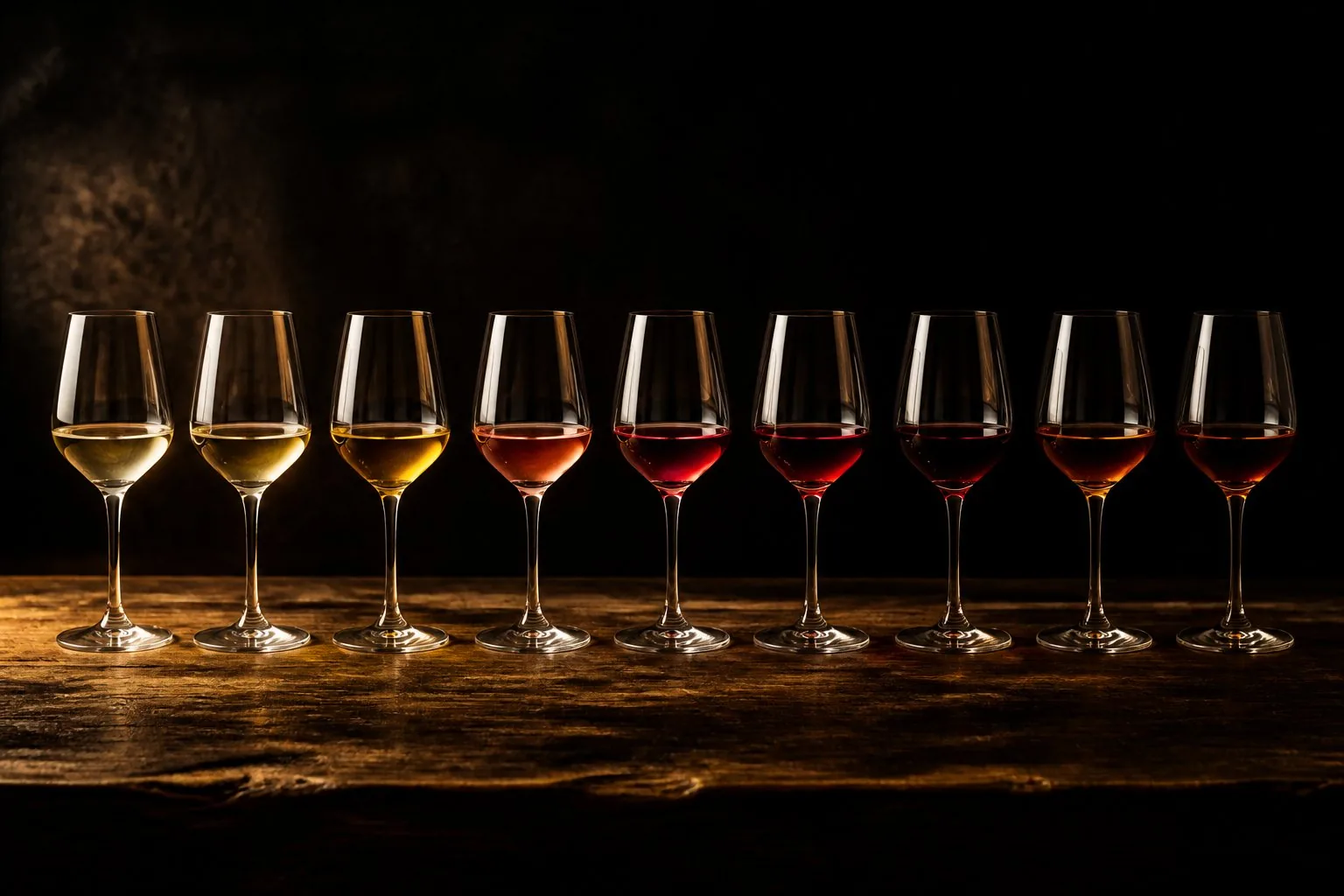
There are thousands of grapes and hundreds of thousands of labels, and the trick to not drowning is this: they all sort into nine styles. Nine drawers, arranged light to bold. Once you know which drawer a bottle lives in, you know how it will taste before you pull the cork.
We'll walk the map in order, from a whisper of bubbles to a glass of liquid raisin. For each style I'll give you the grapes that matter, when you actually want the thing, one sentence you can say across a counter to land in the right drawer without naming a single grape, and what it should honestly cost in Swedish kronor. The library has the full profile of every grape here; this chapter is the map, not the street atlas. No homework, no flashcards. Just a shelf in your head that fills itself every time you drink something new.
Three questions that place any bottle
Before the nine drawers, the filing system. Any bottle on earth can be placed with three questions, and you can usually answer the first from across the room.
First: does it sparkle, and what colour is it? That one glance splits the world into sparkling, white, pink and red before you've read a word of the label. Second: how much does it weigh? Not the bottle. The wine. Light wines feel like skimmed milk in the mouth, full ones like cream, and the alcohol percentage on the label is a decent proxy. Around 11% usually means light, around 13% medium, 14% and up full. Third: dry or sweet? Most wine is dry. Sweetness is the exception, and it's either announced on the label or hiding in the alcohol number, a trick I'll show you when we reach Riesling.
Answer those three and you've landed in one of the nine drawers below. This is also, almost word for word, how professionals talk to each other. A sommelier doesn't need you to remember Assyrtiko; she needs "white, light, bone-dry, no oak". Describe a wine along those three axes and any decent wine shop can hand you exactly what you meant. Every style below comes with its own version of that sentence.
Does everything fit? Almost. Orange wine (white grapes made like a red, skins and all) straddles two drawers, and sherry manages to be both bone-dry and filed under dessert. Fine. A map with two odd streets is still a map, and the other several hundred thousand labels behave. When a bottle refuses to file itself, that's usually the most interesting thing about it, and a reason to open it rather than worry.
The whites & bubbles
1 · Sparkling
yes, champagne is mostly RED grapesStart with the surprise: Champagne is built mostly from red grapes. Pinot Noir and Meunier make up the bulk of the blend, with Chardonnay for the polish. The juice stays pale because it's pressed off the skins fast. That bakery smell in good Champagne, the brioche and toast? That comes from years spent lying on dead yeast cells in the bottle. Glamorous business, wine.
Cava is made the exact same way, in Spain, for roughly a third of the price: the best-kept open secret in the fizz aisle. Prosecco takes a different route: the second fermentation happens in a big steel tank, which keeps it fresh, simple and full of pear. And then there's Lambrusco, a dark, fizzy Italian red that has been unfairly mocked for decades and wants nothing more than a plate of salami. Give it one.
When do you want it? More often than you currently drink it, frankly. Fizz is the only style that works before food, through food and after it. Acid and bubbles scrub salt and fat off the palate, which is why Champagne with crisps is a genuinely great pairing and not a joke. It's also the answer to the hardest hosting question there is: the party where you know nothing about the guests. Nobody has ever been offended by a glass of fizz.
To order it, say: "something sparkling and properly dry, I like that bready, toasty character." That gets you the traditional method: Champagne, Cava, Crémant. Swap the ending for "fresh and fruity" and you'll be handed the tank method instead, meaning Prosecco and its cousins.
cava: champagne's method, a third of the billNow the kronor. Champagne's floor sits around 300 kr, and at the floor you're mostly paying for the word on the label; honest Champagne starts closer to 400. The smart money knows that Cava and Crémant use the same bottle fermentation for 100–180 kr, and Crémant d'Alsace and Crémant de Loire in particular deliver a startling share of Champagne's character at a third of the bill. Prosecco should cost 90–130 kr, and here's the myth to bury: Prosecco is not failed Champagne. It's a different method on purpose. The tank keeps the pear-and-blossom fruit front and centre, exactly what years on yeast would erase. Judging Prosecco for lacking brioche is like judging a sundress for not being a wool coat.
Start here:
- Cava brut or brut nature: the real method, bone-dry, pocket change.
- Crémant d'Alsace or Crémant de Loire: the closest thing to Champagne that isn't.
- Grower Champagne (look for "RM" in tiny print on the label) when the occasion is real.
The world's most famous white wine, Champagne, is mostly made from red grapes.
pinot noir & meunier, pressed pale2 · Light-bodied white
The crisp, cold, Tuesday-evening drawer. Sauvignon Blanc leads it, smelling of cut grass and gooseberry thanks to compounds called methoxypyrazines, the same family that makes green peppers smell green. Albariño, from Spain's Atlantic coast, carries a faint sea-salt edge. Grüner Veltliner, Austria's grape, finishes with a twist of white pepper. Muscadet, from the mouth of the Loire, is legally capped at 12% alcohol and is the best thing that ever happened to an oyster. Pinot Grigio rounds out the drawer: light, neutral, and enormously popular for exactly those reasons.
You want this drawer as an aperitif, with anything from the sea, and on any day over twenty degrees. It's the wine for before you've decided anything else, and it sharpens appetite rather than filling you up. It's also the safest white to bring when you don't know the menu, because high acid and no oak clash with almost nothing on a table.
To order it, say: "white, bone-dry, light, citrusy, no oak, and saline if you have it." That sentence lands you here every time, anywhere on earth.
The kronor bring the happiest news on the whole map: this is the cheapest style to drink well. The floor is drinkable at about 90 kr, the sweet spot sits at 100–160, and above 250 there's very little more the style can even express. The name-tax example is Sancerre (Sauvignon Blanc from a famous Loire village) at 200–300 kr, while Touraine, its neighbour a few river bends away, gives you most of the experience for 120. And one twist for the Pinot Grigio drinkers: the same grape grown in Alsace, spelled Pinot Gris, comes out smoky, honeyed and full-bodied. Same grape, different postcode, different drawer. Grapes are less loyal than we think.
Start here:
- Muscadet sur lie: the oyster wine, light by law, absurdly cheap for what it does.
- Albariño from Rías Baixas: peach with a lick of sea salt.
- Grüner Veltliner: crisp first, white pepper on the way out.
On almost every shelf, the sweet spot sits between 100 and 200 kronor. Below it you're buying luck; far above it, a name.
honest kronor, all nine drawers3 · Full-bodied white
One grape rules here, and it's a chameleon. Chardonnay made naked, steel tank and no oak, gives you Chablis: lean, stony, citrus-bright. The same grape given oak barrels and a second, softening fermentation (malolactic, if you want the word) turns into butter and toast. When people say they hate Chardonnay, they usually hate one costume, not the grape. Viognier brings apricot and perfume to this drawer; Sémillon brings lanolin richness and, in Australia's Hunter Valley, an odd talent for ageing decades at low alcohol.
Say the myth plainly, because half the ABC club (Anything But Chardonnay) has never heard it: Chablis is Chardonnay. One hundred percent. Same actor, plainest costume, grown on chalk that used to be a seabed and raised in steel. If you've written the grape off, order a Chablis and meet it again without the make-up.
This is the drawer for cream, butter, roast chicken, lobster if life is going well, and for winter, when a light white feels like someone opened a window. Full whites are the reds of the white world; they want food with some weight and a glass a few degrees warmer than fridge-cold.
To order it, say: "a white with weight and texture, oak is fine, richness is the point, but dry." If you want the lean end instead, say "Chablis-style"; every wine person on the planet knows that shorthand.
The kronor: Mâcon-Villages at 120–180 kr is the quiet smart buy: southern Burgundy, riper and rounder, no fame surcharge. Village Chablis runs 160–250 and earns it. Meursault and its neighbours start around 500 and climb into the sky; up there you're paying for scarcity and a name the rest of the table will recognise, which is a real pleasure. Just be honest that it's the thing you're buying. Meanwhile South Africa and Chile make 130-kronor Chardonnay that embarrasses bottles at twice the price.
Start here:
- Mâcon-Villages: round, ripe, unpretentious white Burgundy.
- Village Chablis: the steel-and-chalk end of the same grape.
- South African Chardonnay: oak in balance at half the Burgundy bill.
4 · Aromatic white
petrol in old riesling is a complimentThe perfume counter. Riesling is the king: screaming acidity with sweetness as an optional extra, from bone-dry to honeyed. With age it develops a petrol note, a compound called TDN, strongest in grapes baked on sunny slate slopes, and I promise it's a feature, not a fault. Gewürztraminer smells of lychee and rose water, unmistakable from across the room. Chenin Blanc is the shape-shifter, dry to sweet to sparkling depending on the Loire village. Muscat has a party trick no other grape can manage: it's the only one that actually smells of grapes. And Torrontés does the floral thing for Argentina, all blossom on the nose, dry on the tongue.
the label whispers it: 8% abv = sweet, 12–13% = dryThe big myth lives here, so let's kill it: Riesling is not always sweet. Germany makes oceans of bone-dry Riesling, and the label trick is beautifully simple: check the alcohol. Sugar the yeast ate became alcohol; sugar left behind didn't. Around 8% means the wine kept its sweetness. Around 12–13% means it was fermented dry. The word trocken on a German label means dry outright, and Alsace and Austria run drier still by default.
You want this drawer with spicy food, first and always. Thai, Sichuan, Indian: a touch of sweetness quenches chilli, and perfume stands up to lemongrass and ginger where subtle whites drown. This is the drawer that solves the takeaway. It's also the drawer for people who claim not to like wine; a cold Gewürztraminer has converted more sceptics than any lecture of mine.
To order it, say: "something aromatic and floral, off-dry is fine, as long as the acidity is there." If you want it bone-dry, say exactly that. Say it twice.
The kronor make this the best value on the entire map, because fashion looks the other way. German Kabinett Riesling runs 120–180 kr and ages for a decade. Alsace runs 130–220. Nobody charges a name-tax here, because the names frighten people: the labels are gothic, the words are long, and the reward for pushing past all that is enormous.
Start here:
- Mosel Kabinett Riesling: featherlight, gently sweet, electric acidity.
- A dry Riesling: Alsace, Austria, or a German trocken.
- Gewürztraminer d'Alsace: lychee and rose; one sniff tells you if it's yours.
The pinks & reds
5 · Rosé
Rosé is not a grape. It's a method: take any red grape, and either leave the juice on the skins for just a few hours, or bleed off some pink juice from a red-wine tank (the French call that saignée). The result runs from bone-dry, pale Provence, the colour of onion skin, to sweet, candied White Zinfandel. One rule covers all of it: drink rosé young. It's made for the summer it was released in, not the one after.
The myth to kill here is the oldest one on the map: rosé is not sweet. The confusion is White Zinfandel's fault: a sugary pink invented by accident in California in the 1970s, which taught a generation that pink means pudding. Provence, the world's reference point, is as bone-dry as any white in this chapter. If you were put off rosé by something that tasted of boiled sweets, you haven't actually tried rosé yet.
You want it in sun, at lunch, and at mixed tables: the meal where one person ordered prawns, another ordered chicken, and somebody is having only chips. Rosé is the diplomatic passport of the wine list. From May to September it's also the correct answer whenever a red feels heavy and a white feels thin.
pale ≠ dry by law, but in provence it might as well beTo order it, say: "a pale, bone-dry rosé, Provence style." Strictly speaking, colour doesn't guarantee dryness, but in practice the shorthand works nearly everywhere on earth.
The kronor: Provence runs 100–180 kr, and the style barely improves with money after that. Above 250 you're mostly paying for the shape of the bottle and its appearances on beach-club tables. The exception is Bandol, Provence's serious little enclave, where the Mourvèdre grape makes rosé with actual spine for 200–300 kr. That's a different wine, not a dearer version of the same one.
Start here:
- Côtes de Provence: the pale, dry, global benchmark.
- Spanish rosado from Navarra or Rioja: darker, fruitier, honest money.
- Bandol: the upgrade with structure; give it food, not just sunshine.
6 · Light-bodied red
serve pinot COOL, 30 min in the fridgePinot Noir is called the heartbreak grape because it's thin-skinned, fussy about weather, and ruinous to grow. And yet growers plant it the world over, because when it works nothing else comes close. Climate writes its flavour: cranberry and dried herbs from cool places, black plum and cola from warm ones. Serve it cool, please. Fifteen minutes too warm and it goes soupy.
Gamay shares the drawer and has the better story: in 1395 the Duke of Burgundy banished it from his lands by decree, calling it a "disloyal plant". It moved a few miles south, and that's why Beaujolais exists. Much of it is made by carbonic maceration, whole grapes fermenting from the inside out, which gives those juicy, almost bubble-gum wines that go down far too easily.
This is the red for white-wine weather and white-wine food: salmon, duck, charcuterie, mushrooms, roast chicken, and for any red craving in July. Low tannin means it doesn't demand protein; bright acid means it behaves at the table like a white with a suntan. If someone at dinner "only drinks white", pour them a cool Gamay and watch the policy collapse.
To order it, say: "a light red, low tannin, fresh, something I could serve slightly chilled." The word chilled tells a sommelier exactly which shelf you mean.
Now some honest arithmetic. Entry-level Bourgogne rouge, basic Burgundy Pinot Noir, starts around 200 kr and is frequently thin at that price; the famous villages start at 350 and accelerate from there. The smart Pinot-adjacent play is cru Beaujolais (Morgon, Fleurie, Moulin-à-Vent) at 130–200 kr: Gamay from ten named villages, with real earth and seriousness under all that juice. New Zealand and Chile sell trustworthy Pinot at 130–200, and they put the grape on the label so you can't get lost.
Start here:
- Cru Beaujolais, Morgon or Fleurie: the thinking drinker's 150-kronor red.
- New Zealand Pinot Noir: cherry-bright and dependable.
- Bourgogne rouge: when you're ready to pay for the postcode and taste why.
7 · Medium-bodied red
My favourite drawer, and the one restaurants quietly live on: the food wines. Enough acid to cut through dinner, not so much tannin that they need a steak. Merlot is the plush, generous one: plum and softness. Sangiovese is Chianti's spine, high-acid and cherry-bitter, and it was born for tomatoes; there is no better pizza wine. Grenache brings warm raspberry sweetness. Zinfandel is the same grape Italy calls Primitivo, jammy and cheerful under either passport. Barbera gives you dark fruit with almost no tannin. Cabernet Franc adds raspberry and pencil shavings. Carménère, Chile's signature, spent a century being mistaken for Merlot before anyone noticed. When in doubt at dinner, order from this shelf.
That's also exactly when you want it: dinner, most nights that call for red at all. It's the drawer to order for a whole table that chose four different mains, and the drawer I reach for with anything tomato-based, where the acid in the wine has to match the acid in the sauce, or the wine turns flat and metallic. Pizza, pasta, sausages, a weekday stew: all filed here.
To order it, say: "a medium red with good acidity, a food wine, not a blockbuster." The phrase food wine is understood everywhere, and it quietly tells the sommelier you know what you're doing.
montepulciano: a grape in abruzzo, a town in tuscanyThe kronor make this the value centre of all red wine. Côtes-du-Rhône Villages at 100–150 kr, Rioja crianza at 100–160, Chianti Classico at 140–200, Montepulciano d'Abruzzo drinkable from 90. There's no famous-name trap in this drawer worth warning you about, which is precisely why it drinks so well for the money; prestige lives in the drawers on either side. One knot to untie, though, because Italy enjoys confusing us: Montepulciano d'Abruzzo is a grape called Montepulciano grown in Abruzzo. Vino Nobile di Montepulciano is Sangiovese grown around the Tuscan town of Montepulciano. Same word, two unrelated wines. You now know something plenty of wine waiters don't.
Start here:
- Côtes-du-Rhône Villages: warm, Grenache-led comfort.
- Chianti Classico: look for the black rooster seal; born for tomatoes.
- Rioja crianza: soft leather and vanilla for loose change.
8 · Full-bodied red
nebbiolo: tannic as a tax auditThe big drawer. Cabernet Sauvignon rules it, and here's a fact I love: it's literally the child of Cabernet Franc and Sauvignon Blanc, a chance vineyard crossing that conquered the world. Blackcurrant, cedar, tannin built for ageing. Syrah and Shiraz are the same grape with different accents: peppery and savoury when the label says Syrah, ripe and bold when it says Shiraz. Malbec is a Bordeaux refugee that found what it was missing, altitude, in Argentina, a kilometre up in Mendoza. Tempranillo carries Spain: leather, dried cherry, and dill from long naps in American oak.
And then Nebbiolo, the trap on this shelf. It smells of roses and tar, genuinely both, and makes Barolo, which rewards a decade of patience and punishes none at all. It also carries this drawer's best lesson, so I've boxed it out below.
You want this drawer in winter, with steak and braises, and on evenings when the wine is the entertainment rather than the accompaniment. What it doesn't do is aperitif duty; tannin without food is a chew, and a big red before dinner flattens everything you drink after it.
To order it, say: "big, dark and structured, happy with oak and tannin." Add what you're eating and you've done the sommelier's whole job for her.
The kronor: Mendoza Malbec at 100–160 kr overdelivers year after year, and Portugal's Douro reds and France's Languedoc do the same at 100–180: those three are this drawer's honest engine room. The name-tax territory is Bordeaux and Barolo. Drinkable claret exists from 150 kr, but classified names multiply the price far faster than the pleasure. Barolo starts around 300 and means it; the scout's move is Langhe Nebbiolo at 130–180: same grape, same hills, younger vines and looser rules, a postcard from Barolo at a fifth of the postage.
Start here:
- Mendoza Malbec: plush, dark, nearly impossible to dislike.
- Crozes-Hermitage, or any northern Rhône Syrah: pepper and smoked meat.
- Langhe Nebbiolo: the affordable scout you send ahead of Barolo.
The most tannic grapes in the world: Tannat, Nebbiolo, Cabernet Sauvignon. Approach with food.
tannin loves protein · chapter three9 · Dessert & fortified
The sweet end of the map, where wine gets fortified with spirit or concentrated into something closer to nectar. Port comes in two main houses: ruby (dark, fruity, youthful) and tawny (aged in barrel until it turns amber and tastes of caramel and walnut). True vintage Port is only declared in the best years, roughly three per decade, which is why it costs what it costs.
Sherry runs a ladder from pale to profound: fino (bone-dry, saline, brilliant with almonds), amontillado (nutty), oloroso (dark and rich), and at the bottom rung Pedro Ximénez (PX), which is essentially raisin syrup and belongs on vanilla ice cream. Madeira has its own grape ladder, dry to sweet: Sercial, Verdelho, Bual, Malmsey. It's cooked and oxidised on purpose during ageing, which makes it near-immortal; bottles from the 1800s still drink beautifully. Sauternes is France's golden dessert wine, made from grapes shrivelled by a friendly fungus, and Tokaji is Hungary's answer, the wine kings argued over. A little of any of these goes a long way, which is the point.
fino is bone-dry. tell your grandmotherWhich brings us to a myth I take personally: sherry is not your grandmother's cream sherry. That sticky thing was a sweetened export style built for the British market. Fino, the real, native sherry, is bone-dry, pale, about 15% alcohol, served fridge-cold with salted almonds or a plate of ham, and it may be the best-value serious wine on earth. Sommeliers drink it on their nights off, which tells you everything.
When do you want this drawer? Cheese, pudding, deep winter, and, the underrated part, the weeks after opening. Fortified wine survives an open bottle for a month, where table wine dies in days. A bottle of tawny in the cupboard is the cheapest luxury in the house: one small glass on a Sunday night, no waste, no hurry.
To order it, you need two sentences for two moods. "Something fortified, nutty and completely dry" gets you fino or a dry Madeira. "Something sweet, for the cheese" gets you Port, Sauternes or PX, and a good sommelier will have matched it to the blue cheese before you finish asking.
The kronor here often come in half-bottles, which flatters the arithmetic. A 10-year tawny at 180–250 kr delivers more flavour per krona than anything else on this map, and it keeps for weeks. Fino runs 100–160 and must be drunk fresh and cold, within days, like a white. Sauternes half-bottles start around 150. Vintage Port is the cellar purchase, 500 and up: a wine for birthdays with a year attached.
Start here:
- Fino or manzanilla: a fresh bottle, fridge-cold, salted almonds alongside.
- 10-year tawny Port: the Sunday-cupboard bottle.
- PX over vanilla ice cream: pudding and sauce in a single pour.

If you like X, walk this way
Taste rarely jumps between drawers; it walks. If you know one wine you love, there's a line of relatives leading somewhere better, or somewhere cheaper that drinks the same. A few well-worn paths, each read left to right:
- Pinot Grigio → Albariño → Chablis. The same lightness; more salt and stone at every step.
- Marlborough Sauvignon Blanc → Sancerre → dry Riesling. The perfume calms down and the minerals start talking.
- Buttery Chardonnay → Mâcon-Villages → Meursault, or its cheaper neighbour Auxey-Duresses. The butter stays; elegance moves in with it.
- Prosecco → Crémant or Cava → grower Champagne. Fruit gives way to bread, one method upgrade at a time.
- Sweet rosé → dry Provence → Bandol. First the sugar leaves, then the structure arrives.
- Beaujolais-Villages → cru Beaujolais → Bourgogne rouge. Juice, then earth, then heartbreak, priced accordingly.
- Malbec → northern Rhône Syrah → Aglianico. Plush, then peppery, then volcanic and stern; Taurasi is the summit.
- Jammy Zinfandel or Primitivo → a Châteauneuf-style Grenache blend → Priorat. The jam deepens into herbs, liquorice and slate.
Walk one step at a time. Skipping straight to the end is how people buy Barolo before they're ready and conclude that wine hates them.
One glass, maybe two
Glassware is the most oversold corner of wine. The truth: one decent all-purpose glass, tulip-shaped, narrowing slightly at the rim, big enough to swirl without consequences, covers ninety percent of everything on this map. Two additions earn their cupboard space. A big balloon bowl for Pinot Noir, Nebbiolo and the aromatic whites, because delicate perfume needs room and air to gather. And a narrower bowl for the high-alcohol bruisers, because a tighter opening keeps alcohol vapour from arriving ahead of the fruit.
And here's a hill I'm happy to die on: flutes ruin Champagne. They look lovely in photographs, and they strangle the aroma: all that yeast-and-brioche complexity, built over years in a chalk cellar, funnelled through an opening the width of two fingers. Pour Champagne into a white-wine glass. The bubbles last perfectly well, the smell triples, and anyone who objects is defending the photograph, not the wine.
One practical note before anyone spends real money: thin glass genuinely improves the experience, but thin glass also dies in dishwashers and at parties. Buy six sturdy all-purpose glasses for everyday life and two good ones for the wines you've saved up for. Wine should survive contact with your actual kitchen. So should the glasses.
Temperature is half the wine
The fastest free upgrade in wine is serving it at the right temperature. Too cold mutes aroma; too warm makes alcohol shout. Four bands cover everything:
| Band | Temperature | What goes there |
|---|---|---|
| Ice-cold | 3–7 °C | Sparkling and light-bodied whites |
| Cold | 7–13 °C | Full-bodied whites, aromatic whites, rosé |
| Cellar | 13–16 °C | Light- and medium-bodied reds |
| “Room” | 16–20 °C | Full-bodied reds and fortified wines |
A warning about that last band: "room temperature" was coined in draughty French châteaux, not a Swedish apartment in July. If your room is 24 degrees, your Cabernet wants twenty minutes in the fridge. Nobody will arrest you.
15 minutes out of the fridge · 15 minutes inIf four bands feel like homework, one rule of thumb covers nearly everything and needs no thermometer: fifteen minutes out, fifteen minutes in. Whites and fizz come out of the fridge fifteen minutes before pouring, so the cold loosens its grip and the aroma wakes up. Reds go into the fridge fifteen minutes before pouring, which drops them neatly from flat-warm to cellar range. Two glances at a clock, and you're serving wine better than most restaurants do.
The map in your pocket
That's the whole territory: nine styles, light to bold, whites and bubbles up top, sweetness at the far end. Next time you face a wall of unfamiliar labels, don't read the labels; place them. Bubbles and colour, weight, sugar: three questions, and the bottle files itself. A Grüner Veltliner you've never heard of is a light white; you already know it will be crisp, cold and peppery. An unknown Douro red sits on the full shelf; you know it wants food and a cooler room than you think. The map does the work. You just have to open it.
Test yourself
Five questions, no flashcards
0 of 5.
next: reading europe's labels without a phrasebook