
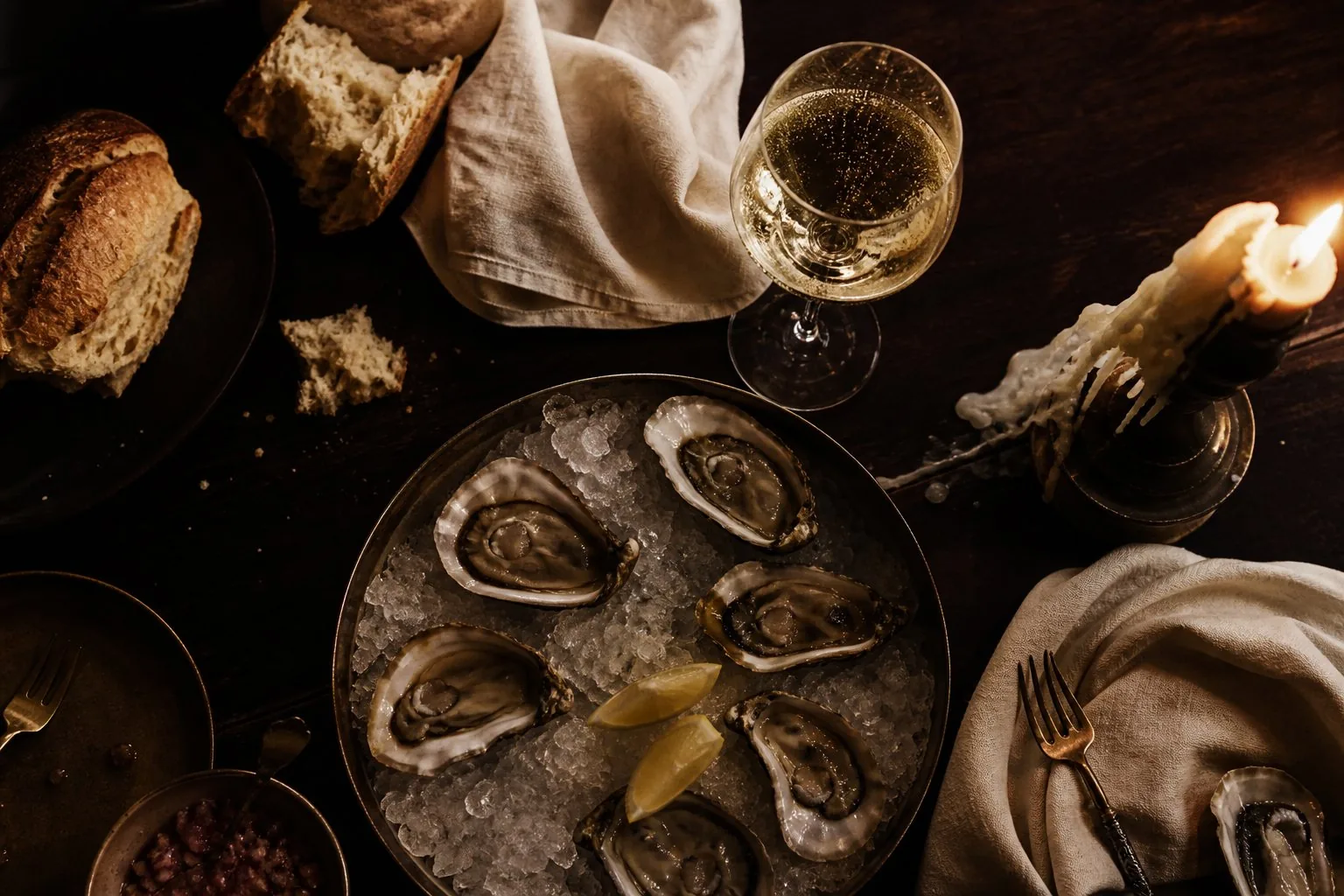
Six chapters of theory, and now the part it was all for: dinner. Everything in this chapter you can test tonight, in your own kitchen, with one bottle and whatever's in the fridge. That's how I want you to learn it. It's also the longest chapter of the seven, because it's the one you'll live in.
Pairing, biology first
Food and wine pairing has a reputation for being an art, guarded by people in aprons with strong opinions. It's mostly chemistry, and the chemistry is simple enough to taste for yourself in one evening. Your tongue reacts to acid, sugar, salt, fat and bitterness in predictable ways, and a pairing is nothing more than two of those reactions happening at once. Four experiments, all cheap:
- Acid cancels acid. Squeeze lemon on an oyster, then sip Champagne. The wine tastes rounder, almost creamy, because the lemon absorbed the sourness the wine would otherwise have to carry alone.
- Sugar bullies dry wine. Take a bite of cake, then a sip of anything dry. The wine turns thin and sour. Dessert always needs a wine sweeter than itself, or the wine loses.
- Tannin binds fat. Sip a firm young red, note the grip, then eat a knob of butter and sip again. Softer. Tannin literally latches onto fat and protein, which is the entire logic of steak with Cabernet.
- Salt inflames tannin but flatters acid. Salted crisps make a tannic red taste bitter and metallic; the same crisps make a crisp white sing. Salt is why fish and big reds fall out.
A fifth player deserves a name: umami, the savoury depth in mushrooms, soy, parmesan, cured ham and anything slow-cooked. Umami sharpens tannin the way salt does (this is why sushi murders most red wine), and it flatters acid and bubbles, which is why Champagne turns out to be so absurdly good with food that has nothing to do with celebration. File it next to salt: a hidden hand on the plate that pushes the wine around.
Once you've tasted those four, the method is three steps. First, match the weight of the dish: delicate food, delicate wine; rich food, rich wine. A blockbuster Shiraz flattens a sole meunière no matter how good both are. Second, check the structure interactions above: any sugar, salt, acid or fat in the dish that will push the wine around? Third, pair to the dominant flavour, which is usually the sauce, not the protein. Steak au poivre is a pepper dish that happens to contain beef, so you reach for peppery Syrah, not the Cabernet you'd pour over a plain rib-eye.
Two meta-rules do the rest of the work. What grows together goes together: goat cheese and Sancerre come from the same Loire villages and have had a few centuries to sort out their differences; the same goes for tomatoes and Chianti, oysters and Muscadet. And one star per table: a complex, expensive wine wants simple food. Roast chicken. Good bread. If the cooking is the performance, let the wine be the audience, and the other way round.
The anchors
Some pairings have survived every fashion because the chemistry underneath them is bulletproof. Nobody sat down and invented them; kitchens and cellars ground them out over generations, and each one is a working demonstration of the experiments above. Learn these eight and you can improvise the rest:
| Pairing | Why it works |
|---|---|
| Oysters + Champagne | Salt loves acid, and the bubbles scrub the brine off your palate between each one |
| Steak + Cabernet | Tannin binds the fat; the fat softens the tannin. Each fixes the other |
| Blue cheese + Sauternes | Salt and sugar, bickering happily like an old married couple |
| Thai or Indian heat + off-dry Riesling | Sugar puts chilli fire out. Alcohol is petrol, so keep big reds far away |
| Tomato sauce + Chianti | Acid meets acid and they cancel, leaving fruit on both sides |
| Goat cheese + Sancerre | Grown together for centuries; the tang and the chalk match exactly |
| Fried food + Champagne | Acid and bubbles cut straight through fat. The most underrated pairing on this list |
| Port + Stilton or chocolate | Sweetness and weight matched to sweetness and weight |
Pairing by cuisine
Structure is the engine, but nobody stands at the stove thinking "I have prepared a high-acid, moderately salty dish tonight." You've made pad thai. So here is the map I actually cook and drink by, for the dinners that happen in real kitchens rather than in pairing manuals. Notice how often the answer is white, fizzy or faintly sweet. The big structured red you've been saving fits about two dinners in ten, and one of them is steak.
| The dinner | What pushes the wine | Open this |
|---|---|---|
| Italian, tomato-based | Tomato acid, olive oil, herbs | Chianti or Barbera: acid meets acid and both relax. Pesto is a different country: Vermentino, from the same Ligurian coast as the basil |
| Thai & Vietnamese | Chilli, lime, fish-sauce salt | Off-dry Riesling or Vouvray. Sugar puts the fire out and acid answers the lime. Keep the alcohol under 12.5%; it's petrol |
| Indian | Cream, layered spice, heat | Gewürztraminer for korma and butter chicken; dry rosé or Cabernet Franc for tandoori, where the char wants a little red fruit |
| Japanese | Umami, soy salt, delicacy | Champagne, fino sherry or Chablis. Tannin turns metallic against umami; acid and bubbles never do |
| Mexican | Chilli, corn, lime, coriander | Albariño with fish tacos; cold Lambrusco with al pastor, where the fizz and the pork fat adore each other |
| Burgers & barbecue | Char, fat, sweet sauce | Zinfandel or Shiraz. A sweet-fruited red for a sweet-glazed plate: match the sauce, not the meat |
| Pizza | Its own food group | Barbera, Montepulciano d'Abruzzo or dry Lambrusco. Juicy, cheap, acid to burn |
Choose the dinner. I’ll give you the structure first and a few bottles that fit it.
The pattern worth stealing from that table: cuisines built on chilli and lime want sugar and acid. Cuisines built on umami want bubbles and no tannin. Cuisines built on smoke and fat want big fruit. Read any plate for its heat, salt, acid and fat, and you can pair a cuisine you've never even eaten. The grape names fill themselves in.
The Swedish table
My home turf, and the questions I'm asked most often, usually in December, usually with mild panic in the voice. The traditional answer to pickled herring is snaps and beer, and I won't argue with four centuries of field testing. But wine belongs on this table too, and it behaves far better than the old wisdom claims:
- Sill. Vinegar, sugar and raw onion: on paper, a wine assassin. Dry Riesling survives where nearly everything else dies: its acid stands up to the pickle and its fruit shakes hands with the sweetness in the cure. Pour it next to the snaps and judge for yourself.
- Gravlax with mustard sauce. Blanc de blancs Champagne. Cured salmon, dill and that sweet mustard want chalk and bubbles, and this is the prettiest pairing on the whole smörgåsbord.
- Västerbotten. Our answer to parmesan, and it drinks like one: aged white Burgundy or a glass of oloroso sherry. The same goes for the midsummer Västerbotten pie.
- Köttbullar with lingon. Beaujolais cru, Morgon or Fleurie. The lingonberries already do the acid work, the wine matches them fruit for fruit, and it takes a light chill without complaint.
- The julbord. Don't try to pair fifteen dishes; that way lies madness. Pick one bottle that cuts: dry Riesling or brut Champagne handles ham, herring, meatballs, salmon and cheese without flinching. One bottle, the whole table.
The cheese truth
Time to say it plainly: red wine with cheese is mostly a myth. It's the most repeated pairing in the world and one of the least reliable, and every sommelier privately knows it. Cheese is salty, fatty and dense with umami, exactly the things that turn tannin harsh and metallic. Pour a proud Bordeaux over a cheese board and the board wins; the wine comes out thinner and meaner than it went in. What works, over and over, is white, sparkling, sweet and fortified. Serve those and the whole board suddenly makes sense:
- Fresh goat cheese: Sancerre, or any sharp Sauvignon Blanc. The oldest anchor there is, and still the best.
- Brie and camembert: Champagne. The bubbles scrub the butterfat off your palate and the toasty side of the wine echoes the rind.
- Hard aged cheeses: comté, parmesan, Västerbotten. Oxidative whites. Vin jaune if you can find it, oloroso sherry, an old white Burgundy. This is also the one corner where a structured red finally earns its seat, because age has traded the cheese's moisture for crystals and depth.
- Washed-rind stinkers: époisses, munster. Gewürztraminer. Alsace has put these two together for centuries; the perfume meets the funk head-on and somehow they get along famously.
- Blue cheese: sweet, always. Sauternes with roquefort, Port with stilton, PX sherry with anything blue and fierce. Salt and sugar, the happiest argument in food.
One practical heresy to finish: skip the heroic ten-cheese board. Two cheeses with the right glass each is a course. Ten cheeses with one confused red is a pile.
Dessert without disaster
The cake experiment from the top of this chapter is the entire law here: the wine must be sweeter than the dish, or the dish strips it to sour water. No exceptions, no clever workarounds. This is why the Champagne-and-wedding-cake ritual is quietly a disaster: brut fizz against sugary sponge tastes like battery acid, and everyone smiles through it anyway. If there must be bubbles with the cake, demi-sec is the style that survives.
Chocolate is its own problem, bitter and sweet and mouth-coating at once, and it wants fortified wine: Banyuls from the French–Spanish border, ruby Port, or PX sherry, which you can also pour straight over vanilla ice cream and call dessert settled. Fruit tarts, and anything built on apple, apricot or citrus, want Sauternes or a late-harvest Riesling: enough acid under the sugar to keep the whole thing from going flabby.
And the honest tip no menu will print: salt is a better canvas than sugar. Champagne with crisps is a sommelier cliché because it works every single time: acid and bubbles against salt and fat, the fried-food anchor in its cheapest clothes. If the choice is between pairing the dessert correctly and ending the evening well, eat the dessert on its own and bring out something salty with the last of the bubbles.

Buying without fear
Start before you reach the shop: know why you're there. Wine for tonight's dinner is one errand; wine for the week, a gift for a colleague, a case for a party are different errands, and each points at different shelves. Walk in with a purpose and the wall shrinks to a corner of itself before you've read a single label.
A wall of five hundred bottles is only frightening if you read it left to right. Filter instead, in this order: type (red, white, sparkling, rosé) → sweetness (dry or not) → body (light, medium, full) → style words on the shelf tag (crisp, oaky, earthy, chapter five's vocabulary) → adventure level (safe grape or something new tonight?) → and price last. By the time you reach price you're choosing between four bottles, not five hundred, and any of the four will do the job. Most people start with price, which is like choosing a book by page count.
Ignore the shelf-tag scores while you filter. A stranger's 91 points tells you what that stranger likes, and you've never met. And build one small habit that will teach you more than any critic: for every nine bottles you already know, buy one stranger: same style, same price, unfamiliar name. Nine safe, one wild. In a year you'll have met fifty new wines, and a handful of them will have become yours.
Better still: date your wine shop. Pick one shop, find one clerk, and tell them honestly what you drank last time and whether you liked it. Three visits in, they know your palate better than you do, and they will start putting things in your hands that you'd never have pulled off the shelf. This is the single best deal in wine and it costs nothing.
One refinement for gifts: buy for their palate, not yours. Ask what they usually drink, then buy a slightly better version of exactly that: a lovelier Rioja for the Rioja drinker, a grower Champagne for the prosecco lover. The bottle that says I noticed what you like beats the bottle that says here is what you should like, every time, in every country I've poured in.
When the year matters
Vintage is simply the year the grapes grew, which means it is a weather report printed on the bottle. The year matters most where getting grapes properly ripe is a struggle rather than a certainty. In marginal climates, a cold summer can leave hard acid and green tannin, while rain at harvest can dilute fruit or invite rot. Burgundy, Bordeaux, Germany, Barolo, Champagne and England all live close enough to the edge for one season to taste distinctly different from the next. That does not make a cool or wet year bad by definition. It makes the producer’s judgement more important.
Under reliable sun, relax. Mendoza and Barossa usually ripen their grapes without the same annual suspense, as do most of Spain’s south and California’s valley floors. Blends also smooth the weather out, since the maker can adjust the mix across grapes, parcels or reserve wines. Non-vintage fizz is built to do exactly that: several harvests are blended into a house style, so consistency is the point. Rioja blends and everyday supermarket wines are generally made with the same useful aim. You are buying the producer’s steady hand, not a meteorological souvenir.
Here is the price rule I actually use in a shop. Under about 150 kr, ignore vintage entirely. The producer has blended, selected and adjusted the wine to land where it should, and a vintage chart will not improve your Tuesday. Above roughly 300 kr in a marginal region, take thirty seconds before you spend. That is where the year can change the shape of the wine enough to matter, and where the price makes a quick check worthwhile. Between those figures, use common sense: the more specific the place and the more ambitious the bottle, the more weather can show.
You do not need to memorise a single chart. Search “<region> <year> vintage” and read two sensible sources, because one person’s elegant, cool year is another person’s thin disappointment. Better still, ask the shop: “How was 2021 in Barolo?” is a perfectly ordinary question, not a password into a club. And keep the hierarchy straight. A good producer in a tricky year is usually a better buy than a lazy producer in a celebrated one. Weather sets the problem; people still make the wine.
Scripts that work
The cheapest bottle on a wine list carries the fattest markup and the trophy bottle the thinnest. Mathematically, the expensive end is the bargain.
the mid-list is your hunting groundRestaurants run on different arithmetic, and knowing it changes everything. Bottles are typically marked up four to five times wholesale at the bottom of the list, and far less proportionally at the top, where nobody pays five times cost for a famous name. So the second-cheapest bottle is often the worst value in the room, and the middle of the list is where the sommelier hides the things they actually love.
point at the price. they'll protect it.Two more restaurant facts. One glass sold usually covers the wholesale cost of the whole bottle, which means it never hurts to ask for a small taste before committing; the house has already done fine. And when you talk to the sommelier, give your budget by pointing at a price on the list rather than saying a number out loud. They'll keep your secret and stay near your figure. Protecting your budget while finding you something good is not a favour; it's the job, and the good ones love being asked to do it.
Knowing the arithmetic is half the game. The other half is knowing what to say, so here are three scripts, word for word. I've watched each one work hundreds of times from the other side of the table:
a short list that changes often is a good sign- To the sommelier, with a budget. Open the list, rest a fingertip on a price, and say: "Something around here. We're having the fish and the lamb. Surprise us." Budget delivered in silence, food on record, and you've handed over the one thing sommeliers crave, which is permission. Expect the best bottle of your month.
- In the shop. "I want a white like Chablis, but under 150 kronor. What do you have?" A reference point plus a ceiling is everything a good clerk needs. You'll walk out with a Muscadet, a picpoul or an Alto Adige white, and you'll have taught them your palate for next time.
- By the glass. "Could I taste a splash of the Barbera before I decide?" The bottle is already open and, as we established, already paid for. No decent place refuses, and the indecent places have just identified themselves.
If you want to know whether the sommelier is worth trusting before you hand over the decision, ask one soft question: "What are you drinking at the moment?" A good one lights up and names something specific, usually inexpensive, often odd. A poor one names the most expensive bottle on the list, or shrugs. And if you're the one holding the list at a business dinner: order for the table's tastes, not for your own reputation, go by the glass when the food splits in two directions, and never turn wine into a contest. Nobody at that table will remember the bottle. They'll remember whether the evening was easy.
the good stuff hides in the middle of the listRead the list itself before you trust it, too. Red flags: no vintages printed anywhere, which means nobody expects you to care; bottles standing upright in a sunny window, slowly cooking; a list that is wall-to-wall famous names, a trophy cabinet with no evidence that a human being chose anything. Green flags: regions you've never heard of, because somebody tasted their way to those; a short list that changes with the seasons; and Riesling anywhere on it. Nobody puts Riesling on a list for the money. Only for love.
riesling on the list means someone there caresThe twelve-bottle starter cellar
Not a cellar for ageing; chapter one settled that 95% of wine wants drinking now. This is a working reserve: twelve bottles chosen so that no dinner, guest or sudden Tuesday can catch you without the right one. Buy it as one mixed case, replace each bottle as you drink it, and the system runs itself.
| Bottle | The archetype | ≈ kr | Why it's here |
|---|---|---|---|
| Sparkling, everyday | Cava brut | 100 | Tuesday bubbles, fried food, apologies |
| Sparkling, occasion | Crémant de Bourgogne or Loire | 160 | Champagne's understudy at a third of the price |
| Light white | Muscadet or Picpoul de Pinet | 110 | Oysters, sushi, the aperitif hour |
| Aromatic white | Dry Riesling, German or Alsace | 140 | Thai, herring, spice; the problem-solver of the case |
| Full white | Mâcon or another white-Burgundy style | 180 | Roast chicken, cream sauces, autumn |
| Rosé | Dry Provence style | 120 | Mixed tables and indecision insurance |
| Light red | Beaujolais cru: Morgon, Fleurie | 180 | Salmon, charcuterie, meatballs; takes a chill |
| Medium red | Rioja crianza or Chianti Classico | 140 | The weeknight everything-red; loves tomato |
| Full red | Syrah or Malbec | 160 | Steak, barbecue, big winter food |
| Sweet | Half-bottle of Sauternes | 200 | Blue cheese, fruit tarts, small emergencies of joy |
| Fortified, dry | Fino sherry | 130 | Olives, almonds, the greatest aperitif on earth |
| Fortified, sweet | 10-year tawny Port | 200 | Cheese, chocolate, and it keeps a month once open |
Twelve bottles, about two thousand kronor, and there is no dinner that can catch you unprepared.
restock as you drink and it runs foreverThe total lands somewhere between 1,800 and 2,200 kronor, depending on how the Crémant mood takes you. Notice what's missing: nothing over 200 kr, no trophies, no bottle you'd be nervous to open, because a reserve you're afraid to drink is furniture. And notice the shape of it: half the case is white, sparkling or fortified, because that is roughly the shape of how food actually falls across a year, whatever the shop's shelf space implies.
a half-bottle of sauternes fixes most emergenciesServing and keeping
Temperature is structure you can adjust after the bottle is bought, which makes it the cheapest upgrade in wine. Chill mutes sweetness, hides flab and sharpens the whole wine; warmth amplifies alcohol and turns everything soupy. This is why cheap whites taste better ice-cold, why a great white deserves to warm up a little in the glass so its aromas can escape, and why a big red poured straight from a warm kitchen shelf tastes brutal: hot, blurry, all elbows. The old advice to serve reds at "room temperature" was written when rooms were cold; it meant a stone house in November, not a modern flat at 22 degrees.
The working numbers, once, so you have them. Sparkling and sweet wines: 6–8°C, straight from an ice bucket. Crisp whites: 8–10. Full whites and rosé: 10–13, which in practice means lifting the good Chardonnay out of the fridge twenty minutes before dinner. Light reds: 13–15, and those are the fifteen fridge minutes. Full reds: 16–18, always cooler than your kitchen. When unsure, err cold. A glass warms in your hand within minutes, but a warm wine has nowhere to go.
Fifteen minutes in the fridge fixes more red wines than decanting ever will.
the least glamorous trick in the trade
Decanting still has a use: a bold young red (Cabernet, Barolo, a serious Syrah) genuinely opens up with fifteen to thirty minutes of air. Anything older or lighter, just pour it. As for keeping unopened bottles, the rule is cool, dark and steady. Wine ages roughly four times faster in a warm pantry than in a proper cellar, so the cupboard above the oven is where bottles go to die. A wardrobe floor is fine.
Opened bottles are hardier than people fear, so stop pouring good wine down the sink on day two. Recork a light white and refrigerate it and you have one to three good days. A sturdy red lasts up to a week, and some actually improve on the second evening. Sparkling holds its fizz overnight with a proper clamp stopper, which costs 50 kr; the teaspoon-in-the-neck trick, sadly, is folklore. Fortified wines like Port and Madeira shrug for a month. And remember chapter one: about 95% of all wine is made to drink within five years of the vintage, while the fruit is still alive. Buy for tonight, not for a legacy.
When you are not drinking
Start at the sparkling shelf. Alcohol-free fizz is usually the most convincing option because bubbles carry aroma and put texture back into a wine that has lost the weight of alcohol. Acidity matters for the same reason: without enough of it, sweetness sits heavily and the drink tastes like grape juice in formal clothes. Check the label, choose the driest style you can find, and serve it properly cold. Cold sharpens the edges and helps almost everything on this shelf.
Expect something adjacent to wine rather than an exact copy of it. The best bottles can be bright, grown-up and genuinely good with dinner, but they will usually have a shorter finish and a lighter middle. That is chemistry, not failure. Sparkling tea, verjus-based drinks and bitter aperitifs can be better choices than a flat imitation red because they are allowed to be themselves.
Tools that earn their drawer space
Wine attracts hardware the way boats do, and most of it solves problems you don't have. Here is my honest inventory, after years of pouring for a living:
- A waiter's friend corkscrew. The only true essential. Get the kind with the two-step hinged lever, spend about 150 kr, and it will outlive several of your relationships. The winged supermarket model chews corks; the 800 kr lever contraption fills a drawer and impresses nobody worth impressing.
- Glasses: one shape. A single universal glass (a medium tulip, thin rim, narrower at the top than in the middle) serves red, white and honestly even sparkling. Thinness matters more than silhouette. The six-shapes-per-grape cabinet is a sales strategy, not a requirement.
- A decanter. Any clean jug. The job is air, and occasionally leaving sediment behind, and a water carafe does both. The swan-necked crystal one is lovely, and it is also a jug.
- Vacuum pumps. Mediocre, since they pull out some air and a little aroma with it, but better than nothing. Recorking the bottle and standing it in the fridge does most of what the pump does anyway.
- Coravin. The needle-through-the-cork gadget is genuinely brilliant: it pours a glass without ever opening the bottle. It's only worth the money if you regularly drink single glasses from good bottles across weeks. If you finish bottles with company, and I hope you do, skip it.
- An ice bucket. Faster than the fridge, and it's not close: water plus ice touches the whole bottle, so fifteen minutes does what forty-five in the fridge does. Any bucket. A saucepan works. The freezer works too, right up until you forget the bottle, and you will forget the bottle.
Taking wine on the road
Sooner or later a holiday will bend itself around a wine region, and you should let it, because one afternoon in a working cellar teaches more than a month of reading. Timing first. Harvest is the theatre: trucks of grapes on the back roads, the crush pad in full roar, the smell of fermenting must hanging over whole villages, and yet everyone is on sixteen-hour days and nobody has time for you. Winter looks bleak, all bare vines and empty car parks, and it is the best-kept secret in wine travel: the winemaker is rested, unhurried and quietly delighted that anyone came at all. Spring splits the difference. Summer weekends are for people who enjoy queues.
go in winter. the winemaker has time.Plan the day like a delivery route, not a pilgrimage. Three wineries is a full day, four is a forced march. Plot them on a map, drive out to the farthest one first and taste your way home, which takes the clock-watching out of the afternoon. Keep water and something to eat in the car, because vineyard country is beautiful and has no shops, and day drinking on an empty stomach ends careers as a tasting companion.
In Europe, book ahead: the drop-in cellar door is a New World habit, and a small Burgundy domaine wants an email before it wants you. Once you're in the tasting room: spit. It feels wrong the first time and it is the single most professional thing you can do; the winemaker spits too, and it's their wine. Pour out anything you don't love, never drink to be polite, and never guilt-buy, since a warm thank-you and a clean exit beats six bottles of regret in the boot. Do photograph the labels of everything you like, because you will not remember, whatever you tell yourself at the time.
Getting bottles home is easier than it looks: a shipping box or a padded wine suitcase, checked as luggage, declared at customs: the duty on a dozen bottles is usually less than the taxi from the airport. And pack one melancholy truth alongside them: the rosé that tasted of the entire Mediterranean on that terrace will taste ordinary in your kitchen in November. That's not the wine's fault, and it's not yours. Context is an ingredient: the heat, the holiday and the company were all in the glass. Buy the bottles anyway. You're buying the memory too, and memory is a legitimate flavour.
Go and eat
That's the course. Seven chapters, and the only real homework is this: open bottles with people you like, pay attention for the first two sips, then forget everything and enjoy your evening. You now know more about wine than most people ever will, and the point of knowing it was never the knowing. I've spent years pouring wine in Stockholm, and the best tastings are never the quietest ones. They're the ones with laughing in them.
Wine should be fun. If it ever stops being fun, you're holding it wrong. Skål.
Test yourself
Five questions, then dinner
0 of 5.
that's the course. go open something.