Left alone, grape juice becomes vinegar. The winemaker's entire job is to interrupt that slide at the good part, and every choice about how, when and with what shows up in your glass. This chapter is the recipe book, minus the mystique.
First, the split
blush is a sweetness, rosé is a colourWhite wine: press the grapes straight away and ferment the juice on its own. Red wine: crush the grapes and ferment juice and skins together, because that's where the colour and the tannin live. The juice inside almost every red grape is clear. A red wine is a white wine that spent quality time with its own skins.
Rosé sits between, but closer to white than you'd guess. The juice gets a brief skin soak (hours, not weeks) and is then pulled off and fermented pale. One correction while we're here: blush is not a synonym for rosé. Blush describes a sweetness style (think White Zinfandel), while rosé describes a colour. Plenty of the world's best rosés are bone dry.
The fermentation itself is gloriously simple. Yeast eat sugar and give back alcohol, carbon dioxide and heat. That's it: the whole miracle. It also means riper grapes carry more sugar, and more sugar means more potential alcohol. Keep that in your pocket; it explains half the wine world.
The two paths diverge at the very first step and only meet again at the bottle. Here's the whole journey on one page, before we walk it slowly.
The six levers
Everything a winemaker does fits under six headings. The first you already know.
Place
Chapter one covered this: climate is the flavour dial, and the vineyard is a decision made before a single grape exists.
Grape
The variety sets the ceiling. Thick-skinned Cabernet gives dark colour and firm tannin; thin-skinned Pinot Noir gives neither, no matter how hard you try. A winemaker can shape a grape's character but never swap it for another one. Choose the grape, and you've chosen the range of possible wines.
Yeast
Here's the first real fork in the road. Let the ambient yeasts already living on the skins and in the cellar do the work, and you get risk plus character: ferments that stall, and ferments that produce flavours no lab could design. Buy a cultured strain and you get consistency, a ferment that starts on Tuesday and finishes on schedule. Neither is virtue; they're temperaments. And after fermentation, the dead yeast cells (the lees) can be stirred back through the wine for months, feeding it a bready, nutty richness. If a white wine tastes faintly of fresh brioche and hazelnut, someone was stirring.
Malolactic
the butter in your Chardonnay is popcorn chemistryA second, quieter conversion follows the first, this one run by bacteria, not yeast. They take sharp malic acid, the acid of green apples, and turn it into soft lactic acid, the acid of cream. Nearly every red on Earth goes through it. In whites it's a genuine style choice: block it and the wine stays taut and appley; allow it and the wine turns rounder. A by-product called diacetyl tastes of butter, the same molecule the popcorn industry uses for butter flavouring. That fat, buttery Chardonnay you either love or flee from? Now you know its name.
Oak
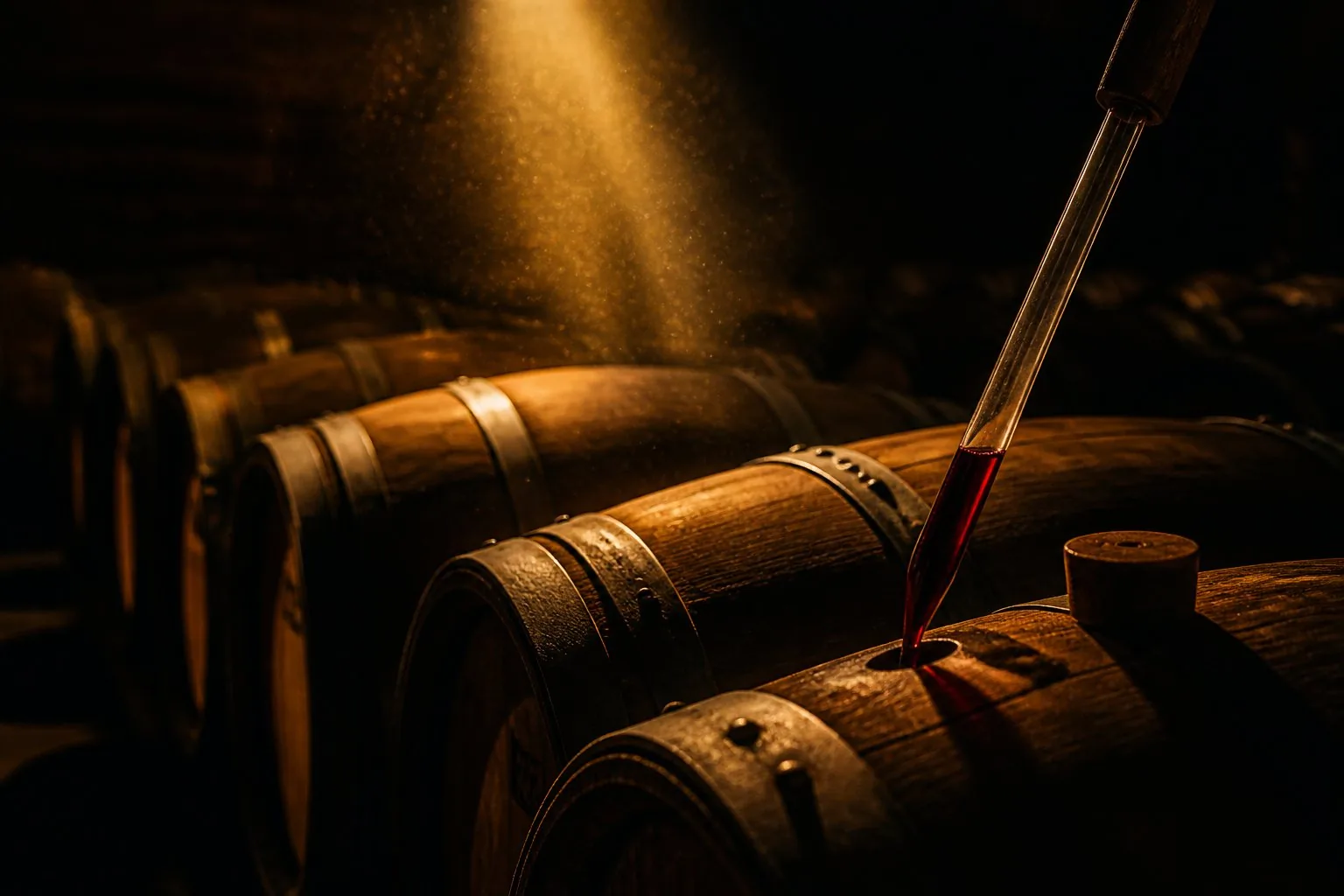
3 litres of pure stubbornnessA new oak barrel is a seasoning. It gives vanilla, clove, sweet spice, and coconut if the oak is American. But a barrel only has so much flavour to give, and after three or four fills it goes neutral: a used barrel doesn't season the wine, it just lets it breathe through the grain, softening it slowly. French oak is finer-grained, subtler, and costs more than twice as much as American. The cooper toasts the inside of each barrel over flame, and that toast level is a spice dial: light keeps the fruit forward, heavy pushes toward smoke, coffee and caramel.
My favourite detail in all of this: Bordeaux ages its wine in a 225-litre barrique, Burgundy in a 228-litre pièce. Nobody can give you a real reason. Three litres of difference, defended for centuries, because the neighbours do it the other way.
A 100-year-old oak yields just two to four barrels; only about 4% of the tree is good enough to become a stave.
which is why new oak costs what it costsTime
The last lever is the slowest: oxygen chemistry, running at a whisper through cork and barrel. Tannins knit together and soften. Fresh fruit flavours fade and stranger, better ones arrive: leather, tobacco, forest floor, dried earth. A great old red tastes less like fruit and more like autumn. There's a catch, though. Ageing wines pass through a “dumb phase”, a sulky adolescence when the young fruit has gone and the mature flavours haven't shown up, and a very expensive bottle tastes of very little. Open one then and you'll swear the critics were lying. They weren't. The wine was just mid-sentence.
Decisions in the rows
Wine is farming that happens to end in a glass. Long before anyone crushes anything, the shape of the wine is mostly decided out in the vineyard, and a grower who gets that part wrong cannot rescue it in the cellar. You can polish a mediocre grape. You cannot promote it.
low yields is on the back label because it usually costs the grower moneyStart with yields, the amount of fruit a vine is allowed to carry. Nearly every premium back label brags about “low yields”, and there's real logic under the marketing. A vine has only so much sugar, flavour and colour to hand out, so a vine carrying forty bunches spreads itself thin and a vine pruned back to ten pours everything it has into fewer, more concentrated grapes. The grower drops the extra fruit on the ground in summer (a green harvest) and watches the crop, and the income, fall with it. That's why it's worth boasting about. But low yields only matter up to a point. Past a certain leanness you're just growing less wine at the same intensity, and some grand old vineyards make gorgeous wine at generous yields because the site does the concentrating for them. Treat “low yields” as a signal of ambition, not a guarantee of quality.
Then there's the canopy, the curtain of leaves around the fruit, and one of the quiet dials that decides style. Pull leaves away and expose the bunches to sun, and the skins thicken, colour deepens and tannins ripen; that's how you get a dark, structured red. Leave the canopy shading the fruit, and you keep more of the green, herbal, leafy notes: sometimes on purpose, for freshness, sometimes because the grower ran out of time. A Cabernet that smells of blackcurrant leaf and bell pepper spent too long in the shade or came off the vine a fortnight early. Now you know which.
Comes the harvest, and the first fork is hand versus machine. A mechanical harvester straddles the row and shakes the berries loose: fast, cheap, works through the night, and perfectly good for a lot of wine. But it only picks berries, not bunches, so any wine that wants whole clusters has to come off by hand. And a machine can't climb: the steep slopes of the Mosel, the Douro, the Northern Rhône are hand-picked because nothing on wheels could stay upright. Hand-picking also lets a crew choose what to take and leave the rot behind, which brings us to the last vineyard tool worth naming: the sorting table. Good producers tip the fruit onto a moving belt and pick out the underripe, the mouldy and the earwigs before a single grape reaches the crusher. Boring, unglamorous, and the difference between clean wine and a taint you'll smell three years later.
One more, for the hot places. In somewhere like inland Australia or southern Spain, growers pick at night, floodlights on, because grapes harvested at 4am come in cold and hold their acidity, while grapes picked into afternoon heat arrive warm, soft and already halfway to a flabby wine. It looks theatrical. It's just physics.
At the crush pad
The fruit arrives, and the first real cellar decision lands: keep the stems or lose them. A destemmer strips the berries off the woody stalks so you ferment fruit alone. Leave the bunches whole (whole-cluster, whole-bunch) and the stems go in too, and they change the wine. Ripe stems add spice, a lift of perfume and a bit of grippy structure that makes a young red feel more savoury and less sweetly fruity. Green stems, from a cold year that never ripened the wood, add a stalky, bitter edge nobody wants. This is Burgundy's oldest argument, still going: some of the region's finest growers ferment everything whole-bunch and swear it's the soul of Pinot Noir, others destem to the last berry and call whole-cluster a crutch. Both make wine I'd happily drink. There's no answer, only house style.
Before the yeast wakes up, many red winemakers hold the crushed fruit cold for a few days, a cold soak. With no alcohol in the mix yet, water pulls colour and fresh fruit flavour out of the skins gently, so the wine gets its colour early and its harsher extraction later. And for whites there's a smaller choice with a big footprint: crush the grapes first, or press whole bunches straight away. Whole-bunch pressing is slower and gentler and keeps the juice cleaner and less phenolic, which is why Champagne and the best Chardonnays do it, and why a cheap crushed-then-pressed white can taste faintly coarse.
The ferment, properly
We met the yeast already. What we skipped is the two dials that sit over the whole fermentation: temperature, and the vessel it happens in.
cool ferments make the tropical-fruit smell in your SauvignonTemperature is a flavour dial, plain as that. Ferment a white cool (12 to 16°C, the tank jacketed and chilled) and you protect the delicate aromatic compounds the yeast throw off, the ones that read as passionfruit, pear, gooseberry and lime. Let that same white ferment warm and those aromas boil off; you're left with something duller. Reds go the other way. They ferment warm, 25 to 32°C, because heat drives extraction, pulling colour and tannin out of the skins to build a wine with structure. Too hot, though, and you can kill the yeast or stew the fruit into jam. The winemaker is riding that line for a fortnight.
Then the vessel, which does more than hold the juice. Each one hands the wine a different texture and a different amount of air, and the choice is as much about what the winemaker wants to avoid as what they want to add. Here's the tour on one table.
| Vessel | What it gives | Air |
|---|---|---|
| Stainless steel | Nothing: pure, precise, temperature you can control to the degree | None |
| Concrete (eggs, tanks) | No flavour, but a gentle micro-breath through the walls; the egg shape keeps lees swirling | A little |
| Old oak foudre / large cask | Breathing and texture, but no vanilla; the barrel's flavour is long gone | Some |
| New oak barrique | Vanilla, clove, sweet spice, plus air through the grain | Some |
| Amphora / qvevri (clay) | The 8,000-year-old method: air and a savoury, textural grip, no wood note | Some |
Concrete eggs are fashionable for a good reason, not just because they look like modern art in the cellar: they give a wine breath and roundness without stamping oak flavour over the fruit. Amphorae (buried clay pots, the Georgian qvevri chief among them) are the oldest winemaking tech on Earth, back in fashion precisely because they add texture without adding taste. Everything old is new again once the fruit is good enough to stand on its own.
One last job during a red ferment: cap management. The skins float up and form a dense raft (the cap) on top of the fermenting juice, and if you leave it there it dries out and the wine extracts nothing. So you either punch it down into the wine, gently, by hand or paddle, or you pump juice from the bottom over the top of the cap. Punching down is softer and more delicate; pumping over is more forceful and pulls more tannin. Same wine, two textures, depending on which the cellar chose.
Pressing matters
Once fermentation is done, the wine has to be separated from the solids, and here's a distinction worth carrying to every tasting. The wine that runs out on its own, under nothing but gravity, is free-run, the softest, most elegant fraction. What's left in the sodden mass of skins still holds wine, so it's pressed out, and that press wine is darker, more tannic and rougher. The winemaker keeps them apart and then decides how much press wine, if any, to blend back for grip. Cheap wine uses all of it because throwing wine away costs money. Fine wine is choosier.
How you press matters as much as when. For centuries the tool was the basket press, a wooden cage screwed down hard, brutal, crushing pips and stalks and squeezing bitterness into the juice. The modern pneumatic bladder press replaced it: a rubber bladder inflates slowly inside a cylinder and presses the fruit against the wall with a soft, even squeeze you can dial by the fraction of a bar. Gentler pressing, cleaner juice, less bitterness. Champagne takes this furthest of all: the pressing is split into named fractions, the first and finest juice (the cuvée) kept separate from the later, coarser taille, and only so many litres may be pressed from each batch of grapes. The rules are strict because the gentlest juice makes the finest fizz.

Élevage, the quiet year
élevage means “raising”; the wine is being brought upBetween fermentation and bottling sits a stretch of months, sometimes years, that the French call élevage: literally the raising of the wine, as you'd raise a child. Not much appears to happen. Plenty does. This is where the dead yeast cells, the lees, get their say: leave a white on its lees and it grows a creamy, bready weight, and stir them up through the wine (bâtonnage, from the French for stick) and you push that texture further, toward fresh dough and toasted nuts. Muscadet does it for years and turns a thin wine plush. Meanwhile the winemaker racks the wine, gently pumping the clear liquid off the sediment into a fresh vessel, both to clean it and to give it a controlled gulp of air. A slower version of the same idea, micro-oxygenation, trickles tiny bubbles of oxygen through a young red to soften its tannins without a barrel.
And somewhere in here, most wine gets blended, which is a skill, not a con. The word makes people suspicious, as though a single-vineyard wine were somehow more honest. It's the opposite. Non-vintage Champagne is blended across dozens of wines and several years precisely so the house tastes the same every time you reach for it. That consistency is the house's memory, held in wine. Bordeaux grows five red grapes and blends them because they ripen at different moments and hedge each other against a bad year: if frost takes the Merlot, the Cabernet carries the vintage. Blending is insurance and it's artistry, and the winemaker who tastes forty barrels and assembles the best whole from them is doing the hardest job in the building.
Bottling day decisions
The wine is made. A handful of last choices still reach your glass, and the labels that mention them are telling you something real.
unfined & unfiltered = a bit more texture, a bit of sedimentFirst, clarity. A young wine is cloudy with tiny particles, and most producers fine it (add something that grabs the haze and drags it to the bottom) then filter it through fine mesh so it pours bright. Some skip both, and “unfined and unfiltered” on a label means the wine kept a little more of its texture and body, at the price of throwing a sediment and, occasionally, a touch of cloudiness. Neither is better. It's a trade between polish and substance, and now you can read it. There's also cold stabilisation, chilling the wine hard before bottling so the harmless tartrate crystals drop out in the tank instead of appearing on your cork later, done purely so you never have to wonder what the little glassy shards are.
Then sulphur. A small dose of SO2 keeps wine from oxidising and stops stray microbes, and winemakers have used it for centuries because the alternative is vinegar. Organic wine allows it, in smaller amounts; “no added sulfites” wines skip it entirely and live a riskier, shorter life, sometimes brilliant, sometimes wobbly. The headache myth is mostly a myth: dried apricots carry far more sulphur than any wine.
Last, the closure, and here's my honest verdict on a fight that gets weirdly heated. Natural cork is romance and tradition and it lets a wine breathe as it ages, but roughly one bottle in twenty is tainted by a compound called TCA that makes the wine smell of wet cardboard and strips its fruit, and there's no way to know until you pull it. DIAM is a technical cork, ground up and cleaned of taint and reassembled, and it's boring and it works. Screwcap gives a flawless seal, and Australia and New Zealand won that argument years ago; it ages wine perfectly well, and the old worry about it (reduction, a struck-match smell from too little air) is a solved problem now. I'll take a screwcap on a crisp white every time and lose no sleep. Cork on a wine I mean to cellar for twenty years, and I'll accept the small gamble for the romance.
Bubbles
Sparkling wine is a finished wine sent back to work. In the traditional method (Champagne's method) a still base wine is bottled with a little sugar and yeast, and a second fermentation happens inside the sealed bottle. The carbon dioxide has nowhere to go, so it dissolves into the wine. Then comes the cleanup: the bottles are riddled, tilted and turned until the dead yeast collects in the neck, the neck is frozen, and the plug of frozen sediment is fired out under pressure. The tiny top-up that follows, the dosage, sets the sweetness of the final wine, from bone dry to properly sweet.

The waiting matters as much as the method. Non-vintage Champagne must rest at least 15 months on its lees; vintage Champagne typically rests five or six years. All that time on dead yeast is where the toast and brioche notes come from. Champagne tastes of bakery because it spent years lying on one. Prosecco takes the other road: the second fermentation happens in a big pressurised tank instead of the bottle, which is faster, cheaper and keeps the wine fresh and pear-bright. Not a lesser method, just the right one for a wine whose whole charm is fruit.
The English were deliberately engineering sparkling wine by 1662, while Champagne's most famous monk was still trying to remove the bubbles.
the fault that became the celebrationTwo methods sit off to the side and are worth knowing. The transfer method starts like Champagne, with a second ferment in the bottle, but instead of the fiddly riddling and freezing, the wine is emptied under pressure into a big tank, filtered clear and rebottled. Cheaper than the full ritual, and it's how a lot of large-format sparkling and own-label fizz gets made. And then there's the original, now the hipster's darling: méthode ancestrale, or pét-nat. Here the wine is bottled while it's still fermenting the first time, before all the sugar is gone, and it finishes in the bottle with no disgorging and no dosage. It came before Champagne (this is how country people made accidental fizz for centuries) and it's cloudy, a bit wild, faintly cidery, and often delicious. When a natural-wine bar hands you something hazy with a crown cap, that's what you're holding.
The whole spread, and what your money is actually buying:
| Method | Where | Tastes like | Price logic |
|---|---|---|---|
| Traditional (bottle) | Champagne, Cava, English fizz | Toast, brioche, fine bead | Years on lees, hand labour, so dear |
| Tank (Charmat) | Prosecco, Lambrusco | Pear, fresh fruit, softer fizz | Fast, scalable, cheap and cheerful |
| Ancestral (pét-nat) | Limoux, natural-wine world | Cloudy, cidery, wild | One ferment, no ritual, so variable |
| Injection (carbonated) | Bargain-shelf fizz | Big fleeting bubbles, plain | Gas pumped in, cheapest going |
Sweet shortcuts and fortified detours
ten grapes → one millilitreGreat sweet wine is never made by dumping in sugar. It's made by concentration, by taking water out of the grape. Three ways in. Botrytis, the “noble rot”, is a fungus that punctures and shrivels the grapes, concentrating the sugar while the acid stays; it looks revolting on the vine and produces Sauternes and Tokaji, two of the most beautiful wines on Earth. Ice wine is pressed from grapes frozen solid on the vine: the water stays behind as ice and about ten grapes surrender a single millilitre of nectar. And in Italy they simply dry the grapes on straw mats until they're half raisin, which gives you Amarone and Vin Santo.
Fortified wines take a different route: add spirit. Do it early, mid-ferment, and the alcohol kills the yeast with sugar still unfermented: that's Port, sweet and strong at around 20%. Do it after the ferment finishes dry and you get Sherry, which then ages either under flor, a living blanket of yeast that keeps it pale and saline, or in open contact with air, which turns it nutty and dark, then is blended across decades of barrels through the solera system, so every bottle contains a trace of very old wine.
Madeira is the one wine that abuse improved. Barrels of it sailed through the tropics as ballast, baking in ships' holds and sloshing for months, and came back tasting better than they left. Producers noticed, and to this day they cook Madeira on purpose. Having already survived heat and oxygen, it's nearly indestructible: an open bottle keeps for months on the counter, which makes it the most practical fine wine in existence and, I'd argue, the most underpriced.
Between sweet and fortified sits a lovely third thing: the vins doux naturels of southern France, which stop a ferment with spirit the way Port does but start from different grapes. Muscat de Beaumes-de-Venise catches the fragrant Muscat grape while it's still full of grapey, orange-blossom sweetness. Banyuls, from steep schist terraces on the Spanish border, does the same to Grenache and comes out tasting of figs, cocoa and dried cherry: a genuine rival to Port for a fraction of the fame. And if you want to taste the far end of the style, Rutherglen in Australia bakes fortified Muscat in the heat for years, sometimes decades, until it's brown, syrupy and tastes of treacle, raisins and coffee. A thimbleful is plenty. It's one of the great cheap thrills in wine.
flor is alive; oxidation is what happens when it diesSherry deserves its own map, because it's the most misunderstood wine there is: dry, and mostly not sweet at all. Everything hangs on flor, that living blanket of yeast. Where flor grows thick and shields the wine from air, you get pale, bone-dry, saline styles. Where the wine is fortified higher and the flor dies, the wine sits in contact with air for years and turns dark and nutty. Most sherries live somewhere along that ladder, from all-flor to all-air.
| Sherry | Ageing | Tastes like |
|---|---|---|
| Fino | Under flor | Pale, dry, saline, almond |
| Manzanilla | Under flor, by the sea | As fino, with a briny tang |
| Amontillado | Flor, then air | Amber, dry, hazelnut |
| Palo cortado | The odd one, flor lost early | Poised between the two, savoury |
| Oloroso | Air, no flor | Dark, dry, walnut, warm |
| Pedro Ximénez (PX) | Air, from dried grapes | Black, sweet, raisins and treacle |
Read that table top to bottom and you've walked from the palest, driest wine on Earth to a black syrup you'd pour over ice cream: all one grape family, all one region, the whole difference made by a film of yeast and a few years of air. That's the trick worth knowing: Sherry is not a wine, it's a spectrum.
The honest trade secrets
Small truths the back label leaves out:
- Many wines are clarified, or “fined”, with egg whites, milk casein or isinglass from fish bladders. Traces are removed with the sediment, but it's why a wine isn't automatically vegan.
- Those glassy crystals on a cork are tartrates, the “wine diamonds”, completely harmless. Most producers chill the wine before bottling purely so you never see them and never worry.
- Adding sugar before fermentation is called chaptalisation. It's legal in cool parts of France and illegal in the US, and it doesn't sweeten anything: the yeast eat it all. It buys alcohol, not sugar.
- Big commercial brands blend across regions and tanks to hit the same taste every year. That's why the vintage on a supermarket label barely matters; consistency is the product.
- The single biggest decision of the year is the pick date. Pick early and the wine is fresh, tart, lighter. Wait, and it turns jammy and strong. Everything else in this chapter adjusts a wine; the pick date defines it.
None of this is scandal. It's craft, and now it's craft you can see through the glass.
Taking the alcohol out
Low-alcohol wine can begin in the vineyard or end in a machine, and those are different drinks. Grapes picked early carry less sugar, so fermentation naturally makes less alcohol, but early picking also means sharper acid and greener, less developed flavour. Most bottles labelled alcohol-free or dealcoholised start as fully fermented wine. The producer then removes the alcohol under conditions gentle enough to keep as much aroma as possible.
Vacuum distillation lowers the boiling point, so alcohol can evaporate at a temperature that does less damage to the wine. A spinning cone does this in thin films, first lifting off delicate aromas, then removing alcohol, then putting the aromas back. Reverse osmosis pushes wine through a very fine membrane, separates alcohol and water from the flavour compounds, and rebuilds the wine afterwards. None is a simple shortcut, which is one reason a good alcohol-free bottle does not cost less.
alcohol is texture, not just heatThe hard part is not aroma but shape. Alcohol gives wine weight, warmth and a finish that carries flavour after you swallow. Take it away and the middle can feel watery, the ending abrupt, so producers often lean on sweetness, acidity or carbonation to fill the gap. Fizz survives the operation best. Bubbles throw aroma out of the glass and provide physical texture where alcohol used to be, while cold service tightens everything. That is why the convincing end of the no-alcohol shelf usually sparkles.
Why two bottles of the same grape cost 90 kr and 900 kr
Same grape, ten times the price. It's the question everyone asks and almost nobody answers honestly, so here's the anatomy of a bottle's cost, without the mystique or the guilt.
Start with the dirt, because that's where most of the money hides. A hectare of nothing-special vineyard in a warm, generous region costs about what a family car costs. A hectare of grand cru Burgundy or prime Napa bench runs into the tens of millions, and that price has to come out of the bottles it grows. Then yields: the cheap wine's vine carries a heavy crop and spreads its cost over lots of litres, while the fine wine's vine is starved down to a handful of concentrated bunches, so every bottle carries the whole cost of the vine. Low yields taste better and cost more, both at once.
Now labour. The bargain bottle was machine-picked in a night for pennies a row. The fine one was hand-picked by a crew, sorted berry by berry, punched down by hand twice a day. People are the most expensive thing in wine after land, and quality spends them lavishly.
a new French barrique is ~10 kr of oak in every bottleThen oak, and here's a number worth carrying. A new French barrique costs around 8,000–12,000 kronor and holds about 300 bottles, and it's only new once, so a wine aged in all-new French oak carries roughly ten to forty kronor of barrel in every single bottle before anyone's paid for grapes, labour or the cellar. Multiply that by a full-new-oak régime and you see where the money goes. And time is money sleeping: a wine held three years in a cellar is three years of a warehouse, of capital tied up, of tax paid on stock that earns nothing until it sells. Cheap wine is bottled and sold within months. Expensive wine costs its maker interest for years before you ever open it.
Barrel, land, labour and cellar time explain most of the gap. The last stretch, the leap to 900 kronor, is scarcity and scores, not liquid.
where price stops tracking costThat last part is the honest bit. Above a certain price, you're not paying for better wine so much as rarer wine: a few thousand bottles the whole world wants, a 98-point score, a name that turns up at auction. That's real, and it's a market, and it has almost nothing to do with what's in the glass. Which is the good news, because it means the sweet spot lives far below the fireworks. The 120-to-250-kronor middle is where careful winemaking meets sane pricing: unfashionable regions doing serious work, second labels of famous estates (the same cellar, the younger vines), grapes nobody's chasing yet. Learn to shop there and you'll drink better than the person paying triple for the label. That's the whole point of knowing how wine is made: not to spend more, but to spend well.
Test yourself
Five questions, no cellar coat required
0 of 5.
next: nine styles, every bottle on earth