Every wine on Earth is an argument between six traits: sugar, acid, tannin, alcohol, body and the finish. None of them needs a trained palate. Each one shows up in a specific place, on a schedule, and once you know the addresses you can read any glass put in front of you.
Sweetness
“dry” just means the yeast finished dinnerSweetness arrives first, on the very tip of your tongue, within about a second. What you're detecting is residual sugar, whatever the yeast left on its plate, counted in grams per litre. Bone-dry sits under 1 g/L. Dry runs 1 to 17. Off-dry, 17 to 35. Sweet, 35 to 120. Dessert wines climb from 120 to 220, which is jam with a licence.
Two traps. First, “dry” on a label can legally hide about half a teaspoon of sugar per glass, and plenty of commercial reds use exactly that trick to feel plush. Second, perception is relative: the same sugar tastes sweeter in a low-acid wine, because nothing is pushing back. Sweetness and acidity sit on opposite ends of a seesaw.
Sparkling wine has its own ladder, and it was clearly named out of spite:
| The label says | Sugar | Translation |
|---|---|---|
| Brut Nature | 0–3 g/L | Bone-dry: nothing added |
| Brut | up to 12 g/L | Dry; most Champagne lives here |
| Extra Dry | 12–17 g/L | Sweeter than Brut. Yes, really. |
| Demi-Sec | 32–50 g/L | Properly sweet: cake territory |
| Doux | 50+ g/L | Dessert in a flute |
When in doubt, run the nose-pinch test. Block your nose and touch the wine to the tip of your tongue. Real sugar tingles there even with the nose out of action. If the tingle vanishes, the wine is dry and your nose was fooling you. Vanilla, for instance, smells sweet and tastes bitter.
To learn the two ends of this scale in one evening, buy a Muscadet (the Loire's oyster wine, so dry it practically squeaks) and a half-bottle of Sauternes or a Tokaji aszú. Taste them side by side. That gap, from under 1 g/L to somewhere north of 130, is the entire territory. Every other wine you ever drink sits somewhere between those two posts, and now you own both posts.
The words, from failure to triumph:
- Cloying: sugar with no acid behind it. The sip sits in your mouth like syrup on a spoon and nothing rinses it away. This is the flaw, and it has nothing to do with how much sugar there is, only with what's balancing it.
- Bone-dry: nothing left. Not austere by definition, just empty of sugar.
- Dry: the everyday setting. Any sugar present is below the level where you'd swear to it.
- Off-dry: a detectable softness. The single most useful word on this list when you order for a table that includes spicy food.
- Luscious, honeyed: sweet, and proud of it, with enough acid that you keep going back. The compliment end of the scale.
Acidity
if your mouth waters, that's acidity talkingAcidity is the mouth-watering axis. You feel it under the tongue and along the jawline, where saliva pools a few seconds after you swallow. Your body is quite literally rinsing the acid out. The more your mouth waters, the higher the acidity. That's the whole measurement.
Wine is as acidic as lemonade, pH 2.5 to 4.5, and your teeth never notice because everything else is louder.
each pH point is ten times the acidOn paper, wine sits between pH 2.5 and 4.5, lemon-to-yoghurt territory, and pH is logarithmic, so each point is ten times the acidity of the last. Cool climates and early picking keep acid in the grape; heat burns it off. In the glass, high acid reads as “fresh”, the quality that makes you want a second sip before the first is finished. No acid reads as flab.
Calibration is cheap here. For the low end, pour a Viognier or a Gewürztraminer, plush, perfumed grapes that ripen with very little acid, so the wine feels broad and soft, like a duvet. For the high end, a Mosel Kabinett Riesling, a Sancerre or a Vinho Verde, wines that make your jaw ache in the best possible way. Drink the Viognier and the Sancerre on the same night and the word “acidity” stops being abstract forever.
The vocabulary runs from insult to flourish, and it's worth having the whole ladder:
your tongue is the only instrument you need- Flabby: the acid never turned up. The wine lies in the glass like warm juice, and the second sip is a chore.
- Soft: low acid, but on purpose. Perfectly pleasant in a plush style; the polite word for a wine that doesn't bite.
- Fresh: enough acid to keep everything moving. The baseline of any wine worth drinking.
- Crisp: the apple-bite level. Standard-issue praise for white wine, and deserved more often than not.
- Racy: high acid worn as a personality. The wine has somewhere to be.
- Nervy: higher still, taut as a violin string, and a compliment only when there's fruit to carry it.
- Searing, tart: over the line. Unripe grapes, nothing to cushion them, and a wine that's slightly painful to drink. Same acid as “nervy”, minus the balance.
Notice the trick: the top and bottom of that ladder describe nearly identical chemistry. What changes the word is whether the rest of the wine showed up. That pattern repeats for every trait, and it's the single most honest thing about wine language.
Tannin
the same chemistry that turns hide into leatherTannin is the one people misname, because it isn't a flavour at all. It's a texture. Tannins are polyphenols from grape skins, seeds and stems, plus new oak barrels, and what they do in your mouth is strip proteins straight off your tongue. That drying, grippy sensation is the same chemical reaction that tans animal hide into leather. Every sip of Barolo tans you, very mildly.
If you want the feeling without the wine, over-steep a black tea. That furry grip across the mid-tongue and gums is pure tannin. Grape tannin and oak tannin behave differently, too: grape tannin can run from silk to firm leather, while oak tannin is harsher and more bitter, which is why winemakers ration new barrels, and why used barrels give almost none.
Some grapes are simply born with more. Nebbiolo, Tannat, Cabernet Sauvignon and Syrah carry thick, tannin-loaded skins; Gamay and Pinot Noir have thin ones and travel light. So the calibration pair writes itself: a Beaujolais or a decent Pinot Noir on the quiet end, where you'll barely register the grip, against a young Barolo, a Madiran (that's Tannat country in south-west France, home of the firmest handshake in wine) or a Napa Cabernet. Take one sip of each with a minute between them and your mid-tongue will file the difference permanently.
tannin is texture, never a flavourThe ladder, from caress to complaint:
- Silky: tannin so fine you notice it only as polish. Great mature Burgundy lives here.
- Fine-grained: present, ripe, evenly spread, like the nap on good suede. High praise.
- Velvety: more plush, more weight, still zero aggression.
- Chewy: you feel like you could bite the wine. A compliment for big reds, and usually a request for food.
- Grippy: the tannin holds your tongue and doesn't quite let go. Fine in a young wine built to age; tiring in one that isn't.
- Astringent: over-extracted or simply too young. Mouth-scouring, out of proportion, though time in the cellar can sometimes talk it down.
- Green: the worst word on the list. Underripe stems and seeds, bitter and raw, and no amount of ageing rescues it. Astringent is a phase; green is a verdict.
Tight is the hedge you'll hear between those rungs; it usually just means the wine is young and the tannins haven't relaxed yet. And tannin is why big reds love steak: tannin binds fat and protein, so every bite of entrecôte softens the next sip. The steakhouse cliché is chemistry.
Alcohol
swirl, tilt, count the tearsYeast ate the sugar; alcohol is the receipt. You feel it as warmth at the back of the throat, sliding down after the swallow. Warmth is fine. Burning is not: a wine that burns is “hot”, and hot is a flaw, not a personality.
The bands: under 11.5% is low, 11.5 to 13.5 is medium, above 13.5 is high (Wine Folly draws the high line at 15%, but by that point we're splitting hairs and slurring them). Alcohol does two jobs beyond the obvious: it carries aroma up and out of the glass, and it builds body.
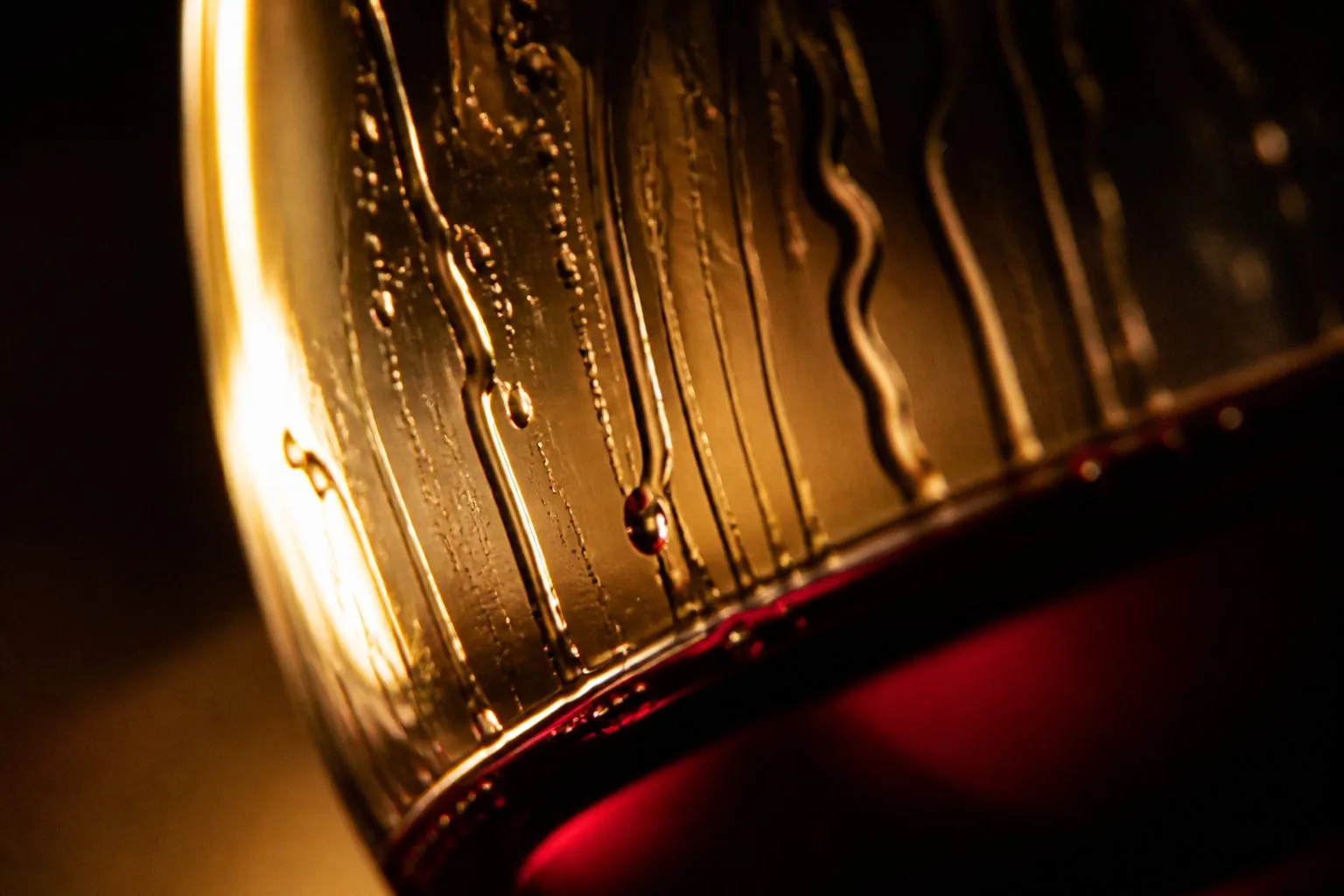
Party trick: swirl the glass, tilt it, and watch the legs, the tears streaking down the inside. Alcohol evaporates faster than water, which drags liquid up the wall of the glass and sends it weeping back down. Physicists call it the Marangoni effect; use that at a dinner party at your own risk. Thick, slow legs suggest higher alcohol. Guess the ABV out loud, then check the label. I'm right about two times in three, which is enough to look clairvoyant.
Calibration pair: a Vinho Verde at around 10%, or a Mosel Kabinett at 8 or 9, against an Amarone at 15.5%, a ripe Zinfandel or a Châteauneuf-du-Pape. The low bottle feels like a spring morning; the high one arrives wearing a fur coat. Once you've felt 8% and 15.5% in the same sitting, guessing anything in between becomes surprisingly easy; your throat remembers.
The vocabulary, cool to scorched:
- Thin: too little alcohol for the wine's frame; watery, deflated. Rare, but real.
- Light: low alcohol as a virtue. Lunchtime wines, picnic wines, Tuesday wines.
- Warm: you notice the glow and rather like it.
- Generous: high alcohol pulling its weight, filling the wine out. What Châteauneuf does on a good day.
- Heady: you're aware of the strength in every sip. Not yet a fault; definitely a warning.
- Hot: burning at the back of the throat. The alcohol has escaped its handlers. A flaw, always.
Body
skimmed milk vs whole milkBody is the odd one out: not a measurement but a sum. Alcohol plus sugar plus tannin plus extract, everything dissolved in the liquid, adds up to a physical weight in the mouth. The classic calibration is milk. Skimmed milk is light-bodied; whole milk is full-bodied. Same category, different heft, and you'd never confuse them with your eyes closed.
Of the ingredients in that sum, alcohol is the loudest. It's why the same Grenache reads light from a cool vintage and heavy from a hot one, and why almost nothing under 11% ever feels “full”. Glycerol, a slippery by-product of fermentation, adds a little more, dead yeast cells left in the tank add texture, and oak adds both tannin and the impression of size. In bottles: a Muscadet or a Beaujolais on the skimmed end, a barrel-fermented Chardonnay or an Australian Shiraz on the whole-milk end. The scale runs watery · light · medium · full · massive, and only the two ends are insults.
Hold on to this one, because matching the weight of the food to the weight of the wine is chapter seven's opening move. Light dish, light wine; rich dish, rich wine. Most pairing wisdom is that sentence wearing a bow tie.
The finish
A sip has three acts: the attack (the first impression: sweetness, fruit), the mid-palate (where acid and tannin take over) and the finish (whatever stays after you swallow). Cheap wine tends to have a hole in the middle: a bright hello, then nothing, then a short goodbye. Great wine changes profile two or three times across the sip and keeps talking for twenty seconds or more after it's gone.
One more instrument, free of charge: after swallowing, exhale through your nose. Aromas drift up the back corridor to your olfactory bulb, retro-nasal smelling, and you catch a second broadcast, often different from the first. The finish is where wine earns its price. Length can't be faked, and no back label has ever mentioned its absence.
The words here are mercifully simple: short or abrupt (gone before the glass is back on the table), clean (short but tidy, no shame in it at the right price), lingering, long, and the reviewer's favourite, endless. One caution: a flaw can linger too. Bitterness or burn that hangs around isn't length, it's a stain. A long finish only counts if what's echoing is something you wanted to hear again.
The calibration cellar
ten bottles, two evenings, scales for lifeHere's the problem with every scale in this chapter: words don't calibrate anything. I can tell you Barolo is tannic until we're both bored, but your tongue has to meet the wine before “4 out of 5” means a thing. So do what music students do with a tuning fork. Buy the extremes, taste them side by side, and let your mouth memorise the endpoints. Every wine you drink afterwards lands somewhere between bottles you've actually met.
| Trait | Feels like | The quiet bottle | The loud bottle |
|---|---|---|---|
| Sweetness | Sugar tingle, tip of the tongue | Muscadet | Sauternes · Tokaji aszú |
| Acidity | Watering, sides of the mouth | Viognier · Gewürztraminer | Mosel Kabinett · Sancerre · Vinho Verde |
| Tannin | Drying grip, mid-tongue & gums | Beaujolais · Pinot Noir | Young Barolo · Madiran · Napa Cabernet |
| Alcohol | Warmth, back of the throat | Vinho Verde ~10% · Kabinett ~8.5% | Amarone ~15.5% · Zinfandel · Châteauneuf-du-Pape |
| Body | Weight, the milk scale | Muscadet · Beaujolais | Barrel-aged Chardonnay · Barossa Shiraz |
None of this requires money. A Muscadet and a Vinho Verde are two of the cheapest good wines on any shelf, and a half-bottle of Sauternes covers the sweet end for the price of a cinema ticket. Notice, too, how hard some bottles work. The Muscadet teaches bone-dry, light body and often a faint prickle of gas in a single pour; the Mosel Kabinett sits at the loud end of acidity and the quiet end of alcohol in the same glass. Ten bottles across a month of ordinary dinners, and you own a permanently calibrated instrument that no app can sell you.
The masking game
nothing in the glass is heard aloneNow the part most wine courses skip: the six traits lie about each other. What you taste is never one trait in isolation. It's the argument between them, and your mouth only hears whoever's winning. A wine's lab report and your impression of it can disagree completely, and both are right.
Sugar mutes acid. The best demonstration is in your fridge, and it's not wine. Coca-Cola sits at around pH 2.5, more acidic than almost any wine on Earth, and nobody has ever called it sharp. Why not? Because 106 grams of sugar per litre stand in front of the acid with their arms crossed. You cannot taste past them. Winemakers know the trick as well as soft-drink chemists do, which is why those “smooth” supermarket reds carry their quiet spoonful of sugar: it files the edges off cheap acid and rough tannin in a single move.
Coca-Cola is more acidic than nearly every wine ever made. You've never noticed, because 106 grams of sugar per litre are paid to keep it quiet.
the whole masking game, in one red canAcid returns the favour. A great Sauternes carries more sugar than that can of Coke, 130 grams and up, yet finishes fresh, because underneath the honey sits a wall of acidity that scrubs your palate clean between sips. A cheap sweet wine has the sugar without the wall, and cloys before the second glass. The lesson is worth underlining in pencil: sweetness is never the problem. Unaccompanied sweetness is the problem.
Tannin surrenders to protein and fat. Tannin's grip comes from binding the proteins in your saliva. Give it richer prey, steak, hard cheese, a knob of butter, and it binds that instead, and your tongue gets left in peace. A Barolo that feels like licking a blackboard on its own turns silky beside braised beef. It also means every big red you taste without food seems one size more brutal than it will be at the table. Judge accordingly.
Alcohol impersonates sugar and body. Ethanol tastes faintly sweet on its own tongue-tip terms and adds weight everywhere, so a bone-dry 15% Zinfandel will convince half a dinner party it's off-dry. It isn't. Run the nose-pinch test from earlier: no tingle, no sugar. The sweetness is a costume alcohol likes to wear.
Temperature turns every dial at once. Cold suppresses your perception of sugar and locks aroma into the liquid; warmth releases aroma and amplifies alcohol. This is why cheap sweet whites get served arctic (the fridge does the balancing the winemaker didn't) and why a red parked near the radiator tastes like fruit soup with a shot in it. The same bottle, ten degrees apart, is two different wines.
Which is the punchline of the whole chapter: balance is the entire game, and now you can see why. A “balanced” wine is simply one where the masking stalemate holds: every trait loud enough to be heard, none loud enough to gag the others. And temperature hands you a free equaliser, the only structural control you keep after the cork comes out. Fifteen minutes in the fridge tightens a flabby, hot red; ten minutes on the counter lets a fine white speak. You can't change the wine. You can absolutely change which traits get the microphone.
Reading structure off the label
the ABV is a confession, not a statisticYou can read most of a wine's structure in the shop, before a drop is poured. The richest clue is the number everyone ignores: the alcohol percentage, printed small on every bottle by law. Alcohol is fermented sugar, so the ABV tells you how ripe the grapes were and, in certain wines, exactly how much sugar got left behind.
German Riesling is the cleanest case. The grape ripens with vast acidity, the winemaker chooses where fermentation stops, and whatever didn't become alcohol is still in the wine as sugar. So the label does arithmetic for you. At 8 or 9% you are holding a sweet wine. Around 11%, off-dry. From about 12.5% up, the yeast finished the job and the wine is dry and firm. No tasting note required.
A German Riesling declares its sweetness in numbers: 8% means sweet, 11% means off-dry, 12.5% and up means dry. The small print has never once lied about this.
low alcohol = the yeast stopped earlyEverywhere else the same number reads as body and ripeness: 12% suggests lean and brisk, 14.5% promises weight and warmth. Then stack the other clues on top:
- Climate is printed on the label; it's called the region. Cool places (Mosel, Loire, Chablis, Tasmania) mean higher acid, lighter body, lower alcohol. Warm places (Barossa, southern Italy, most of California) mean riper fruit, softer acid, more punch. The appellation is a weather report you already paid for.
- Grapes have factory settings. Riesling and Sauvignon Blanc run high-acid whatever you do to them; Viognier and Gewürztraminer run plush and strong; Cabernet, Nebbiolo and Tannat bring tannin; Gamay never does. Learn a dozen defaults and every varietal label becomes a spec sheet.
- Vintage matters, but only where the weather is a gamble. In marginal regions (Mosel, Burgundy, the Loire, England) the year rewrites the wine: a cold one means nervier acid and less alcohol, a hot one the reverse. In reliably sunny places like Mendoza or Barossa, vintage is close to a formality. Spend your vintage anxiety where it earns interest.
None of this replaces tasting. It means you walk up to the wall of wine able to estimate acidity, body, alcohol and often sweetness from print alone: four of the six traits before you've spent a krona.
The seventh trait nobody names
fabric words are measurements, not poetryScore sheets track six traits, and then every taster quietly judges a seventh: texture. Not weight (that's body) but the surface of the wine, the way it moves across your tongue. Two wines can match on every scale in this chapter and still feel as different as silk and corduroy, and that difference has physical causes you can name.
- Silky: friction-free, seamless. It comes from ripe, softened tannin and gentle winemaking, and it's the house texture of fine Pinot Noir and old Rioja.
- Oily: viscous and coating, like a teaspoon of olive oil. Glycerol from fermentation plus alcohol plus, usually, a low-acid aromatic grape. Alsace Pinot Gris and Viognier are the reference points. Half of drinkers call it luxurious, the other half say slippery; I'm in the luxury camp.
- Chalky: a fine, dusty drag, as if the wine carried a pinch of powdered limestone. In reds like Sangiovese it's the particular shape of the tannin; in whites it's phenolic grip from skins and firm pressing. When people say a wine has “mineral texture”, this is usually what their tongue found.
- Creamy: rounded and lactic, from malolactic fermentation and stirred lees. Butter's chemistry on loan to Chardonnay.
- Spritzy: a faint prickle in a still white, from carbon dioxide the winemaker kept deliberately dissolved at bottling. In Vinho Verde, Muscadet and young Grüner Veltliner it's a feature, not a fault: the gas carries a fresh bite that props up the acidity. Notice it once and you'll find it everywhere.
Texture is the trait your mouth registers first and your vocabulary names last. Let the fabric words in: silk, suede, linen, flannel. They sound like poetry, but they're measurements your tongue already made.
When the six hold hands
So how do you judge the whole? Three words. Balance: no trait shouting over the others, with acid propping up sugar, fruit cushioning tannin, alcohol staying in its lane. Complexity: how many distinct things you can find, and whether they keep changing. Typicity: does the wine taste like what it claims to be; does the Chablis actually taste of Chablis?
Balance is the non-negotiable. A simple, balanced wine is a pleasure; a complex, unbalanced one is an expensive argument. When the six traits hold hands, you stop noticing them individually and the wine simply tastes right. That's the target, and the rest of this course is really the story of how the traits got there.
One final distinction, and it may be the most liberating sentence in the course: well-made and for you are separate verdicts. You can taste a wine, register that it's balanced, complex and exactly true to its home, award it full marks in your head, and still not want a second glass. That's not a failure of your palate; it's proof you have one. Respect and desire are different currencies, and only one of them should decide what gets opened on a Tuesday.
The flip side: your palate is not a fixed instrument. It drifts, and mostly it drifts towards the difficult traits: tannin and acid are acquired frequencies, like coffee, like olives. The wine you swore off at twenty-five may be your favourite at forty. Keep a private blacklist if you must, but audit it. I retaste something I “hate” every few months, and the rate at which old enemies turn into friends is frankly embarrassing. The six traits don't change. You do.
Test yourself
Five questions, no points awarded
0 of 5.
next: where all of this comes from