
This is the chapter people fear, so let me lower the stakes immediately: the wine world runs on about a dozen place-names, and most of them are code for a grape you already know. Crack the code once and the intimidating half of the wine shop becomes the interesting half. This is the long one, so pour something and settle in. We're going round the world.
The translation table
producer > classification. always.Old-World Europe writes the place on the label because, after centuries of trial and error, the place and the grape became the same thing. Nobody in Chablis needs to write "Chardonnay". What else would it be? So here is the cheat sheet I wish someone had slipped me at nineteen:
| The label says | The grape is |
|---|---|
| Chablis, Pouilly-Fuissé | Chardonnay |
| Sancerre, Pouilly-Fumé | Sauvignon Blanc |
| Vouvray | Chenin Blanc |
| Muscadet | Melon de Bourgogne |
| Soave | Garganega |
| Red Burgundy | Pinot Noir |
| Côte-Rôtie, Hermitage | Syrah |
| Châteauneuf-du-Pape | Grenache, leading a blend |
| Chinon, Bourgueil | Cabernet Franc |
| Chianti, Brunello | Sangiovese |
| Barolo, Barbaresco | Nebbiolo |
| Rioja | Tempranillo |
Two rules of thumb travel with the table. First: the smaller the place on the label, the more predictable the wine. "Bourgogne" could be anything from a huge region; a single named vineyard is one hillside with one personality. Second, and I will say this until you're tired of me: the producer matters more than the classification. A careful grower's basic wine beats a lazy one's grand cru, and it costs a third of the price.
France, properly
France earns the deep dive because its regions became everyone else's templates. Nearly every serious wine region on earth is, one way or another, an answer to a French question. Learn France and you've half-learned everywhere else for free.
Bordeaux
Start in Bordeaux, which is really two wines separated by an estuary. The Left Bank sits on gravel, which drains fast and holds warmth: Cabernet Sauvignon country. The Right Bank sits on clay, cooler and damper, where Merlot ripens happily into something plusher. In the glass, that geology is the whole plot. Left Bank wines are firmer and darker, all blackcurrant, cedar and pencil shavings, and they reward patience and a proper dinner. Right Bank wines are rounder, plum and chocolate and warm earth, and forgive you for opening them tonight. Left Bank structure, Right Bank softness: that one sentence sorts most of Bordeaux.
Then there's the famous 1855 classification, still printed on labels like scripture. It was a price list. Brokers dashed it off for a Paris trade fair, ranking châteaux by what their wines fetched at the time, and in 170 years it has been amended exactly twice. Useful history; terrible shopping advice. Less than 5% of Bordeaux comes from classified estates anyway, and there is a sea of wine outside that little universe.
Bordeaux's sacred 1855 ranking was a broker's price list, written in a hurry for a trade fair, and changed twice in 170 years.
the market moved on; the list mostly didn'tSo how do you buy Bordeaux without a trust fund? Three doors. Cru bourgeois is a Left Bank classification that, unlike 1855, is judged by tasting and has to be re-earned. Look for the little logo on the bottle; behind it sit a couple of hundred honest, well-made clarets at sane prices. Second labels: nearly every famous château makes a junior wine from its younger vines, raised by the same hands in the same cellar for a fraction of the grand vin's price. And the Côtes de Bordeaux, hilly Right Bank villages such as Castillon, where Saint-Émilion producers have been quietly buying land because the soil is similar and the prices haven't heard the news.
One more fact that surprises people at my tastings: Bordeaux makes white wine. The dry Sauvignon Blanc–Sémillon blends are grassy, waxy and reliably underpriced. And at the sweet end sits Sauternes: golden wine from grapes shrivelled by a friendly fungus called noble rot, honeyed but bright with acidity, capable of outliving all of us. Yes, some of the world's greatest sweet wine is made from mouldy grapes. Nobody said wine was glamorous up close.
Burgundy
the monks tasted the soil. allegedly.Burgundy works the other way round: not two banks but a pyramid. Regional wines are the base, about half of everything made. Village wines sit above them, then premier cru, and at the very tip, grand cru: a sliver of production from the slopes the Cistercian monks spent centuries mapping plot by plot. They called each parcel a climat, and they noticed that two rows of vines a footpath apart could make recognisably different wines. Modern soil science mostly agrees with them, which must be satisfying if you've been dead for eight hundred years.
Then Napoleon's inheritance law split every vineyard equally among all heirs, generation after generation, and the map shattered. Some grand cru vineyards now have dozens of owners, each farming a few rows. Same dirt, wildly different wines, which is why, in Burgundy above all, you buy the grower, not the postcode. A meticulous producer's plain Bourgogne from a good year will beat a careless producer's premier cru, and the difference in price funds your next three bottles. The label hierarchy tells you where the grapes grew; only the name at the bottom tells you whether anyone was paying attention.
Chablis is Burgundy's cold northern outpost: Chardonnay on Kimmeridgian chalk (a 150-million-year-old seabed still full of fossilised oyster shells), usually with little or no oak. The wine tastes the way a mountain stream sounds. If you think you dislike Chardonnay, this is the bottle that changes your mind.
The affordable doors into Burgundy sit at the southern end. The Mâconnais (Pouilly-Fuissé, Saint-Véran, Mâcon-Villages) makes riper, sunnier Chardonnay at a third of Côte d'Or money. Below that lies Beaujolais: technically its own region, spiritually the house pour of everyone who works in wine. The grape is Gamay, banished from Burgundy proper by a duke in 1395 and apparently still holding the grudge, and its ten named cru villages, Morgon, Fleurie and Moulin-à-Vent chief among them, make silky, floral reds that drink like junior Burgundy for the price of a takeaway. Skip the bubble-gum Nouveau; buy the crus.
Champagne
Champagne runs on three grapes, and here's the bit that surprises people: two of them are red. Pinot Noir and Meunier make most Champagne; pressed gently, the juice runs clear. It is also the only French region legally allowed to make rosé by blending red and white wine together. Everywhere else that's forbidden; in Champagne it's tradition.
The region shouldn't work at all (latitude 49, average temperature about 10°C), but the chalk underneath acts as both water tank and storage heater, and barely-ripe, screamingly acidic grapes are exactly what sparkling wine wants. Most bottles are non-vintage: a house blend of dozens, sometimes two hundred, base wines from different years and vineyards, built to taste identical every single time. Vintage Champagne is declared only when one year is good enough to stand alone, a few times a decade, and priced accordingly.
look for the tiny RM near the small printThe quiet revolution here is grower Champagne, or farmer fizz. Find the two tiny letters near the edge of the label: NM means a house that buys grapes from many farmers; RM means the person who grew the grapes also made the wine. Grower bottles are less polished and more individual (the difference between a hotel breakfast and one cooked by the farmer), and they usually cost less than the famous names they out-interest.
The Rhône
The Rhône splits neatly in two, and the two halves barely speak the same language. The north is pure Syrah clinging to granite terraces so steep everything is done by hand: Côte-Rôtie, the "roasted slope", and Hermitage, small and serious, all black pepper, olives, bacon and violets. A local eccentricity I adore: some Côte-Rôtie ferments a splash of white Viognier in with the Syrah, and the red somehow comes out both darker and more perfumed. The south relaxes into sun-baked Grenache-led blends grown among the galets, fist-sized rounded stones that soak up heat all day and radiate it back at the vines all night. Châteauneuf-du-Pape famously permits thirteen grapes; almost nobody uses all of them, but the permission tells you the local philosophy: blend first, ask questions later.
"villages" on the label = one rung upThe south also runs the most usable value ladder in France. Plain Côtes-du-Rhône is a lottery. Côtes-du-Rhône Villages is one rung up, with tighter rules. A named village, Cairanne for instance, is another rung. And the crus at the top, Gigondas and Vacqueyras, taste like Châteauneuf that never got famous: same grapes, same stones, kinder bill.
The Loire
One river, a thousand kilometres, and the whole white-wine syllabus laid out in order. At the Atlantic mouth: Muscadet, from the Melon de Bourgogne grape: bone-dry, faintly salty, the official wine of oysters. The good ones say sur lie on the label, meaning the wine rested on its spent yeast all winter for extra texture. Mid-river is Chenin Blanc country: Vouvray runs from properly dry (sec) through off-dry (demi-sec) to honeyed and sweet (moelleux) depending on the year, so check for that word before you buy. Nearby, Chinon and Bourgueil make Cabernet Franc reds with crunchy red fruit and a pencil-shaving edge, wonderful lightly chilled. Far inland: Sancerre and Pouilly-Fumé, Sauvignon Blanc on limestone and flint, the smoky, polite originals that New Zealand later turned up to eleven.
what wine people drink with their own moneyThe Loire is what sommeliers pour at home: low alcohol, high acidity, endlessly food-friendly, and priced as if nobody has told the region it's fashionable. Long may nobody tell it.
Alsace
Alsace has spent centuries being passed between France and Germany, and the wine shows the custody arrangement: tall German-shaped bottles with France inside. It is France's great exception: the grape goes on the label, so you can actually read it. Sheltered behind the Vosges mountains, this is one of the driest, sunniest corners of the country, and its whites (Riesling, Gewurztraminer, Pinot Gris, Muscat) come out aromatic, rich in texture and, from the best producers, properly dry. There's a Grand Cru system of 51 named vineyards; some earn the title, others were drawn generously, so once again the producer's name is the real guarantee. And Crémant d'Alsace is one of the best Champagne substitutes in Europe, at a fraction of the tariff.

Italy, the beautiful chaos
Italy grows wine in all twenty of its regions, officially recognises more than 350 grape varieties with a few hundred more waiting in the wings, and has never decided whether to name its wines after the grape (Pinot Grigio), the place (Chianti), or both at once (Brunello di Montalcino). France is complicated but consistent; Italy is complicated and improvising. Don't fight it. Learn the load-bearing regions below and treat everything else as a lifetime supply of pleasant surprises.
Piedmont
In the fog at the foot of the Alps, Nebbiolo makes Italy's two most serious reds. Barolo and Barbaresco are both pure Nebbiolo, ten miles apart: power versus perfume. The wine is deceptively pale, tastes of tar and roses, goes faintly orange at the rim with age, and carries tannin like scaffolding, so give Barolo ten years, or at least a decanter and a roast. But here's the thing. The locals don't drink Barolo on a Tuesday, and neither should you. They drink Barbera, dark and tangy with soft tannin, born for pizza, and Dolcetto, plummy with a bitter-chocolate finish. Weeknight wines from Italy's grandest neighbourhood, at weeknight prices.
Veneto
Veneto pours more wine than any other Italian region, and quality swings accordingly. Prosecco pulled off a lovely legal trick: the grape used to be called Prosecco too, so when the name got valuable, Italy renamed the grape Glera and fenced "Prosecco" off as a protected place. It's tank-fermented to stay fresh and fruity: a different animal from Champagne, not a lesser version of it. Soave, from the Garganega grape in the hills east of Verona, is the white to relearn. From the original Classico hills it's saline, almondy and far better than its jug-wine reputation from the seventies.
same grapes, four different winesAnd then there's the Valpolicella ladder, my favourite piece of winemaking logic in Italy. One zone, one blend of grapes (Corvina and friends) and four wines, where the only real variable is what happens after picking. Fresh grapes make Valpolicella: light, sour-cherry, happy slightly chilled. Dry the grapes on racks for months before pressing and you get Amarone: dark, dry, powerful, 15% and up, all raisin and bitter chocolate. Referment young Valpolicella over Amarone's leftover skins and you get ripasso, a middleweight with borrowed muscle, and the value pick of the family. Stop the dried-grape wine before it ferments fully dry and you have sweet recioto, the ancestor of the whole line.
Tuscany
the black rooster is the real chiantiSangiovese country. Chianti is the famous name, but the zone was stretched over the decades to let everyone cash in, so insist on Chianti Classico, the original hills between Florence and Siena, and look for the black rooster on the neck of the bottle. Brunello di Montalcino, from a Sangiovese clone grown around a warmer hilltop town to the south, is Sangiovese and nothing but, by law, aged for years before release and priced like it. Its little sibling Rosso di Montalcino comes from the same estates' younger vines at a third of the price, and is one of the most reliable buys in Tuscany. So is Vino Nobile di Montepulciano, noble Sangiovese with a name nobody remembers, which keeps its price pleasantly wrong.
And the Super Tuscans: in the 1970s, producers near the coast made Bordeaux-style wines that broke Chianti's blending rules, so the law filed them as bottom-tier table wine, a status they kept while selling at collector prices to rapturous reviews. Italy eventually invented a whole new category, IGT, rather than keep admitting its most expensive reds were legally its humblest.
The South
The south is where Italy's next decade lives. Campania, in Vesuvius country, grows ancient grapes on volcanic ash: Aglianico makes brooding, ageworthy reds, with Taurasi as the flagship, while Fiano and Greco are whites with real texture and a smoky mineral streak. These varieties were nearly extinct fifty years ago; today they're some of the best-value serious whites in Europe. Puglia, down in the heel, does Primitivo, genetically the same grape as California's Zinfandel, sunny and generous. And Sicily's Mount Etna has become the most exciting address in Italy: Nerello Mascalese reds and Carricante whites from high terraces of black lava, pale, taut and mineral. People call it Burgundy on a volcano, and for once the slogan fits.
The letters on Italian labels, decoded honestly: DOC is the controlled-origin tier; DOCG adds a G for "guaranteed", a government tasting and a numbered paper strip over the cork; IGT is the loose tier the Super Tuscans made respectable. Now the honest part: DOCG does not mean better. There are dull DOCGs and magnificent IGTs. The letters tell you the wine followed its local rules; Classico tells you it came from the original heartland; the producer's name tells you whether anyone cared.
Spain & Portugal
Spain
the spanish label tells you the oak timeSpain puts the cellar time on the label, which I find very considerate: it's the only major labelling system that predicts how the wine will taste rather than merely certifying where it grew:
| The label says | The cellar did | Translation |
|---|---|---|
| Joven / Cosecha | Little or no oak | Fruit first; drink it young |
| Crianza | 1 year in oak, 1 more in bottle | The weeknight step up, with a vanilla edge |
| Reserva | 1+ year in oak, 3 years total | Released ready to drink |
| Gran Reserva | 2 years in oak, 5 years total | Best vintages only; the cellaring is done for you |
Rioja itself, Tempranillo's home turf, splits into two schools. The traditionalists age long in American oak and release pale, silky wines that taste of dried cherry, vanilla and old libraries. The modernists pick riper and use French oak for something darker and plusher. A handy tell: the traditional houses have labels that haven't been redesigned since your great-grandmother's day; the modernists hired a graphic designer. Choose accordingly.
old label = old-school. new artwork = new oak.Beyond Rioja: Ribera del Duero, a high plateau north of Madrid, is Tempranillo with the volume up: hot days, cold nights, darker fruit, more muscle. Priorat grows old Garnacha and Cariñena on black slate so poor the vines yield almost nothing, and the wines are correspondingly dense, mineral and dear. Rías Baixas, on the green Atlantic coast, is Albariño: peach and sea spray, the seafood white. And Jerez in three sentences: real sherry is dry unless the label says otherwise. Fino ages under flor, a living veil of yeast, and comes out bone-dry, saline and brilliant with anything salty. It is the most underpriced serious wine on earth, largely because somebody's grandmother ruined its reputation with the sweet stuff.
Portugal
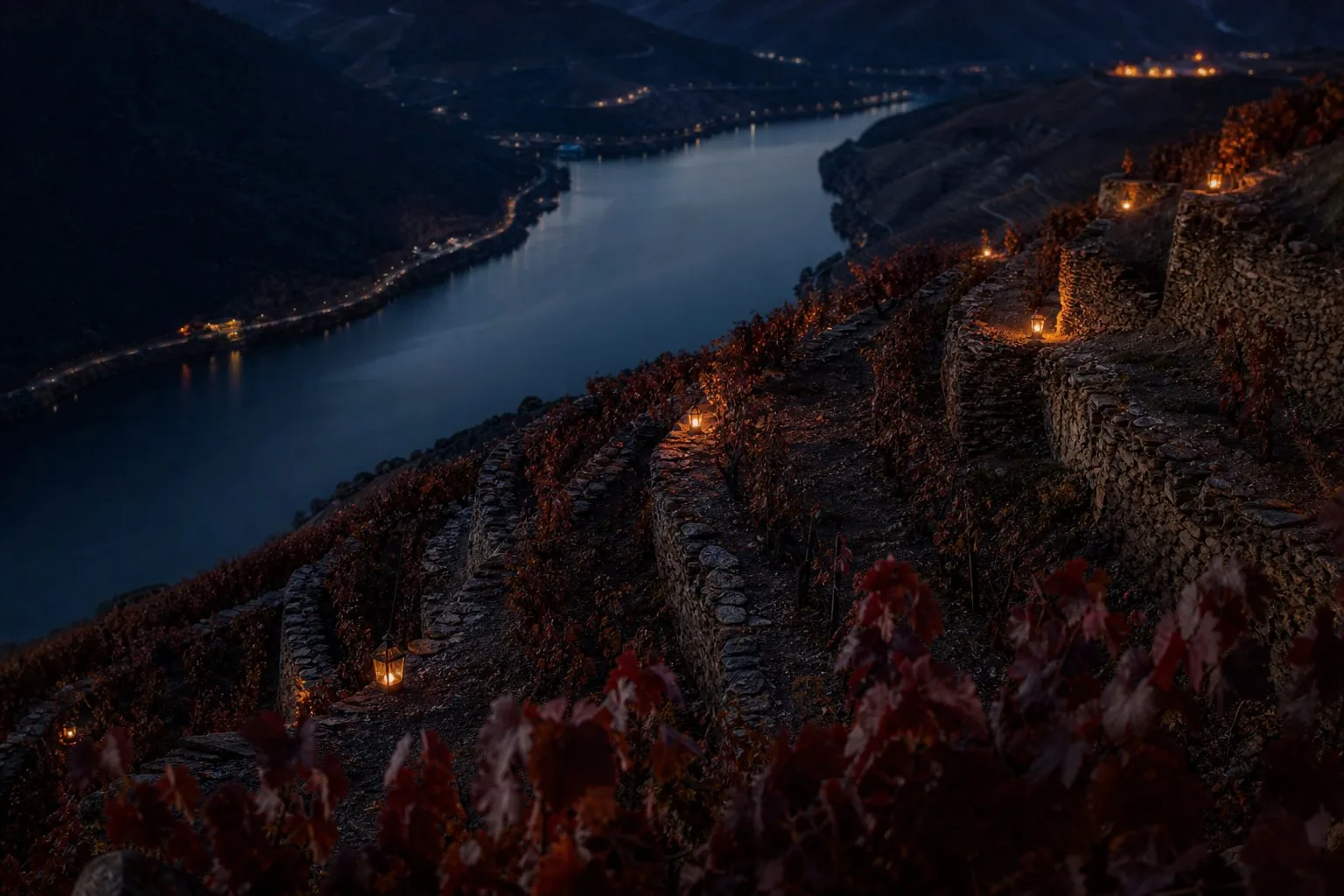
Portugal's headline act is Port, from the Douro's stone terraces, some of the hardest farmland in Europe. A note on tawny Port: the age statement is a flavour target, not a birth certificate. A 20-year tawny is a blend judged to taste twenty years old. But the country's real story now is dry wine. The same Douro grapes that go into Port, Touriga Nacional in the lead, also make dark, firm, self-assured table reds: Port country's dry secret, and Cabernet drinkers take to them instantly.
Vinho Verde, from the rainy north-west, is the anti-Douro: light, faintly spritzy, low in alcohol and cheap enough to be a weeknight habit. Alentejo, in the warm south, makes round, friendly reds that convert Malbec loyalists on the spot. And running underneath it all is Portugal's quiet superpower: hundreds of native grapes nobody else grows, in blends nobody can pronounce, at prices that haven't noticed how good the wine is. Bottle for bottle, Portugal is Europe's best value, and it isn't particularly close.
Germany & Austria
Germany grows Riesling at the 50th parallel, the cold edge of where vines work at all, on slate slopes above the Mosel that reach a 70% grade, where pickers genuinely rope themselves in. The classic labels rank ripeness at harvest, climbing from Kabinett through Spätlese and Auslese up to Beerenauslese, Eiswein and Trockenbeerenauslese. Note what that ladder measures: how ripe the grapes were when picked, not how sweet the wine ended up.
Which brings us to the update your uncle's wine knowledge is missing: Germany has gone dry. Most quality German wine today ferments its sugar out, and the word to know is trocken, meaning dry. The top growers even run a Burgundy-style vineyard classification now, and its grandest dry bottlings are labelled Grosses Gewächs, "GG" to its friends: grand-cru Riesling, bone-dry, standing comfortably among the great white wines of the world. The sweet ladder still exists and its upper rungs are glorious, but sweet-by-default Germany is a museum exhibit.
check the abv before you chill itCan't decode a label? Use the alcohol trick: under about 11% the sugar stayed in the wine, so expect sweetness; 12.5% and up, it fermented dry. And the regions in a line each: Mosel is the ethereal one: slate, low alcohol, wines that seem to float. Rheingau is the stately one, firmer and drier, with twelve centuries of paperwork. Pfalz is the sunny one, just over the hills from Alsace, and today's best value.
Austria is not Germany-lite. It runs dry, precise and quietly self-assured. The calling card is Grüner Veltliner, all white pepper, green lentil and citrus, which sounds odd and tastes wonderful, especially with the vegetables that defeat other wines: asparagus, artichokes. The Wachau, a stretch of terraced Danube bank west of Vienna, grows Grüner and Riesling about as well as white wine can be grown. And the reds, Blaufränkisch above all, are peppery, crunchy and overdue their moment.
The rest of the Old World, briskly
Greece has been making wine for four thousand years and world-class wine, again, for about thirty. Start on Santorini, where Assyrtiko grows in baskets coiled against the wind on volcanic ash and tastes of lemon, salt and struck stone. Then go north to Naoussa for Xinomavro, pale but fiercely tannic, all dried cherry, tomato and olive. Santorini is now expensive and often worth it; for Xinomavro, buy a producer with some bottle age or give the wine dinner and time.
The rest of Greece is the value map. Nemea in the Peloponnese turns Agiorgitiko into soft, spicy reds with plum and dried herbs, while high, breezy Crete makes vivid whites and savoury reds from grapes most export markets are only learning to spell. Even retsina has been rehabilitated: careful modern versions use a whisper of pine resin rather than a mouthful of furniture polish. Ask a Greek specialist for one current producer and let them choose the island.
retsina grew up while nobody was lookingHungary still means Tokaji: the amber dessert wine once reserved for kings, made from botrytised Furmint, apricot and honey held almost weightless by electric acidity. The old puttonyos number tells you sweetness, but producer and balance matter more. Half-bottles are the sensible buy, because four people need less dessert wine than they imagine.
Tokaj's modern movement is dry Furmint, a taut, smoky white with pear, lime and volcanic bite that can sit comfortably beside dry Riesling at dinner. Down south, warm Villány makes plush, paprika-edged reds, especially Cabernet Franc, often labelled Villányi Franc. Dry Furmint is Hungary's sharpest value now; with Villány, avoid the heaviest bottle and look for freshness over oak.
England, yes, England. The chalk seam under Champagne dives beneath the sea and surfaces in Sussex. Same rock, same three grapes, similar chill, and English sparkling wine now wins blind tastings against the French original. The climate finally cooperated; whether that's good news overall is another conversation.
Switzerland keeps most of its wine close to home. In Valais, Chasselas is called Fendant and comes out delicate, stony and faintly herbal, a quiet white for melted cheese rather than a wine that shouts across the table. Around Lake Geneva, Lavaux's vertiginous terraces catch sun from sky, water and stone. Exports are rare because the Swiss drink almost all of it, so take a recommendation when you see a bottle and accept that rarity, not power, sets the price.
Croatia and the Balkans begin on Croatia's Dingač slopes, where Plavac Mali clings above the Adriatic and makes dark, sun-warmed reds with fig, cherry and a salty, rugged grip. It is a child of Tribidrag, also called Crljenak Kaštelanski, the Croatian root in Zinfandel's family tree. Across Slovenia's border with Friuli, long skin contact gives white grapes amber colour, tannin and tea-like savour. Serbia and North Macedonia offer the easier buy: honest, hearty local reds at prices the coast has left behind. Ask for freshness, since southern sun can push all of them too far.
Lebanon grows its serious wine high in the Bekaa Valley, where cold winters and mountain nights keep lift in all that sun. Chateau Musar became a legend by making wine through civil war, hauling grapes past checkpoints, and its reds fold old-vine Cinsault into Cabernet and Carignan: red cherry, leather, spice and a glorious, sometimes unruly savour. Musar is the reference and bottle variation is part of the ride; for a calmer first bottle, ask for a younger Bekaa blend built around Cinsault.
Almost every bottle Switzerland makes stays in Switzerland. The Swiss drink their own cellar.
the rare wine country hiding in plain sightGeorgia has an eight-thousand-vintage head start. In the traditional qvevri method, crushed grapes, skins, pips and sometimes stems ferment together in beeswax-lined clay vessels buried to the neck, where the earth steadies the temperature. Whites emerge amber, tannic and savoury, with dried apricot, tea, walnut and herbs. This is not orange wine's fashionable cousin; it is the source tradition.
qvevri: the cellar is buried in the floorThere is clean, modern Georgian wine too: crisp Tsolikouri whites and dark, juicy Saperavi reds, often made in steel. For qvevri amber wine, start with a glass or a restaurant recommendation, because months on skins can be thrilling or stern and the producer matters enormously. If you like grip, dried fruit and savoury edges, buy the bottle. If you want a familiar white, start with the same country in steel.
The New World tour
Cross the oceans and the labels turn honest: grape first, place second. The places still matter enormously; they just introduce themselves differently.
United States
The USA is 90% California, but the story starts in Paris. In 1976 a British wine merchant staged a blind tasting: California against the best of France, judged by French experts. California won both the red and white flights, and a few mortified judges reportedly tried to get their scorecards back. Too late. The result cracked open the idea that great wine could only be French.
Paris, 1976: French judges blind-tasted California against Bordeaux and Burgundy. California won, and some judges tried to retrieve their scorecards.
the judgment of paris, and nothing was the sameNapa is the estate that tasting built: a strip six kilometres wide and fifty long where fog from San Pablo Bay rolls in every morning, burns off by noon, and gives Cabernet Sauvignon warm days with cool bookends. Mountain fruit makes firmer wines that need time; valley-floor fruit makes plusher ones that need a steak. What "Napa" on a label does not guarantee is quality. It's an address, and an expensive one, so the producer matters as much here as in Burgundy.
"Napa" on a label is an address, not a promise. It tells you the postcode was expensive; only the producer tells you the wine is good.
same rule as Burgundy, higher rentNext door, Sonoma is the farmers' county: bigger, cooler towards the coast, and home to the Russian River Valley, where Pacific fog lingers long enough for genuinely fine Pinot Noir and Chardonnay. Further north, Oregon's Willamette Valley is Burgundy's American cousin: small family wineries, marginal weather, Pinot Noir with actual restraint. The Burgundians noticed, because several famous domaines have bought land and planted. Washington grows its vines in a desert east of the Cascades, on soils dumped by cataclysmic Ice Age floods, with about two extra hours of summer daylight over California; its Syrah and Cabernet are some of America's best value. And New York's Finger Lakes, warmed in winter by lakes deep enough to blunt the frost, turn out Riesling that can stand next to Germany's without blushing.
Canada
Canada has made cold reliable. Niagara freezes grapes on the vine for ice wine at an industrially dependable scale, where Germany now gets the necessary frost only in rare years; the result is intensely sweet, all apricot, marmalade and clean acid. Across the country, the dry Okanagan Valley gives dark, ripe reds from its warm southern desert and cool-climate Chardonnay further north, with apple, citrus and a restrained hand on oak. Buy Canadian ice wine in a half-bottle from a named estate, and seek Okanagan reds by sub-region rather than assuming the whole valley is cold.
Argentina
Argentina plays the altitude card. Mendoza's vineyards sit between 900 and 1,500 metres in the rain shadow of the Andes; thin air means fierce sun by day and cold nights, which is why Malbec here has both dark colour and fresh acidity. Elevation is the style dial. Valley-floor Malbec is soft, plummy and velvety; the high Uco Valley, where the smart money has been planting, gives firmer edges, floral lift and real freshness. The sub-region is usually on the back label, so read it. And up in Salta, the vineyards of Cafayate climb towards 3,000 metres, among the highest serious vineyards on earth, where Torrontés makes a white that smells of flowers and honeysuckle and then, against every expectation your nose has set up, finishes dry.
Uruguay
Uruguay is the Atlantic answer to Argentina. Sea air, rain and rolling green country give Tannat fresher fruit and gentler edges than its famously stern French version, with blackberry, plum and cocoa over a firm frame. Coastal Garzón, on poor granite soils east of Montevideo, has become the polished name to know. The contrast with Mendoza is useful: Uruguay feels humble, damp and quietly serious beside the high-desert theatre across the river. Buy Tannat with food in mind, and look beyond the flagship bottles because the country's middle shelf is where the charm lives.
Chile
the louse never crossed the AndesChile is a natural fortress, with desert to the north, Andes to the east and Pacific to the west, and phylloxera, the louse that ate the world's vineyards, never got in. Chilean vines still grow on their own roots, which is close to unique on earth. My favourite Chilean fact: for about a century the country proudly sold "Merlot" that turned out, on inspection in the 1990s, to be Carmenère, a lost Bordeaux grape everyone assumed extinct. Chile shrugged, relabelled, and adopted it as the national grape.
For a hundred years Chile sold "Merlot" that was really Carmenère, a Bordeaux grape the world had written off as extinct.
wine's happiest case of mistaken identityThe map reads west to east: coast, valley, mountains. The cold Humboldt current drags fog into coastal valleys like Casablanca and Leyda, which make sharp grapefruit-and-herb Sauvignon Blanc and nervy Pinot Noir. The Maipo Valley, in the Andes foothills behind Santiago, is Cabernet country: blackcurrant with a signature minty edge. And in the dry-farmed south, old bush vines of País, the humble grape the conquistadors brought and dismissed for centuries, are being revived into light, thirst-quenching reds by a young generation with excellent taste in old vineyards. Chile remains the world's most reliable overdeliverer: spend slightly more than you meant to, and the wine drinks like double the price.
Australia
Australia also dodged the louse in places, which is why Barossa has Shiraz vines older than anything in France: gnarled survivors planted in the 1840s, still producing dark, chocolatey, generous wine. But the range runs far beyond sunshine. Clare and Eden Valleys make Riesling so dry it squeaks, all lime juice and slate in youth, toast and honey with age. Coonawarra grows Cabernet on a cigar-shaped strip of red terra rossa soil over limestone: cassis, eucalyptus, cool composure. Margaret River, on the Indian Ocean with water on three sides, is Bordeaux-blend country; it makes 3% of Australia's wine and around a fifth of its best. The cool south (Yarra Valley, Mornington Peninsula, Tasmania) has turned to Pinot Noir, Chardonnay and sparkling wine with a precision that startles anyone still filing Australia under "sunshine in a bottle".
And Hunter Valley Semillon performs the strangest magic trick in wine: picked lean at 10.5%, austere in youth, it ages into toasty, honeyed richness that tastes of oak without ever meeting a barrel. Nobody fully understands how. Buy two, drink one now, hide the other from yourself.
New Zealand
New Zealand rewrote Sauvignon Blanc in a single generation. Marlborough's version (gooseberry, passionfruit, cut grass turned up to eleven) now accounts for roughly 80% of the country's output, and no vineyard in the country sits more than about 130 kilometres from the sea, which is why the freshness never quite switches off. One buying note: at the bargain end the magic thins, so climb a single price tier and the difference is out of all proportion. At the bottom of the South Island, Central Otago, the southernmost serious wine region in the world, a continental pocket of hot summers and freezing winters, grows Pinot Noir with pure, dark fruit that Burgundy lovers keep buying while pretending not to. And on the North Island, Hawke's Bay makes Syrah in the peppery northern-Rhône mould from a warm old riverbed called the Gimblett Gravels.
South Africa
South Africa splits the difference between the worlds: New World fruit with an Old World earthiness underneath, which makes it the perfect bridge for drinkers crossing in either direction. Stellenbosch is the establishment: Cabernet and Bordeaux blends with real polish, tobacco and graphite over dark fruit. Swartland, an hour north, is the revolution: a once-ignored wheatland where a scruffy, brilliant generation coaxes Syrah and old-vine Chenin from dry-farmed bush vines, and makes some of the most exciting wine in the southern hemisphere. Chenin Blanc is the national stronghold (South Africa grows more of it than France does), from crisp and cheap to honeyed old-vine bottlings that embarrass far grander whites.
Then there's pinotage, the local red created in a Stellenbosch laboratory in 1924 by crossing Pinot Noir with Cinsault. It divides people, and I'll be honest about which side I'm on: at its best it's smoky, plummy and characterful; at its worst it tastes of burnt rubber and regret, and the worst outnumbers the best. Taste before you commit to a case.
The small print, decoded
rules guarantee origin, not pleasureLabel law sounds dry but takes two minutes and settles a lot of arguments:
- EU "PDO" (appearing locally as AOP/AOC in France, DOC/DOCG in Italy, DO/DOCa in Spain) means strict rules on place, grapes and style: the wine must taste typical of its home.
- "PGI" (IGT in Italy, IGP in France) is the looser tier: real geography, far more freedom. Some of it is dull; some of it is a rule-breaking bargain, as the Super Tuscans proved.
- Italy's DOCG adds a government tasting and a numbered paper strip over the cork. A guarantee of typicality, not of excellence.
- Spain's cellar terms (Crianza, Reserva, Gran Reserva) are the one genuinely useful hack: they tell you oak and bottle time, which predicts taste far better than geography does.
- A US AVA only guarantees that 85% of the grapes came from that area. It says nothing about style or quality: Napa on the label is an address, not a promise.
- A varietal label needs just 75% of the named grape in the US, 85% in the EU and most of the New World. The remainder is the winemaker's seasoning.
None of these systems can taste. They certify geography and process; the name that certifies pleasure is the producer's, same as it ever was.
How to actually use this chapter
place → grape → level → producerTheory is lovely; shelves are real. Here are three bottles, decoded the way I'd do it standing in the shop.
"Sancerre 2023." A place, not a grape: Old World, so the translation table does the work: Sauvignon Blanc, from the eastern end of the Loire. Small, specific appellation, so the style is predictable: bone-dry, citrus and flint, no oak. The vintage is young, which is exactly right here, since this is a wine for freshness, not the cellar. Unknown producer? In an appellation this consistent, that's a gamble worth taking. Chill it, find some goat's cheese, and consider your money precisely spent.
read the place first, then trust the producer"Barossa Shiraz 2021." Grape on the label, so it's New World, no translation needed. The place sets the style: Barossa is warm and old-vined, so expect a dark, ripe, chocolate-edged red, and the 14.5% on the back label will confirm it. Vintage matters less than it would in Europe, since South Australia is reliably sunny, so the real questions are producer and price. This is a wine for winter, for anything that's been near a grill, and for people who claim they don't feel the cold.
"Rioja Reserva 2018." Two codes on one label. Rioja: Tempranillo, northern Spain. Reserva: at least a year in oak and three years' ageing before release, so the winery has done the cellaring and a bottle bought today is ready tonight. That's the quiet gift of the Spanish system: it sells you wine at its drinking window, not a project. Label design like a nineteenth-century bank note? Probably the traditional school: pale, silky, vanilla and dried cherry. Modern artwork? Darker and plusher. Either way, roast something.
And that's the atlas. Not memorised (you don't need to memorise it), but open on the table where you can find your way back to it. A dozen place-names, two rules of thumb, three worked labels, and the confidence to pick up the strange bottle instead of the safe one.
Test yourself
Five questions, no geography exam
0 of 5.
last one: bringing it all to the table