
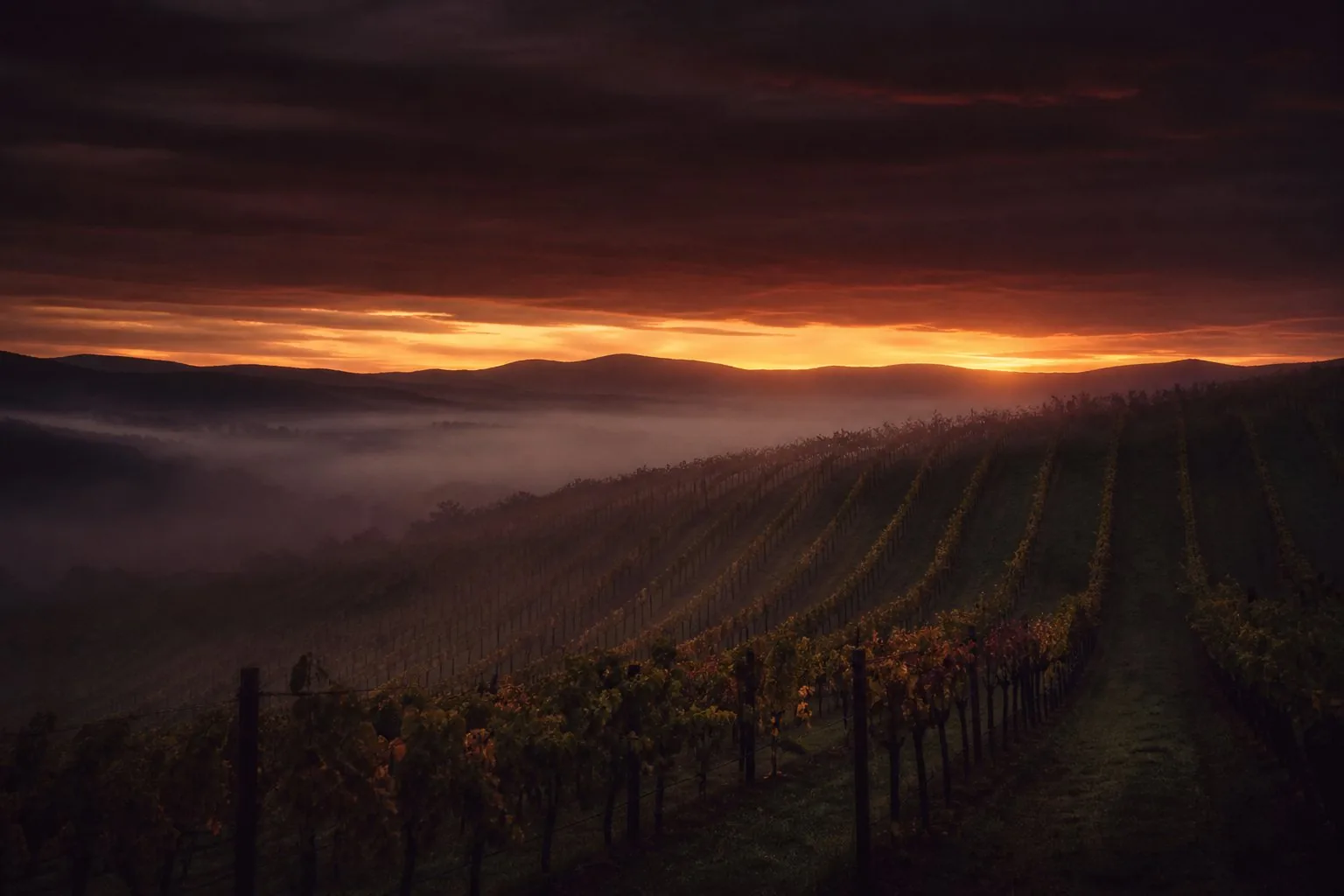
Strip away the ritual and wine is a farm product: grape juice that yeast turned into something with a memory. The grape matters. The year matters more than you'd think. And the place matters most of all.
Farmed weather
wine grapes ≠ the grapes in your fruit bowlWine comes from Vitis vinifera, a species of grape that split from its table cousins the way wolves split from dogs. Wine grapes are smaller, sweeter and seedier than anything you'd put in a lunchbox. All that concentration is the point: sugar becomes alcohol, skins become colour and grip, and the juice carries a record of the season that grew it.
A ripe wine grape is a complete kit. The pulp carries sugar and acid; the skin carries colour, tannin and most of the aroma; the seeds carry a bitterness best left behind. Everything in your glass was either in that berry or made from it by yeast; nobody drips raspberry juice into Pinot Noir. The un-grapey flavours are chemistry the berry shares with the rest of the plant kingdom: the compound that makes a green pepper smell green occurs naturally in Cabernet Sauvignon, and Nebbiolo smells of roses because it holds some of the same molecules a rose does.
That's why the same grape tastes different every single year. A cool, rainy summer gives you a leaner, sharper wine. A heatwave gives you something riper and heavier. The vintage on the label is a weather report.
The vine's year
Wine is farming, so it runs on a calendar, and that calendar explains more about your bottle than any tasting note ever will. One turn of the wheel, one vintage. Here is the year as the vine lives it, northern-hemisphere edition.
It starts in the cold. Between December and February the vine is bare wood, fast asleep, and workers walk the frozen rows cutting away up to ninety per cent of last year's growth. Winter pruning looks like vandalism, but it is the first winemaking decision of the vintage: the number of buds left on the cane now is, more or less, the number of bunches picked in autumn. Leave few, and the vine pours everything into a small, intense crop. Leave many, and you have chosen quantity, nine months in advance.
In spring the sap rises and the buds burst. Bud break, late March into April, is the moment the first green tips unfurl, and it is also when growers stop sleeping. Those baby shoots die at about minus two, and one clear, windless April night can erase most of a year's income before breakfast. The defences look medieval because some of them are: thousands of paraffin candles lit between the rows at three in the morning, giant fans stirring the air, sprinklers that coat every shoot in a jacket of ice to hold it at exactly zero, and, the expensive option, helicopters hovering low over the vines to push a lid of warmer air back down onto them.
Two April frost nights in 2021 cost France roughly a third of its harvest: around two billion euros of wine that never got to exist.
frost is the grower's oldest enemyJune brings flowering: tiny, green, self-pollinating flowers you would walk straight past. The weather during those ten days sets the size of the crop. Cold or rain, and flowers fail to become berries at all, or set as a muddle of normal grapes and tiny seedless ones. The French, who have suffered this longest, keep tidy words for both disasters. What survives becomes fruit set: hard little green bullets, all acid and no charm. An old growers' rule says harvest lands about a hundred days after flowering, and it still holds up surprisingly well.
High summer is haircut season. In cool regions leaves come off so the bunches see more sun; in hot ones the canopy stays on as a parasol. The most ambitious estates also perform a green harvest, cutting perfectly healthy unripe bunches onto the ground so the vine concentrates on what remains. Every winemaker I know finds it painful. They do it anyway.
veraison: say “vay-ray-zon”, the colour turnThen, in August, the prettiest fortnight of the farming year: veraison, when the berries soften and turn colour. Red grapes go from green to purple one berry at a time, so for a week each bunch looks like a bag of mixed sweets; whites shift from opaque green to translucent gold. Veraison flips the vine's switch from growing plant to finishing fruit, and starts the clock on everything that matters.
Because from veraison onward, the ripeness race is on. Sugar climbs; acid falls; every warm day pushes the two lines further apart, while tannins and aromas ripen on their own, slower schedule. That makes the picking date the single biggest style decision anyone will take about a wine, bigger than any barrel, yeast or blend chosen later. Pick early and you bottle nerve: modest alcohol, sharp acidity, red fruit and herbs. Wait, and you bottle plush: dark fruit, soft acid, alcohol sailing past 14 per cent. One Zinfandel vineyard can give a peppery, brambly red or a prune-and-jam heavyweight depending on nothing more than which week the pickers arrived.
Harvest itself is a bet placed against the sky. In cool regions the window is days wide; growers taste berries every morning, chew the seeds to check they have browned, and watch the rain forecast like currency traders. In hot regions the problem inverts, and many estates pick at night under floodlights so the fruit arrives cold. Meanwhile the southern hemisphere runs the identical film six months out of phase: bud break in September, veraison in January, harvest from February to April. Restless young winemakers exploit this, flying between hemispheres to cram two vintages into every year. You can tell them by their hands.
The two belts
Vines only fruit properly between 30 and 50 degrees of latitude: two bands around the planet, one per hemisphere. Fold the globe at the equator and they mirror each other: Bordeaux lines up with Chile, Germany with New Zealand's far south.
The mirror has a lovely consequence. The north harvests August to October; the south harvests February to April. Somewhere on Earth, it is always harvest.
The limits are real on both edges. Head equatorward of 30 degrees and winter never comes: the vine gets no dormant rest, sugar piles up before flavour arrives, and the wines turn flat and jammy. Push past 50 and most years the grapes simply never ripen. And the belts are on the move: a warming climate is dragging quality wine polewards, which is why southern England now grows serious sparkling wine on the same chalk seam that surfaces in Champagne, and why Swedish vineyards have quietly stopped being a joke.
The world makes roughly 6.8 billion gallons of wine a year: enough to flood 99 Manhattan blocks 40 feet deep.
Italy, France and Spain pour the mostClimate is the flavour dial
same grape, different weather → different fruitHere is the single most useful idea in this whole course. Cool climates keep acid; hot climates build sugar. In your glass, that becomes a fruit spectrum you can actually taste:
The finest sites add one more trick: hot days and cold nights. The heat ripens sugar by day; the chill guards acidity overnight. Growers call it diurnal swing. You'll call it balance.
Latitude is only the coarse dial, though. Altitude cools the air by roughly 0.6°C for every hundred metres you climb, which is how Mendoza grows fresh, perfumed Malbec in a desert at 1,100 metres. Cold ocean currents and their morning fog do the same job for coastal Chile and California, and big rivers soften the frost along the Mosel and the Loire. So when a warm country surprises you with a nervy, elegant wine, check the geography. Height or water will be hiding somewhere in the fine print.
Vines like to suffer
Rich, fertile soil grows magnificent leaves and dull grapes. Poor, rocky, well-drained ground forces the vine to dig deep and put everything it has into a small, intense crop. Almost every legendary vineyard sits on land a farmer of anything else would reject. The mechanism is water: a vine under mild drought stress makes smaller berries, and smaller berries carry a higher share of flavour-bearing skin to watery pulp.
And nearly every vine on the planet grows on borrowed roots. In the late 1800s a sap-sucking louse called phylloxera destroyed more than 70% of French vineyards before anyone worked out the fix: graft European vines onto resistant American rootstock. It worked, and it stuck. Chile, Tasmania and a few lucky pockets aside, the whole wine world stands on American feet.
Phylloxera was a talent agency: the louse that wrecked France sent its jobless winemakers to Chile and over the Pyrenees to build modern Rioja.
every catastrophe pours somewhere
Dirt matters
you're not drinking rocks, promiseIf great vineyards sit on poor ground, is all poor ground equal? Not remotely, and the differences have famous addresses. A handful of soils built a handful of legends, each doing its work in a different way.
| Soil | Famous address | What it does for the vine |
|---|---|---|
| Chalk & limestone | Champagne, Chablis, Sancerre | Drains fast, holds deep moisture, reflects light; freshness at the cold edge of ripeness |
| Slate | Mosel | A heat battery: soaks up the day's sun, returns it at night so Riesling ripens at 50°N |
| Gravel | Médoc, Bordeaux | Sheds Atlantic rain and radiates warmth; late-ripening Cabernet's insurance policy |
| Clay | Pomerol, Bordeaux | Cool and water-hoarding; early-ripening Merlot's best friend, all plush, round wines |
| Volcanic | Etna, Santorini | Lean, stressed ground plus altitude or wind; taut, smoky, faintly saline wines |
Chalk and limestone perform a conjuring trick: rain drains through instantly, yet the rock holds moisture deep down like a cellar sponge, so roots stay watered without ever standing wet. In Champagne and Chablis the pale ground also bounces light back up into the canopy, welcome at the chilly limit of ripeness, and Chablis' limestone is packed with fossilised oyster shells from a sea that dried up 150 million years ago. Mosel slate works the opposite shift: dark stone drinks the day's weak sun and gives it back through the night, which is the only reason Riesling ripens at 50 degrees north on slopes too steep to stand on. In the Médoc, deep gravel banks drain Bordeaux's Atlantic rain and hold warmth around late-ripening Cabernet Sauvignon; drive an hour east to Pomerol and the ground flips to cool, water-hoarding clay that suits early-ripening Merlot instead. Same region, opposite soils, opposite grapes. And volcanic soil (Etna's black lava terraces, Santorini's wind-scoured ash where vines are woven into ground-hugging baskets and phylloxera never got a grip) gives some of the most taut, smoky whites and reds on the planet.
you taste what the rock does, not the rockNow the honest part, because you will meet the word “minerality” everywhere and it is genuinely contested. Vines do not pump flint into grapes. Roots take up water and dissolved mineral ions in trace amounts; no known pathway carries the flavour of a rock into a berry, and the gunflint note in your Chablis was not filed off a fossil. What soil undeniably controls is water (how much the vine gets and exactly when), plus vigour, root depth and ripening speed. Those change the wine in ways you can taste blind, vintage after vintage. So here is my truce in the minerality war: you can't taste the rock, but you can absolutely taste what the rock does.
When the weather turns
marginal climates: brilliant or heartbreaking, rarely boringEach disaster leaves its own fingerprint in the glass. Spring frost takes quantity, not quality: the surviving fruit can be lovely, there is simply far less of it, which is why prices jump after a frost year. Hail is meaner: ten minutes of ice shreds leaves, bruises berries and opens wounds for rot; parts of Burgundy were hammered three vintages running in the early 2010s, and in Mendoza hail nets are as standard as tractors. A heat spike stalls the vine: above roughly 35°C it shuts its pores to save water, so flavour stops developing while sugar keeps concentrating, and you get the jammy, soft, warming style you can spot from a metre away. Drought concentrates the crop right up to the point where it doesn't, and young vines with shallow roots crack first. Harvest rain is the cruellest of all: berries swell, flavour dilutes, skins split, grey rot moves in, and a magnificent summer can be undone in a wet fortnight. The grower's last gamble of the year is exactly this: pick early and safe, or hold out for ripeness and pray at the forecast.
This is also why vintage matters far more in some places than in others. In marginal climates like Burgundy, Germany, Piedmont and Champagne, the grapes barely ripen even in a kind year, so every vintage is a negotiation and the differences between years are enormous. In reliably sunny places like Mendoza's irrigated desert, the Barossa and most of Chile, ripeness is close to guaranteed and vintages mostly shuffle the details. Vintage charts obsess over Europe and shrug at the southern sun for a reason.
The practical rule for a normal buyer: under about fifteen euros, ignore the vintage. Buy the youngest bottle on the shelf and enjoy the freshness. The year starts earning your attention only when three things line up: a marginal European region, real money, and a plan to keep the bottle. Otherwise it's a weather report about someone else's holiday.
Old vines
“old vine” has no legal definition, anywhereA vine can outlive the person who planted it. Yields start sliding after twenty-five or thirty years, and a century-old vine may give barely enough grapes for a single bottle, which is exactly why growers love them. Old vines have spent decades sending roots deep, so they shrug off both drought and downpour; they set a small, even crop without being told to; they ripen calmly in years when young vines panic. Less fruit, more wine per grape: concentration and steadiness rather than power.
But read the label with one eyebrow up. “Vieilles Vignes”, “alte Reben”, “Old Vine”: none of these has a legal definition anywhere on Earth, so the vines behind the words could be ninety years old or fifteen. The only serious attempt at rules is voluntary: the Barossa's Old Vine Charter starts “old” at 35 years and climbs through “survivor” (70+) and “centenarian” (100+) to “ancestor” at 125-plus. The region still farms Shiraz planted in the 1840s, on its own roots, because phylloxera never reached it. So treat the phrase as a hint, not a promise. From a serious grower it usually means something; on a bargain-bin label it's typography.
Organic, biodynamic, natural
Demeter on a label = certified biodynamicThree words that get blurred into one vague halo of virtue, and they mean quite different things. Here is the decoder.
Organic is a farming rulebook: no synthetic pesticides, herbicides or fertilisers in the vineyard, verified by a certifier whose logo goes on the bottle. It says nothing about what happened in the cellar afterwards. One transatlantic wrinkle: the EU allows organic wine a modest dose of added sulfites, while the US essentially doesn't, which is why plenty of American producers who farm impeccably settle for “made with organic grapes” instead.
Biodynamic is organic plus a cosmology. Rudolf Steiner sketched it in 1924: the farm as a single living organism, herbal preparations fermented in buried cow horns, pruning and picking timed to the phases of the moon. As science, the celestial part is unproven and probably unprovable. As practice, it correlates with wonderful wine. Biodynamics is impossible to run from an office, so it forces you into the vineyard row by row, week after week, and that kind of attention shows up in the glass. Several of the greatest estates on the planet farm this way. I don't buy the moon; I keep buying the wines.
Natural moves the argument from the farm to the cellar. At its clearest it means nothing added and nothing removed: the yeasts living on the grapes start the ferment, rather than a cultured packet; the wine is not fined into submission or scrubbed bright by filtration; sulphur is used sparingly or not at all. It may arrive lightly cloudy, with sediment in the bottom. That is not proof of virtue, just evidence that nobody polished it away. Natural wine has no universal legal definition; France's voluntary “vin méthode nature” charter from 2020 is the closest anyone has come.
That lack of a rulebook puts everything on the producer. In careful hands the wine can feel extraordinarily alive: bright fruit, savoury edges, a little wildness, the sense that it is still moving in the glass. In careless hands the same freedom lets oxygen, volatile acidity and unwanted microbes take over, and the bottle smells like mouse cage or tastes of cider vinegar. The movement returned excitement and farming honesty to wine. The flaws-excused-as-character problem is real, too. Both sentences can be true.
cloudy is a method, not a medalOrange wine belongs nearby but is not a synonym. It is white grapes made like red wine, fermented with their skins, which gives an amber colour, tea-like tannin and flavours of dried apricot, herbs and peel. Georgia has made it this way in buried clay qvevri for thousands of years; the colour is ancient, even if the bar menu is new. Buy natural wine where somebody has tasted that bottle and can tell you who made it: a trustworthy independent shop, wine bar or restaurant. A supermarket shelf cannot explain whether the haze is intention or neglect, and the label usually cannot either.
What green actually means
Green claims on wine labels range from audited farming to a leaf drawn by the marketing department. Certified organic and biodynamic logos are the firm end: they come with published rules, inspections and paperwork. Sustainability schemes sit in the middle. Depending on the country or region, they may measure water, energy, worker welfare, habitat and carbon as well as spraying. Many are serious and useful, but the standards differ, so a bare word like “sustainable” without the scheme's name tells you very little. A green bottle, an unbleached label and a story about “respecting nature” tell you nothing at all.
The heaviest ingredient in wine's carbon footprint is often the empty bottle.
less glass, less fuel, same wineThe surprising bit is where the footprint really sits. Growing and fermenting matter, but glass bottle weight and shipping usually dwarf the rest. A thick prestige bottle burns more energy to make and more fuel on every kilometre it travels, without improving the liquid by one molecule. Lighter bottles are genuinely greener. Bag-in-box is greener still per glass, keeps everyday wine fresh for weeks, and deserves better than its picnic reputation. “Local” is not an automatic answer either: wine moved in bulk or by sea can beat a nearby bottle hauled by road in heavy glass. None of this requires sainthood at the shelf. Look for a real certification if farming matters to you, then favour lighter packaging and producers willing to give numbers rather than adjectives. Drink what you enjoy, waste less of it, and leave the moral theatre to the label designers.
Eight thousand years in two paragraphs
qvevri: buried clay vessels, still in use, UNESCO-listedWine is older than writing. Around 6000 BC, in what is now Georgia, farmers were burying man-high clay vessels called qvevri, filling them with crushed grapes and letting the cool earth manage the fermentation, a method some Georgian families still use today, now on UNESCO's heritage list. Phoenician and Greek traders shipped wine in clay amphorae to every corner of the Mediterranean, and Rome planted the map we still drink from: the Mosel, the Rhône and Bordeaux all began as Roman farming ventures.
Medieval monks turned it into science. In Burgundy the Cistercians tasted, compared and recorded plot by plot for centuries, walling off the parcels that consistently beat their neighbours, boundaries you can still read on a label today, at eye-watering prices. Then phylloxera nearly deleted the whole story (you already know how the borrowed American roots saved it), and modern chemistry rebuilt the rest. Keep all this in mind next time a hip young winemaker “rediscovers” the amphora: it is a seven-thousand-year-old technology, and nearly every technique in this book is older than most countries.
Reading a label without panicking
Every wine label on Earth speaks one of three grammars:
| The label says | What it means | Where you'll see it |
|---|---|---|
| A grape | “Malbec”: what's in the bottle, stated plainly | The New World: the Americas, Australia, NZ, South Africa |
| A place | “Chablis”: you're expected to know that means Chardonnay | Old-World Europe: France, Italy, Spain |
| A made-up name | “Midnight Cuvée”: usually a blend with a story | Everywhere, mostly blends |
One footnote worth knowing: a “varietal” label rarely means 100% of that grape. The legal floor is 75% in the US and Chile, 80% in Argentina, 85% in most of Europe. The rest is the winemaker's seasoning.
Bottle arithmetic
- A standard bottle is 750 ml, or five proper glasses. A 150 ml pour runs 130 to 175 calories, most of it from the alcohol, not the sugar.
- Vintage means every grape was picked that year. “NV” means a blend of years; in Champagne, that's a house style, not a shortcut.
- Sulfites get blamed for every wine headache, but wine carries at most 350 parts per million while a portion of fries runs about 1,900 and dried apricots ten times the wine. If chips and apricots don't hurt you, sulfites aren't your problem.
Bottles also come in a ladder of sizes named, for reasons nobody can fully explain, after biblical kings.
| The bottle | Holds | In standard bottles |
|---|---|---|
| Half | 375 ml | ½, ages fastest |
| Standard | 750 ml | 1 |
| Magnum | 1.5 litres | 2, the collector's favourite |
| Jeroboam | 3 litres | 4 |
| Methuselah | 6 litres | 8, party furniture |
Size sets the wine's clock. Every bottle holds roughly the same sliver of air under the cork and admits the same slow seep of oxygen through it, but a magnum spreads that oxygen across twice as much wine, so each millilitre ages at about half speed and, most tasters agree, more gracefully. That is why serious cellars fill up with magnums, and why halves are for restaurants rather than for keeping.
And the honest health notes. Wine headaches are real; sulfites are almost never the cause. White wine typically carries more added sulfite than red, yet nobody ever complains of a “white wine headache”. The likelier culprits are plain dehydration (alcohol is a diuretic, and a glass of water between glasses of wine genuinely works) and the histamines and tyramines that come from fermenting red grapes on their skins. The only prevention I can honestly endorse is the boring one: water, food, and not finishing the bottle alone.
Drink it, mostly
Aging wine is romantic and, for about 95% of bottles, wrong. Most wine is made to drink within five years, while the fruit is alive. The rare agers earn it with high acid, real tannin and a good vintage, and even they pass through an awkward “dumb phase” when they taste of almost nothing.
If you do hold on to a few bottles, keep them dark, still and coolish. The rack above the fridge is a slow oven, and the kitchen is where good wine goes to die quietly.
So: buy the bottle, open the bottle. The winemaker meant now.
Test yourself
Five questions, no diploma
0 of 5.
next: your nose does 90% of the work