
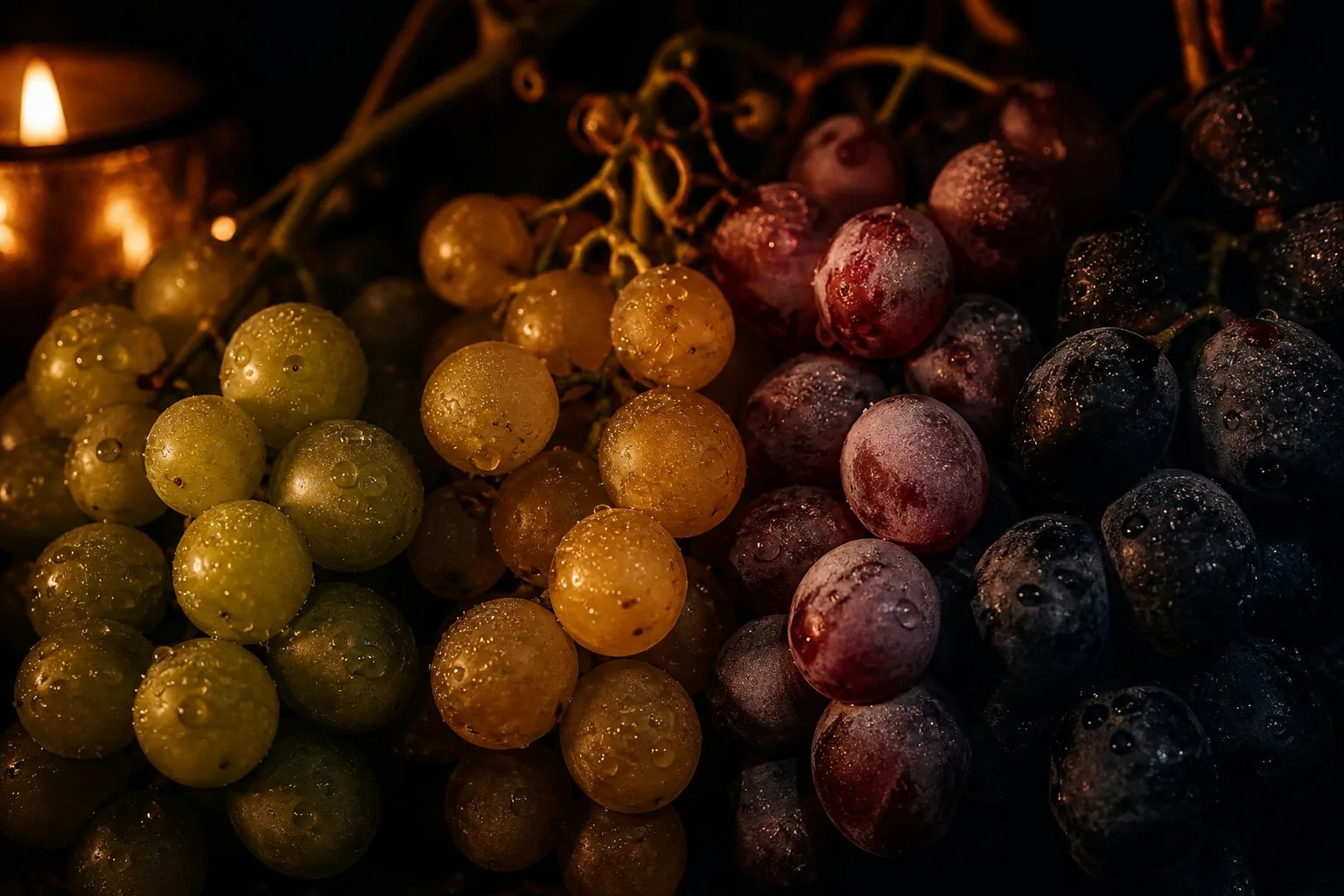
Use this like a field guide, not a syllabus. Find a wine you already know, read its profile, then follow the “if you love it” trail one bottle at a time. The dots run one to five. One means barely there; five means it will introduce itself first.
The lightest endSparkling
Champagne
sham-PAIN · FranceGreen apple and lemon zest first, then the good stuff: warm brioche, toasted almond and a faint chalky smoke, like a struck match in a bakery. Those bread notes come from years resting on spent yeast in cellars carved from the chalk under Reims, some of them first dug by the Romans. Champagne is the friend who arrives overdressed and turns out to be the funniest person in the room. The wine underneath the bubbles is taut and bone dry. Drink it with crisps. Truly. Salt and fat adore it.
Grows Champagne only; everywhere else it's called something honest · Serve 6–8°C, white-wine glass beats a flute · Drink NV now; vintage 10+ years · Entry ~350 kr (the method for less: Cava ~110 kr)
At the table fish and chips, fried chicken, oysters with shallot vinegar
If you love it, try Crémant d'Alsace, English sparkling, Franciacorta.
Prosecco
pro-SEH-koh · Veneto, ItalyPear, honeydew melon, white flowers and a squeeze of green apple. Prosecco keeps things light and sees no reason to apologise for it. Where Champagne ferments in the bottle for years, Prosecco gets its fizz in big steel tanks over a few weeks, which keeps the fruit fresh and the price friendly. The grape is called Glera; the name Prosecco comes from a village near Trieste. The best bottles say Valdobbiadene on the label and come from hills so steep the harvest has to be done by hand. Serve it very cold and don't overthink it.
Grows Veneto & Friuli, Valdobbiadene hills for the serious stuff · Serve 6–8°C, any glass you like · Drink within a year of release · Entry ~100 kr (Valdobbiadene DOCG ~140 kr)
At the table prosciutto and melon, prawn fritters, ricotta ravioli with sage
If you love it, try Moscato d'Asti, Crémant de Loire, Cava.
Cava
KAH-vah · Catalonia, SpainCava is made exactly the same way as Champagne (second fermentation in the bottle, long months on the yeast) and costs a third as much, which remains one of the wine world's great open secrets. Expect quince, lime, dried apple and, in aged versions, an earthy note somewhere near mushroom and fresh bread. The word means cellar in Catalan, after the underground caves where the bottles rest, most of them around one small town: Sant Sadurní d'Anoia. The local grapes (Xarel·lo, Macabeo, Parellada) give it a drier, dustier accent than Champagne's polish. Brilliant with fried food.
Grows Penedès, Catalonia; nearly all of it around one town · Serve 6–8°C, white-wine glass · Drink now–3 years; Gran Reserva keeps longer · Entry ~110 kr
At the table patatas bravas, fried calamari, tortilla española
If you love it, try Champagne, Crémant de Limoux, Franciacorta.
Lambrusco
lam-BROO-skoh · Emilia-Romagna, ItalyYes, sparkling red wine, and no, not the sugary stuff of the 1970s. Proper Lambrusco is dark, foamy and dry, with sour cherry, blackberry, violets and a pleasantly bitter twist on the finish. It comes from Emilia-Romagna, the region that gave the world Parmigiano, prosciutto and lasagne, and it exists to cut through exactly that kind of food. Chill it hard, pour it with a plate of charcuterie, and watch the salt and fat surrender. Look for the word secco on the label for dry; Grasparossa versions are the darkest and grippiest.
Grows Emilia-Romagna, around Modena · Serve 8–10°C, properly chilled · Drink young, within 2 years · Entry ~100 kr
At the table lasagne al ragù, mortadella sandwiches, fennel-sausage pizza
If you love it, try Brachetto d'Acqui, sparkling Shiraz, chilled Beaujolais.
Zip, salt and citrusLight-bodied whites
Sauvignon Blanc
SOH-vin-yon BLONK · Loire, FranceGooseberry, passionfruit, cut grass and a streak of lime that snaps you awake. Sauvignon Blanc is the loudest greeter in the white wine world. That green note is real chemistry: compounds called pyrazines, the same family that makes green peppers smell like green peppers. In the Loire (Sancerre, Pouilly-Fumé) it turns leaner: flint, citrus, wet stones. In Marlborough, New Zealand, it went full tropical in the 1980s and accidentally created one of the most recognisable wine styles on the planet. Drink it young and cold, within arm's reach of a goat's cheese.
Grows Loire, Marlborough, Chile · Serve 7–9°C, white-wine glass · Drink 1–2 years; Sancerre keeps 5 · Entry ~100 kr (Sancerre ~200 kr)
At the table goat’s cheese salad, grilled asparagus with hollandaise, sea bass ceviche
If you love it, try Grüner Veltliner, Verdejo, Albariño.
Verdejo
vair-DAY-ho · Rueda, SpainRueda's local white is the bottle to hand a Sauvignon Blanc drinker who wants the volume turned down half a notch. You still get lime, grapefruit and a grassy lift, but the edges are softer and there is often a lovely fennel note at the finish. Verdejo nearly disappeared after fortified wine fell from fashion. In the 1970s, Rioja producer Marqués de Riscal and Bordeaux consultant Émile Peynaud saw what the old vines could do and helped rebuild Rueda around fresh, dry whites. Buy the youngest vintage for zip, or look for lees ageing if you want more texture.
Grows Rueda, north-west of Madrid · Serve 7–9°C, white-wine glass · Drink 1–3 years · Entry ~100 kr
At the table grilled sardines, chicken with tarragon, fennel and orange salad
If you love it, try Sauvignon Blanc, Assyrtiko, Vermentino.
Pinot Grigio / Pinot Gris
PEE-noh GREE-joh / GREE · Italy & AlsaceOne grape, two personalities, and the name on the label tells you which one turned up. Say Grigio and you get the Italian version: light, dry, quick, with pale citrus, green apple and a saline shrug. Say Gris and you're in Alsace: richer, almost oily, with ripe pear, honey, ginger and sometimes a whisper of sweetness. The grape itself is a colour mutation of Pinot Noir with greyish-pink skins, which is why some bottles carry a faint copper tint. The Italian style is the world's easiest apéritif; the Alsace style can stand up to roast pork.
Grows northern Italy, Alsace, Oregon · Serve 7–9°C; Alsace Gris nearer 10°C · Drink 1–3 years; Alsace 5+ · Entry ~90 kr (Alsace Gris ~150 kr)
At the table lemon pasta, roast pork with apples, prawn cocktail
If you love it, try Soave, Vermentino, Alsace Pinot Blanc.
Albariño
al-bah-REEN-yoh · Galicia, SpainGrapefruit, apricot, lemon zest and a saline finish that tastes like the glass was rinsed in the Atlantic. Albariño grows in Rías Baixas on Spain's green, rainy north-west coast, where vines are traditionally trained up granite posts onto pergolas so the sea air can move underneath and keep the grapes dry. It is the house wine of the world's best shellfish country and behaves accordingly: bright, brisk, faintly bitter at the edges in the best way. If a plate of mussels could order its own wine, this is what it would choose.
Grows Rías Baixas; over the Portuguese border it's Alvarinho · Serve 7–9°C, white-wine glass · Drink 1–3 years · Entry ~120 kr
At the table mussels in white wine, grilled octopus, fish tacos
If you love it, try Muscadet, Vermentino, Vinho Verde.
Grüner Veltliner
GROO-ner VELT-lee-ner · AustriaAustria's signature white opens with green apple and lime, then does something almost no other white does: white pepper, a savoury dusting of it, thanks to rotundone, the same aroma compound found in actual peppercorns. There's often a green streak too, somewhere between snap peas and lentils, which sounds odd and works beautifully. Light versions from the Danube valleys are brisk apéritif wines; the powerful Smaragd bottlings from the Wachau age for a decade or more. This is famously the white that can handle asparagus and artichokes, the two vegetables that bully every other wine.
Grows Austria: Wachau, Kamptal, Kremstal · Serve 8–10°C, white-wine glass · Drink now–5 years; Smaragd 10+ · Entry ~110 kr
At the table Wiener schnitzel, asparagus with hollandaise, pork dumplings
If you love it, try Sauvignon Blanc, dry Riesling, Vermentino.
Assyrtiko
ah-SEER-tee-koh · Santorini, GreeceSantorini gives Assyrtiko the hard mode of grape growing: black volcanic ash, almost no rain and fierce Aegean wind. Growers train each vine into a low basket called a kouloura, tucking the grapes inside for shelter. The wine that comes out is bone dry and bracing, all lemon, crushed rock and salt, with acidity that somehow survives the island heat. Old vines on their own roots add concentration, because phylloxera cannot manage the sandy volcanic soil. Santorini bottles cost more now, so mainland Assyrtiko is the honest buying tip: less volcanic drama, same bright spine, usually for kinder money.
Grows Santorini and mainland Greece · Serve 8–10°C, white-wine glass · Drink 2–6 years; top Santorini 10+ · Entry ~130 kr (Santorini from ~200 kr)
At the table grilled sea bass, lemon-roasted potatoes, fried squid
If you love it, try Albariño, Muscadet, Verdicchio.
Muscadet
moos-kah-DAY · Loire, FranceThe lightest, saltiest, most oyster-shaped white in France. Muscadet tastes of lime, green apple, crushed shells and sea spray, with a gentle yeasty softness in bottles labelled sur lie, meaning rested on their yeast over winter for extra texture. It comes from the mouth of the Loire around Nantes, from a grape called Melon de Bourgogne, and it holds a lovely legal quirk: the appellation caps alcohol at 12 percent, a maximum rather than the usual minimum. Refreshment is the whole point. Cheap, bracing and unbeatable with anything that recently lived in the sea.
Grows the Loire estuary around Nantes, nowhere else · Serve 7–9°C, white-wine glass · Drink 1–3 years; good sur lie surprises at 10 · Entry ~100 kr
At the table oysters with lemon, moules-frites, garlic prawns
If you love it, try Chablis, Picpoul de Pinet, Albariño.
Vermentino
vair-men-TEE-noh · Sardinia, ItalyThe Mediterranean's beach wine: grapefruit, lime, green pear and a bitter-almond flick at the end, like the pith of a citrus fruit. There's usually something herbal in there too, crushed rosemary, a hint of sea breeze, which makes sense once you see where it grows: Sardinia, the Ligurian coast and Corsica, plus Provence where it goes by the name Rolle. It carries a bit more body and grip than the featherweight whites, so it copes with grilled fish, garlic and aioli without flinching. Drink it young, cold, and ideally somewhere you can smell salt water.
Grows Sardinia, Liguria, Corsica & Provence (as Rolle) · Serve 7–9°C, white-wine glass · Drink 1–2 years · Entry ~110 kr
At the table grilled sea bream, pesto pasta, courgette fritters
If you love it, try Albariño, Picpoul de Pinet, Verdicchio.
Verdicchio
vair-DEEK-kee-oh · Marche, ItalyMarche's classic fish white starts with lemon and green apple, then signs off with salt and a clean bitter-almond snap. Castelli di Jesi is the larger, sea-influenced zone. Smaller Matelica sits inland between the Apennines and usually gives a firmer, cooler wine. Both are far more serious than the old fish-shaped bottles suggested. Verdicchio keeps its acidity as it ripens, which is why good riserva can age for ten years or more, gathering honey, herbs and toasted almond without going slack. For tonight, buy a young Classico and put it beside grilled sea bass. For the cellar, look for Riserva.
Grows Castelli di Jesi and Matelica, Marche · Serve 8–10°C, white-wine glass · Drink 2–5 years; Riserva 10+ · Entry ~110 kr
At the table roast sea bass, spaghetti alle vongole, lemon chicken
If you love it, try Soave, Vermentino, Sémillon.
Soave (Garganega)
SWAH-veh · Veneto, ItalyPoor Soave spent decades being sold as cheap and forgettable, which was unfair, because the real thing (from the volcanic hills east of Verona, made from the Garganega grape) is quietly lovely: honeydew melon, white peach, a saline mineral streak and a signature bitter-almond finish. In the 1960s and 70s it outsold every other Italian wine abroad, then drowned in its own success when the flat plains overproduced it. Look for Classico on the label; that's the original hillside zone. It also ages better than anyone expects, picking up honey and gentle smoke.
Grows volcanic hills east of Verona · Serve 8–10°C, white-wine glass · Drink 1–4 years; Classico keeps going · Entry ~100 kr
At the table spring vegetable risotto, grilled trout, pumpkin ravioli
If you love it, try Gavi, Verdicchio, unoaked Chardonnay.
Richer, rounder, warmerFull-bodied whites
Chardonnay
shar-don-AY · Burgundy, FranceThe chameleon. In Chablis it's lean and electric: green apple, lemon, oyster shell. Give it a warm climate and oak barrels and it becomes a different animal: yellow peach, pineapple, vanilla, butter. The butter is real chemistry: a softening step called malolactic conversion produces diacetyl, the same compound used in butter flavouring. So when people say they hate Chardonnay, they usually hate a winemaking style, not the grape, which is a bit like hating potatoes because you once had bad chips. At its peak, as white Burgundy, it's the most sought-after white wine on earth.
Grows Burgundy, California, and everywhere in between · Serve 10–13°C, big glass · Drink 2–10 years depending on style · Entry ~110 kr (village Burgundy ~250 kr)
At the table roast chicken, lobster rolls, mushroom risotto
If you love it, try Viognier, white Rioja, Marsanne blends.
Viognier
vee-ON-yay · Rhône, FranceApricot, honeysuckle, tangerine and a rich, almost oily texture. Viognier is perfume you can drink. It's also a survivor: by the mid-1960s its home vineyard of Condrieu in the northern Rhône had shrunk to barely a dozen hectares, and the grape came close to vanishing entirely. Growers rescued it, and it now thrives in Australia and California too. Low acidity means it needs a careful hand; done badly it turns blowsy, done well it's glorious. In Côte-Rôtie they even ferment a little into the red Syrah to lift the aroma.
Grows northern Rhône (Condrieu), Australia, California · Serve 10–12°C, big glass · Drink 1–4 years · Entry ~120 kr (Condrieu ~450 kr)
At the table chicken korma, crisp pork belly, apricot-glazed chicken
If you love it, try Roussanne, Fiano, oaked Chardonnay.
Sémillon
say-mee-YON · Bordeaux, FranceThe quiet shapeshifter. Young Hunter Valley Sémillon from Australia is picked early, bottled at barely eleven percent alcohol, and tastes of little more than lemon and fresh grass. Then you leave it ten years and it turns golden, toasty and lanolin-rich, as if it had spent time in oak barrels it never touched. In Bordeaux it's blended with Sauvignon Blanc for waxy, full dry whites, and it's the backbone of Sauternes, the world's most famous sweet wine. Expect waxy lemon, chamomile and beeswax; give it time and you get honey and roasted nuts.
Grows Bordeaux, Hunter Valley · Serve 9–12°C, white-wine glass · Drink young, or 10+ years for Hunter · Entry ~120 kr
At the table smoked trout, roast chicken with thyme, pork terrine
If you love it, try white Bordeaux blends, dry Furmint, Marsanne.
Marsanne & Roussanne
mar-SANN & roo-SANN · Rhône, FranceThe northern Rhône's white double act, almost always blended: Marsanne brings weight and flesh, Roussanne brings perfume and nerve. Together they taste of ripe pear, quince, beeswax, chamomile and honeysuckle, with a full, waxy texture and famously gentle acidity. These are whites for people who think they only like reds: savoury, generous, happiest next to roast chicken. Their strange party trick is that the wines can shut down in middle age, going dull for a few years, then re-emerge at ten or fifteen with honey and hazelnut. Australia's Tahbilk still farms Marsanne vines planted in 1927.
Grows northern Rhône (Hermitage), southern France, Australia · Serve 10–13°C, big glass · Drink 1–3 years, or hold past 10 · Entry ~130 kr
At the table roast chicken, pumpkin ravioli, pork with fennel
If you love it, try Viognier, white Châteauneuf-du-Pape, aged Sémillon.
Perfume firstAromatic whites
Riesling
REES-ling · GermanyThe grape wine professionals hoard for themselves. Riesling runs from bone dry to dessert sweet, always strung on a wire of acidity that keeps even the sweetest ones tasting fresh. Lime, green apple, apricot, honey, and, after a few years in bottle, a whiff of petrol, which sounds alarming and is actually prized: a compound called TDN that develops as Riesling ages, especially from sunny vineyards. Germany's Mosel makes featherweights at eight percent alcohol; Australia's Clare Valley makes them stone dry and limey. Almost never oaked, and it ages for decades. If the label says trocken, it's dry.
Grows Mosel & Rheingau, Alsace, Clare Valley · Serve 8–10°C, white-wine glass · Drink now–20+ years · Entry ~100 kr (German Kabinett ~140 kr)
At the table pork schnitzel, Thai green curry, gravlax with mustard sauce
If you love it, try Grüner Veltliner, Chenin Blanc, dry Furmint.
Furmint
FOOR-mint · Tokaj, HungaryFurmint built Tokaj's reputation as the engine of Tokaji Aszú, the honeyed wine made from noble-rotted berries. The newer surprise is how good it is dry. Expect pear, lime and a smoky mineral edge, pulled tight by acidity fierce enough to make a lemon look relaxed. After Hungary's state winery era ended, growers began bottling dry Furmint seriously in the 2000s, often from the same volcanic vineyards that supply the sweet wines. Buy the dry style when you want something between Riesling and Chablis. Keep a good bottle for five years and the sharp corners soften into wax, nuts and smoke.
Grows Tokaj and Somló, Hungary · Serve 8–10°C, white-wine glass · Drink 2–8 years; sweet Tokaji for decades · Entry ~120 kr
At the table smoked trout, chicken paprikash, mushroom pierogi
If you love it, try dry Riesling, Chenin Blanc, Sémillon.
Gewürztraminer
guh-VURTS-trah-mee-ner · Alsace, FranceLychee, rose petals, ginger and baking spice: the most perfumed wine on earth, and it commits to the role completely. The lychee note is no coincidence: grape and fruit share several of the same aroma compounds, so at times it genuinely smells like drinking a lychee. Gewürz means spice in German, though its great home is Alsace, where it grows golden and rich, often with a touch of sweetness left in. Low acidity and high alcohol make it a wine to sip rather than gulp. With Thai food or a properly smelly Munster cheese, it makes perfect sense.
Grows Alsace, Alto Adige, Germany · Serve 8–10°C, white-wine glass · Drink 1–5 years · Entry ~130 kr
At the table Thai red curry, Munster cheese tart, pork with apple
If you love it, try Torrontés, dry Muscat, Viognier.
Chenin Blanc
SHEN-in BLONK · Loire, FranceNo grape does more jobs. From the same Loire valley vines, Chenin Blanc becomes sparkling wine, bone-dry whites, off-dry charmers and honeyed dessert wines that outlive the people who bottled them, all held together by fierce acidity and a flavour range of quince, baked apple, chamomile and wet wool (nicer than it sounds, promise). A bottle of Vouvray can be any of these, so read the label. Meanwhile South Africa, where it long went by the name Steen, grows more Chenin than the rest of the world combined and turns old vines into rich, sunny versions at friendly prices.
Grows Loire (Vouvray, Savennières), South Africa · Serve 8–10°C, white-wine glass · Drink dry 2–5 years; sweet for decades · Entry ~100 kr (Vouvray ~150 kr)
At the table roast pork with apple, goat’s cheese tart, chicken tagine
If you love it, try Riesling, Sémillon, Grüner Veltliner.
Muscat
MUSS-kat · the whole MediterraneanThe only major wine grape that actually smells of grapes: its aroma compounds survive fermentation intact, which is true of almost nothing else. Expect orange blossom, ripe grape, honeysuckle and mandarin, in styles from bone-dry Alsace Muscat to Moscato d'Asti, the gently fizzy Piedmont version at five and a half percent alcohol, arguably the world's finest breakfast wine. It's also among the oldest cultivated grapes we know of, with a family tree tangled across the entire Mediterranean. Sweet versions belong with fruit and cake; the rare dry ones are lovely with asparagus.
Grows Alsace, Piedmont, and all round the Mediterranean · Serve 6–8°C, well chilled · Drink young, within 2 years · Entry ~90 kr (Moscato d'Asti)
At the table asparagus tart, peach galette, lemon drizzle cake
If you love it, try Torrontés, Gewürztraminer, Riesling Spätlese.
Torrontés
tor-ron-TESS · ArgentinaArgentina's own white, and a lesson in never trusting your nose. Torrontés smells sweet (roses, peaches, lemon blossom, a perfume in the Gewürztraminer family), then lands completely dry, with a citrus bite that catches first-timers off guard every single time. The best of it grows around Cafayate in Salta province, home to some of the highest vineyards on earth, up past 1,700 metres, where fierce sun and cold nights keep the perfume intense and the acidity alive. DNA testing shows it's a child of Muscat, which explains the floral genes. Order it with ceviche.
Grows Argentina: Salta (Cafayate), La Rioja, Mendoza · Serve 7–9°C, white-wine glass · Drink within 2 years · Entry ~90 kr
At the table sea bass ceviche, beef empanadas, Thai basil chicken
If you love it, try Gewürztraminer, dry Muscat, Viognier.
Pink, from bone dry to sweetRosé
Provence rosé
proh-VAHNS roh-ZAY · southern FranceThis is the rosé that taught the world to ask for pale pink. Grenache, Cinsault and friends spend only a few hours with their skins, giving just enough colour before a cool fermentation keeps everything crisp. Expect strawberry, melon and pink grapefruit, then a dry, salty finish made for a hot pavement and a plate of lunch. Provence now makes roughly half of France's rosé, and the clear, curvy bottle has become part of the uniform. Do not shop by paleness alone, colour proves very little. Check the newest vintage, skip bottles stored in a sunny window, and serve properly cold.
Grows Provence, especially Côtes de Provence · Serve 8–10°C, white-wine glass · Drink the youngest vintage you can find · Entry ~130 kr
At the table salade niçoise, grilled prawns, tomato and mustard tart
If you love it, try Tavel & Bandol, Vermentino, Txakoli rosado.
Tavel & Bandol
tah-VELL & ban-DOLL · southern FranceNot every rosé wants a pool. Tavel, across the Rhône from Châteauneuf-du-Pape, gives Grenache longer skin contact and comes out darker, broader and full of red cherry, orange peel and herbs. Bandol, on the Provençal coast, leans on Mourvèdre for a firmer backbone, with wild strawberry, spice and a faintly meaty edge. These are dry dinner wines with enough weight for garlic, grilled meat and proper sauces. They can age too, especially Bandol, trading fresh fruit for dried herbs and savoury depth over five or ten years. Buy them when the meal, not the colour, is making the decision.
Grows Tavel in the Rhône; Bandol in Provence · Serve 10–12°C, medium-bowled glass · Drink 2–8 years · Entry ~170 kr
At the table lamb chops with rosemary, bouillabaisse, garlic roast chicken
If you love it, try Mourvèdre, Grenache, Provence rosé.
White Zinfandel
white ZIN-fan-dell · California, USASweet, pink and not remotely embarrassed about either. White Zinfandel owes its life to a happy accident at Sutter Home in 1975, when a tank of pale Zinfandel stopped fermenting and left sugar behind. Customers loved the result: strawberry sweets, watermelon and soft spice, with low alcohol and no hard edges. Wine people mocked it for years, but the craze gave growers a reason not to pull out California's old Zinfandel vines. Many of those vineyards later supplied the serious reds now praised by the same crowd. Drink White Zin cold, buy it fresh and judge it by the job it chose, not the job you wanted.
Grows California, from red Zinfandel grapes · Serve 6–8°C, any glass you like · Drink within a year of release · Entry ~90 kr
At the table glazed ham, spicy chicken wings, pulled-pork sliders
If you love it, try Zinfandel, Provence rosé, Lambrusco.
Silk and perfumeLight-bodied reds
Pinot Noir
PEE-no NWAR · Burgundy, FranceThe heartbreaker. Pale in the glass, quiet at first, then it opens into red cherry, raspberry, dried rose petal and, with a few years in bottle, something like forest floor after rain. It is thin-skinned in every sense: fussy about climate, ruinous to farm badly, sulky in the wrong hands. When it works, nothing else comes close, which is why the most expensive wine on earth, Romanée-Conti, is Pinot Noir from a plot smaller than two football pitches. Start with Oregon or Central Otago; they give you the silk without emptying your savings account.
Grows Burgundy, Oregon, Central Otago · Serve 14–16°C, big-bowled glass · Drink most within 5 years, grand cru Burgundy for decades · Entry ~150 kr (Burgundy from ~250 kr)
At the table duck breast, mushroom risotto, salmon with dill
Gamay
gah-MAY · Beaujolais, FrancePinot Noir's cheerful cousin, with none of the mood swings. Expect tart cherry, raspberry, violets and a whiff of banana in the fresh, carbonic styles, then a darker, peppery core in serious cru Beaujolais like Morgon or Moulin-à-Vent. In 1395 Duke Philip the Bold banished it from Burgundy by decree, and called it a very bad and disloyal plant while he was at it. Gamay moved a little south and has spent six centuries proving him wrong. Give it a light chill and it becomes one of the great food wines: charcuterie, roast chicken, Tuesday.
Grows Beaujolais, Loire, Switzerland · Serve 12–14°C, lightly chilled, big-bowled glass · Drink within 3 years, crus up to 10 · Entry ~110 kr (crus from ~160 kr)
At the table köttbullar, roast chicken, sausage and lentils
If you love it, try Pinot Noir, Frappato, Zweigelt.
The dinner table's best friendsMedium-bodied reds
Merlot
mer-LOW · Bordeaux, FranceThe wine people love until someone teaches them to say they don't. Soft plum, black cherry, cocoa and bay leaf, with tannins like a well-worn sofa. The name probably comes from merle, French for blackbird, a bird with excellent taste in ripe grapes. The film Sideways made sneering at Merlot fashionable, yet the hero's treasured bottle, Cheval Blanc, leans heavily on Merlot and its close relative Cabernet Franc. The joke was on him. Pomerol makes it profound, Chile makes it friendly, and both versions belong at dinner rather than on a pedestal.
Grows Bordeaux, Chile, northern Italy · Serve 15–17°C, medium-bowled glass · Drink within 5 years, top Pomerol for decades · Entry ~100 kr (Bordeaux from ~140 kr)
At the table shepherd’s pie, roast duck, mushroom lasagne
If you love it, try Cabernet Franc, Carménère, Cabernet Sauvignon.
Sangiovese
san-jo-VAY-zeh · Tuscany, ItalyItaly's most planted grape and Tuscany's beating heart. Sour cherry first, always, then tomato leaf, dried oregano, leather and a dusty, savoury finish that makes food close to mandatory. The name translates roughly as blood of Jove, which is a lot of ambition for a grape that mostly wants pasta. It shape-shifts with place: brisk and cherried in everyday Chianti, dark and monumental in Brunello di Montalcino, where it flies solo. On its own it can taste sharp; at the table it clicks into focus. That is not a flaw, that is the design.
Grows Tuscany, Emilia-Romagna, Corsica · Serve 16–18°C, medium-bowled glass · Drink 3–10 years, Brunello for 20+ · Entry ~110 kr (Chianti Classico from ~150 kr)
At the table spaghetti bolognese, bistecca alla fiorentina, aubergine parmigiana
If you love it, try Montepulciano, Barbera, Nebbiolo.
Grenache / Garnacha
gruh-NASH / gar-NAH-cha · Aragon, SpainSunshine in liquid form, and it carries the alcohol to prove it. Ripe strawberry, stewed raspberry, white pepper, dried herbs and a curl of orange peel. France gets the glory, since Grenache is the backbone of Châteauneuf-du-Pape, but the grape is Spanish by birth, from the hot, windswept hills of Aragon. Some of the oldest productive vines on the planet are gnarled Garnacha bushes that have survived a century of drought out there. It loves heat, shrugs at poor soil, and drinks like a warm hug. Watch the percentage on the label, though.
Grows southern Rhône, Spain, Australia · Serve 15–17°C, medium-bowled glass · Drink within 5 years, top Châteauneuf longer · Entry ~100 kr (Châteauneuf from ~300 kr)
At the table lamb kofte, sausage cassoulet, mushroom pizza
Zinfandel / Primitivo
ZIN-fan-del / pree-mee-TEE-vo · Kaštela, CroatiaA grape with three passports. DNA testing settled a long argument: California's Zinfandel and Puglia's Primitivo are the same variety, and both descend from an obscure Croatian grape called Tribidrag. Wherever it lands, it brings jammy blackberry, raspberry sauce, liquorice, black pepper and sweet tobacco, often at alcohol levels that flirt with 15 per cent. California's old-vine bottlings can be genuinely moving; Puglia's are plusher and cheaper. And yes, the pale pink White Zinfandel of the eighties was made from this same grape, a fact serious Zin producers would rather you forgot.
Grows California, Puglia, Croatia · Serve 15–17°C, medium-bowled glass · Drink within 5 years · Entry ~120 kr (old-vine from ~180 kr)
At the table barbecue ribs, pepperoni pizza, beef chilli
If you love it, try Grenache, Negroamaro, Petite Sirah.
Barbera
bar-BEH-rah · Piedmont, ItalyPiedmont's weekday wine, and proud of it. While Nebbiolo got the castles and the collectors, Barbera fed the region for generations: dark sour cherry, blackberry, dried herbs and a bright, mouth-watering snap of acidity with barely any tannic grip. That combination, juicy but structured by freshness rather than grip, makes it absurdly easy to pair. Pizza, salumi, mushroom risotto, anything with tomato. Barbera d'Asti tends to be lighter and friskier, Barbera d'Alba a little deeper. In a wine world obsessed with importance, here is a grape that just wants you fed and happy.
Grows Piedmont, Lombardy, California · Serve 15–17°C, medium-bowled glass · Drink within 5 years · Entry ~110 kr
At the table pizza margherita, sausage ragù, osso buco
If you love it, try Dolcetto, Sangiovese, Gamay.
Blaufränkisch
BLAOW-fren-kish · Burgenland, AustriaThink Pinot Noir with a spice tooth. Blaufränkisch brings sour blackberry, black cherry and a proper crack of pepper, held up by bright acidity and more tannin than its medium body suggests. Its best Austrian home is Burgenland, especially the limestone and slate around Leithaberg and the warmer Mittelburgenland. Across borders it answers to Kékfrankos in Hungary and Lemberger in Germany, just to keep label reading lively. The buying trick is simple: start with an unoaked Burgenland bottle for fresh fruit and value, then move to single-vineyard wines if you want mineral depth and the ability to age.
Grows Burgenland, Austria; Hungary as Kékfrankos · Serve 14–16°C, medium-bowled glass · Drink 3–10 years · Entry ~120 kr
At the table duck confit, beetroot tart, pork schnitzel
If you love it, try Pinot Noir, Mencía, Zweigelt.
Zweigelt
TSVY-gelt · AustriaAustria's most planted red was created in 1922 by crossing peppery Blaufränkisch with delicate St-Laurent. The child kept bright sour cherry and a little spice, then softened the tannin enough for a very easy Tuesday-night bottle. Zweigelt can be made dark and oaked, but its best party trick is the simple style: juicy, fresh and brilliant with twenty minutes in the fridge. The grape was named after breeder Friedrich Zweigelt, whose Nazi involvement is now openly documented, and some producers use the original crossing name Rotburger instead. Whatever the label says, look for a recent vintage and do not pay for too much oak.
Grows across Austria, especially Burgenland · Serve 12–14°C, lightly chilled · Drink 1–5 years · Entry ~100 kr
At the table köttbullar, roast chicken, mushroom pasta
If you love it, try Gamay, Blaufränkisch, Pinot Noir.
Cabernet Franc
KAB-er-nay FRAHNK · Loire Valley, FranceThe quiet parent of a famous family: cross it with Sauvignon Blanc and you get Cabernet Sauvignon, cross it with Magdeleine Noire and you get Merlot. On its own it is leaner and more perfumed than either child, all raspberry, red bell pepper, crushed gravel and pencil shavings, with a leafy edge that divides people at dinner parties. I am firmly in favour. In the Loire, in Chinon and Bourgueil, it makes reds you can chill slightly and drink with almost anything. Bordeaux uses it as seasoning; the Loire lets it speak.
Grows Loire, Bordeaux, Niagara · Serve 14–16°C, medium-bowled glass · Drink 3–8 years · Entry ~120 kr
At the table herb-roast chicken, grilled pork chops, lentil stew
Carménère
kar-men-YAIR · Bordeaux, FranceWine's great case of mistaken identity. Carménère left Bordeaux for Chile in the 1800s, got mixed into the Merlot vineyards, and spent roughly a century being picked, made and sold as Merlot. Growers just thought it was an odd, late-ripening strain. Then in 1994 a visiting French ampelographer took one look and blew its cover. Today it is Chile's signature: plummy raspberry fruit wrapped around green peppercorn, paprika and cocoa powder, a savoury spice cabinet where Merlot keeps only jam. If you find Merlot too polite, this is the interesting sibling.
Grows Chile, especially Colchagua and Maipo · Serve 15–17°C, medium-bowled glass · Drink 3–6 years · Entry ~100 kr
At the table beef empanadas, lamb burgers, rice-stuffed peppers
If you love it, try Cabernet Franc, Merlot, Malbec.
Montepulciano
mon-teh-pool-CHAH-no · Abruzzo, ItalyFirst, the trap: Montepulciano the grape has nothing to do with Vino Nobile di Montepulciano, which is Sangiovese from a Tuscan hill town of the same name. Italy enjoys this sort of thing. The grape lives mainly in Abruzzo, where it makes deep purple-black wine tasting of boysenberry, ripe plum, oregano and a touch of smoke, with tannins that feel soft and dusty rather than grippy. It is one of Europe's most reliable bargains, the bottle you grab for a weeknight ragù without checking your account first. Cheap here rarely means thin.
Grows Abruzzo, Marche, Molise · Serve 15–17°C, medium-bowled glass · Drink within 5 years · Entry ~90 kr
At the table lasagne al forno, lamb ragù, salami pizza
If you love it, try Sangiovese, Negroamaro, Barbera.
Nero d'Avola
NAIR-oh DAH-voh-lah · Sicily, ItalySicily's workhorse has learned to show its face. For years Nero d'Avola disappeared into anonymous bulk blends, but careful growers now bottle its sun-soaked plum and black cherry with a salty edge that stops the fruit feeling heavy. The name means black grape of Avola, a town in the island's south-east, although it grows across Sicily. Warm vineyards can push it towards jam and high alcohol, so look for fresher examples from higher ground or coastal sites, and do not assume extra oak means extra quality. This is still one of Italy's honest-value reds, generous enough for dinner and rarely precious about it.
Grows across Sicily, especially the south-east · Serve 15–17°C, medium-bowled glass · Drink 2–6 years · Entry ~100 kr
At the table pasta alla Norma, grilled sausages, tuna with capers
If you love it, try Montepulciano, Grenache, Syrah.
Mencía
men-THEE-ah · Bierzo, SpainNorthwest Spain's secret handshake. Sour cherry, pomegranate, liquorice and a cool mineral streak that tastes the way wet slate smells, with florals that once got it mistaken for Cabernet Franc. In Ribeira Sacra it grows on terraces so steep they call the farming heroic without irony; everything is done by hand on slopes plunging towards the river Sil, because no tractor would survive the attempt. The wines have a freshness rare in Spanish reds, closer to Burgundy in spirit than to Rioja. If you think Spain only does oak and power, Mencía is your correction.
Grows Bierzo, Ribeira Sacra, Dão (as Jaen) · Serve 14–16°C, medium-bowled glass · Drink 3–6 years · Entry ~130 kr
At the table grilled pork, mushroom croquetas, lentils with chorizo
If you love it, try Cabernet Franc, Blaufränkisch, Pinot Noir.
Power and shadowFull-bodied reds
Cabernet Sauvignon
KAB-er-nay SO-vin-yon · Bordeaux, FranceThe king, though its origins are pure accident. Somewhere in seventeenth-century Bordeaux, red Cabernet Franc crossed with white Sauvignon Blanc in a vineyard, and DNA testing in 1996 revealed the world's most planted quality red grape to be their unplanned child. The signature is blackcurrant, layered with cedar, graphite, mint and, in cooler years, a flicker of green bell pepper. Thick skins mean serious tannin, which is why it loves oak barrels, long ageing and rare steak. From Pauillac to Napa to Coonawarra, it is the closest wine has to a universal language.
Grows Bordeaux, Napa, Coonawarra · Serve 16–18°C, large glass · Drink 5–15 years, top wines for decades · Entry ~110 kr (classed Bordeaux from ~300 kr)
At the table ribeye steak, beef Wellington, aged Cheddar toastie
Syrah / Shiraz
sih-RAH / shih-RAZZ · Northern Rhône, FranceOne grape, two accents. In the Northern Rhône it is Syrah: blackberry, black olive, violets, smoked meat and a crack of black pepper, which is literal chemistry, since the wine carries rotundone, the same aroma compound found in actual peppercorns. In Australia it becomes Shiraz, and the accent gets broader too: riper, sweeter fruit, dark chocolate, more sun in the glass. Both can be magnificent. Hermitage and Côte-Rôtie age for decades and taste like the north wall of a smokehouse; Barossa Shiraz greets you like a bear. Choose your climate, choose your mood.
Grows Northern Rhône, Barossa, South Africa · Serve 16–18°C, large glass · Drink 5–10 years, top Rhône for decades · Entry ~110 kr (Crozes-Hermitage from ~160 kr)
At the table slow-roast lamb shoulder, venison stew, harissa aubergine
If you love it, try Malbec, Petite Sirah, Touriga Nacional.
Mourvèdre
moor-VED-ruh · Bandol, FranceMourvèdre needs enough sun to ripen late, but not so much that it turns into jam. Bandol on the Provençal coast gets the balance right: blackberry, black olive, smoked meat and wild thyme, with tannin built for a decade in the cellar. In Spain it is Monastrell, at home in the hotter vineyards of Jumilla and Yecla, where it becomes broader and riper. Elsewhere you often meet it as the M in a GSM blend with Grenache and Syrah, adding colour, grip and savoury depth. Buy Bandol for patience, Spanish Monastrell for value, and give either a plate with some fat on it.
Grows Bandol; Jumilla and Yecla as Monastrell · Serve 16–18°C, large glass, decant young bottles · Drink 5–15 years · Entry ~120 kr (Bandol from ~250 kr)
At the table rosemary lamb shoulder, duck cassoulet, pork ribs
Malbec
MAL-bek · Cahors, FranceFrench by birth, Argentine by glorious adoption. In medieval Cahors it made a wine so dark the English called it black wine, but a brutal frost in 1956 killed most of Bordeaux's Malbec and France largely moved on. Argentina did not. In Mendoza's high-altitude vineyards, some above 1,500 metres, the thin air and fierce sun turned it plush and perfumed: blackberry, plum, violets, cocoa and sweet tobacco, with tannins like velvet rather than sandpaper. It is the steakhouse wine for a reason, but a good one needs no beef to make its case.
Grows Mendoza, Cahors, Salta · Serve 16–18°C, large glass · Drink 3–8 years · Entry ~100 kr (single-vineyard from ~180 kr)
At the table skirt steak with chimichurri, beef empanadas, mushroom burgers
If you love it, try Syrah / Shiraz, Cabernet Sauvignon, Tannat.
Nebbiolo
neb-bee-OH-lo · Piedmont, ItalyThe famous trap. It pours pale as Pinot Noir, smells of violets, roses, sour cherry and tar, and then bites down with some of the fiercest tannin in the wine world. Nobody forgets their first ambush. The name comes from nebbia, the fog that rolls over Piedmont's hills during the late October harvest, and in Barolo and Barbaresco this grape makes wines that need a decade to unclench and can age for several more. Young Langhe Nebbiolo is the gentler introduction. With braised meat or truffle season, few things on earth compete.
Grows Piedmont, Valtellina, a little in Australia · Serve 16–18°C, large glass, decant when young · Drink Barolo from year 10, happily for decades · Entry ~180 kr (Barolo from ~300 kr)
At the table brasato al Barolo, truffle risotto, tajarin with ragù
If you love it, try Sangiovese, Aglianico, Xinomavro.
Xinomavro
ksee-NOH-mah-vroh · Naoussa, GreeceThe Barolo comparison is useful here, not lazy. Xinomavro pours pale, smells of dried cherry, tomato leaf and black olive, then lands with big tannin and acidity that can carry a bottle for decades. Naoussa in northern Greece is its classic home, on slopes below Mount Vermio where altitude keeps the nights cool. Young bottles can feel stern and savoury, so give them air and food. With age, the grip loosens and dried fruit, leather and herbs come forward. Entry-level Naoussa is often far cheaper than comparable Nebbiolo, which makes it a very good place to learn what patient red wine tastes like.
Grows Naoussa, Amyndeon and Goumenissa, Greece · Serve 16–18°C, large glass, decant when young · Drink 5–20+ years · Entry ~140 kr
At the table lamb stifado, moussaka, tomato-braised beef
Tempranillo
tem-prah-NEE-yo · Rioja, SpainSpain's grand old grape, named for its habit of arriving early: temprano means just that, and it ripens weeks before its neighbours. In Rioja it tastes of dried cherry, tobacco and leather, laced with dill and coconut from the region's long love affair with American oak barrels. The label tells you the ageing, not the sweetness: crianza is youthful, reserva more polished, gran reserva released only after years of patience in barrel and bottle. Across the border in Portugal it moonlights as Tinta Roriz inside Port blends. A grape with range and manners.
Grows Rioja, Ribera del Duero, Portugal · Serve 16–18°C, large glass · Drink crianza now, gran reserva for 20+ years · Entry ~100 kr (reserva from ~150 kr)
At the table lamb chops, jamón croquetas, patatas riojanas
If you love it, try Sangiovese, Montepulciano, Touriga Nacional.
Aglianico
ahl-YAH-nee-ko · Campania, ItalyThey call it the Barolo of the south, which undersells how ancient it is: the vine has grown around Naples since Greek settlers worked these hills more than two millennia ago. On the volcanic soils of Taurasi and Monte Vulture it gives black cherry, dried plum, white pepper, smoke and something faintly like campfire ash, framed by tannin and acidity that both arrive at full volume. Young Aglianico can feel like an argument. Give it eight or ten years and it turns eloquent, savoury and long. Patience is the entire price of admission.
Grows Campania, Basilicata · Serve 16–18°C, large glass, decant when young · Drink best from year 5, ages 20+ · Entry ~130 kr (Taurasi from ~200 kr)
At the table braised beef, wild-boar ragù, lentils with aged pecorino
Tannat
tah-NAHT · Madiran, FranceTannat does exactly what the name warns: this is the most tannic mainstream grape, a dark, tooth-staining mouthful of blackberry, plum and cocoa. In Madiran in south-west France it traditionally needed years before the grip stopped feeling like dental work. Uruguay adopted the grape in the nineteenth century and turned it into a national speciality, helped by an Atlantic climate and a gentler hand in the cellar. The wines are still structured, but the fruit is riper and the tannin less combative. Decant young bottles, do not serve them too warm, and bring fat to the table. This is not the moment for cucumber salad.
Grows Madiran, France; across Uruguay · Serve 16–18°C, large glass, decant · Drink 5–15 years · Entry ~110 kr
At the table grilled ribeye, duck confit, beef short ribs
If you love it, try Cabernet Sauvignon, Aglianico, Mourvèdre.
Petite Sirah
peh-TEET sih-RAH · Rhône, FranceThe most misleading name in wine. Nothing about it is petite except the berries, which are tiny, thick-skinned and packed with colour and tannin, and its real name is not Sirah either: this is Durif, a cross of Syrah and the obscure Peloursin raised by French botanist François Durif in the 1860s. France shrugged; California fell in love. Expect a wine near-black in the glass: blueberry, dark chocolate, black tea and black pepper, with a grip that laughs at delicate food. Pour it with ribs, brisket or a long winter evening.
Grows California, Mexico, Israel · Serve 16–18°C, large glass · Drink 5–15 years · Entry ~130 kr
At the table barbecue ribs, brisket sandwiches, black-bean chilli
If you love it, try Syrah / Shiraz, Zinfandel / Primitivo, Malbec.
Pinotage
PIN-oh-TAHJ · Stellenbosch, South AfricaA wine with a birth certificate. In 1925, Stellenbosch professor Abraham Perold crossed Pinot Noir with Cinsault in his garden, then promptly forgot about it; the seedlings survived only because a colleague rescued them just before the plot was cleared. The result took its father's name and its own path: dark plum, smoked meat, liquorice, rooibos and, in some modern styles, a deliberate note of mocha and coffee bean. Made carelessly it can turn rubbery, which gave it a rough reputation for years. Made well, it is South Africa in a glass, generous and a little wild.
Grows Stellenbosch, Swartland, Paarl · Serve 16–18°C, large glass · Drink 3–8 years · Entry ~100 kr
At the table boerewors rolls, smoked pork ribs, lamb bobotie
If you love it, try Syrah / Shiraz, Zinfandel / Primitivo, Grenache / Garnacha.
Touriga Nacional
too-REE-gah nah-see-oh-NAHL · Douro, PortugalPortugal's crown jewel spent centuries hidden inside Port blends before anyone thought to bottle it dry on its own. Their loss, our gain. The vine yields stingily, tiny berries and not many of them, but every one is concentrated: blueberry, blackcurrant, violets and an unmistakable perfume of bergamot, like Earl Grey tea left near a flower stall. Grown on the Douro's vertiginous schist terraces, it makes dry reds with real structure and a floral lift that keeps all that power light on its feet. One of Europe's best-value serious reds right now.
Grows Douro, Dão · Serve 16–18°C, large glass · Drink 5–10 years · Entry ~110 kr
At the table grilled lamb skewers, beef stew, arroz de pato
If you love it, try Syrah / Shiraz, Malbec, Aglianico.
The long goodbyeDessert & fortified
Port
PORT · Douro, PortugalSweet because someone hit pause. Halfway through fermentation, the winemaker floods the vat with clear grape spirit, the yeast dies on the spot, and the remaining sugar stays in the wine at around 20 per cent alcohol. Ruby Port is young and jammy with blackberry and cinnamon; tawny ages for years in barrel and drifts towards caramel, fig and walnut. The summit is vintage Port, declared only in exceptional years, roughly three times a decade, and built to outlive the people who bottled it. Pair with blue cheese, dark chocolate, or a fireplace.
Grows Douro Valley, Portugal · Serve 16–18°C, small port glass · Drink ruby and tawny now; vintage for decades · Entry ~150 kr (vintage from ~400 kr)
At the table Stilton on toast, chocolate tart, sticky toffee pudding
If you love it, try Madeira, Banyuls, Recioto della Valpolicella.
Sherry
SHEH-ree · Jerez, SpainThe most misunderstood wine in the shop. Yes, sweet cream sherry exists, and Pedro Ximénez pours like fig syrup, but the soul of Jerez is bone dry: fino and manzanilla, pale and saline, tasting of green almond, bread dough and sea air. That character comes from flor, a living veil of yeast that grows across the wine in barrel and guards it from oxygen. Add the solera system, where young wine is endlessly blended through rows of old barrels, and your glass holds traces of decades. Serve fino ice cold with salted almonds and jamón, then apologise to every bottle you ignored.
Grows Jerez and Sanlúcar, Spain · Serve fino 7–9°C, white-wine glass; oloroso 12–14°C · Drink fino young and fresh; finish an open bottle within a week · Entry ~110 kr
At the table garlic prawns, jamón croquetas, tortilla with alioli
If you love it, try Madeira, Marsala, Jura vin jaune.
Madeira
mah-DAY-rah · Madeira, PortugalThe wine that got better by accident. Barrels shipped from this Atlantic island in the 1600s baked in the holds of ships crossing the tropics, and merchants noticed the wine came back improved. Producers now recreate the voyage on land with warm cellars and gentle heat. The result tastes of caramel, roasted walnut, burnt orange peel and salted toffee, held upright by startling acidity, and it runs from bone-dry Sercial to lusciously sweet Malmsey. Having already survived heat and oxygen, it is nearly indestructible: an open bottle keeps for months, and good vintages outlast centuries.
Grows Madeira, Portugal · Serve 13–15°C, small glass · Drink whenever; it ages for generations · Entry ~180 kr
At the table mushroom soup, caramelised onion tart, walnut cake
If you love it, try tawny Port, oloroso Sherry, Marsala.
Sauternes
so-TAIRN · Bordeaux, FranceGolden proof that rot can be noble. Autumn mists off the little river Ciron invite Botrytis cinerea, a fungus that shrivels Sémillon and Sauvignon Blanc grapes on the vine and concentrates everything left inside. Pickers pass through the rows again and again, and yields are absurd: at Château d'Yquem, each vine gives roughly one glass of wine. What survives tastes of apricot, honey, saffron, ginger and orange marmalade, with acidity that keeps all that sugar dancing rather than cloying. Forget dessert pairings if you like; try it with Roquefort or foie gras and understand the fuss.
Grows Sauternes and Barsac, Bordeaux · Serve 6–8°C, small white-wine glass · Drink lovely young, at its peak from 10 to 30 years · Entry ~180 kr for a half bottle
At the table Roquefort tart, foie gras toast, apricot tarte tatin
If you love it, try Tokaji, Monbazillac, late-harvest Riesling.
Tokaji
TOK-eye · Tokaj, HungaryThe wine Louis XIV reportedly called the wine of kings, king of wines, and the region classified its vineyards in the 1730s, more than a century before Bordeaux got round to it. The famous sweet style, Tokaji aszú, is made from Furmint grapes shrivelled by noble rot, gathered berry by berry into baskets called puttonyos; the more berries in the blend, the sweeter the wine, and the label still counts them. Expect apricot, honey, orange marmalade, saffron and beeswax, cut by acidity sharp enough to keep a fifty-year-old bottle tasting alert. Dessert in a glass, with better posture.
Grows Tokaj, Hungary · Serve 8–10°C, small white-wine glass · Drink aszú ages for decades · Entry ~200 kr for 500 ml (5 puttonyos from ~250 kr)
At the table duck liver parfait, blue cheese tart, apricot crumble
If you love it, try Sauternes, Beerenauslese Riesling, ice wine.
58 down. only a few thousand to go.